You mean it should show italics, bold and perhaps even link content?
😛
You mean it should show italics, bold and perhaps even link content?
😛
@quadratur
I understand what you mean but when people were using it for tooltips they were not describing images in the correct way. It created a lot of confusion as to the purpose of alt texts. I don't think I could go as far as calling it a feature ;)
As you rightly point out, title had this purpose.
I agree completely with your observation about exclusive content. I love having access to all alt text visibly here in my Fediverse instance. I'll be making exactly this point in my talk later today.
It's a huge shortcoming in browsers that it's so difficult to view for most people.
@grin I loved trying out Lynx and showing it off in some of my early accessibility talks :)
Some photos I see posted here are worth attention. I will, however, not repeat/boost the ones without image descriptions. And I see examples of those every day.
My wish is for #accessibility to be given more priority when posting images in social networks. In my personal experience it’s gotten a bit worse with the growth of the fediverse.
Later today I’m running an hour long session on writing Alt text and image descriptions, for people enrolled in Ambition Empower*.
Thinking perhaps I should do a public access one as well, if there’s interest. Image descriptions can benefit everyone.
*If you’re a designer or design leader, the Empower program may interest you:
https://ambitiongrp.com/empower/
I just visited 15 blogs about dogs. I wanted to see how well they described all the fun pictures of dogs and their owners. As it turns most alt texts were less than adequate, if they even had any. Some were just stuffed with keywords, and some appeared to be written by AI's, failing to add context.
After 14 sites visited, I finally I found a blog about dogs that does a great job with alt text. Would it surprise you to learn that it is a website about leader dogs?
#accessibility #a11y
https://www.leaderdog.org/
A bit of trivia about alt text.
The ALT attribute for describing images was introduced in a 1993 Internet Draft about HTML. At this time many people online were still using text-only browsers and people wanted to know what the images were about. Some people just couldn't afford to wait for them to download.
In 1999, with the release of HTML 4.01, the ALT attribute was made to be a requirement for the img and area tags.
1999 is also the year Web Content Accessibility Guidelines (WCAG) 1.0 were published. The very first checkpoint starts like this:
"1.1 Provide a text equivalent for every non-text element (e.g., via "alt", "longdesc", or in element content)."
What should be a point of internet embarrassment: Microsoft's Internet Explorer rendered the ALT attribute in the wrong way, as a tooltip, all the way until 2009 when IE8 was released. Microsoft got the standard wrong for ten years. This of course also led to many developers using it incorrectly as a tooltip.
Fast forward to 2023 and the ALT attribute is unfortunately still something not many people who build websites care much about. And I rarely see it in the curriculum of courses that provide education for web editors and writers.
#accessibility #a11y
Edits: Removed reference to HTML 1.2 (this was not a html version but a version number of the Internet Draft). Also changed HTML 4.1 to 4.01. See comments by @mjgardner
@janboddez No worries at all, I enjoy discussing and thinking about this.
@janboddez
😊 This is clear-cut to me as all users can not be expected to understand that their comment on a social media post will end up on a blog page. Thus this happens without consent as the understanding is not there unless the social media post itself has a disclaimer. That does not mean it's illegal, just that it's not fair to expect that all users are okay with this.
(Full disclosure, I've implemented tools like this in the past with Twitter, pulling in all mentions of a blog post. I also thought it was cool when not fully considering impact and consequences)
The other interesting issue is that automated stuff like this will mean that the blog owner may have illegal content posted to their page through the same mechanism. Comments can mention third parties by name and use hateful language, or include copyrighted material for example.
I think some of the most common errors of assumption when going ahead with these tools are:
1. It's technically possible, so must be okay.
2. Everybody who posts on social media wants to be seen as broadly and widely as possible in any context
3. If you're here you must accept that your content will be republished all over the place
4. Nobody could possibly be harmed
5. It's legal so there is no problem
6. It's cool…
@janboddez Thanks for sharing! Yes, there could be a lot of work done to improve Privacy By Design in this space. I believe this is where all the excitement around federated social networking may meet a lot of frustration.
@InsertUser Yes, I'm using my own install of Akkoma since a little more than two weeks.
https://akkoma.social/
@janboddez
Ha, that is cool. Need to try and implement something like that.
@hacdias @en
@david Hehe. I hear you.
@anant Thanks. I feel that I can have the Mastodon logo in the header of my blog and people will recognise it. Having the Akkoma logo would confuse more than help.
Existential crisis when I feel I have to write out my "Mastodon username" on my different websites but can't say that I'm not actually on Mastodon because that would be unnecessarily confusing and require 20 more minutes of time to explain.
@ShmosKnows @JMMaok
Agree. I suppose this could also be built into apps but yes, I'd prefer a max width / height that I can set for my instance or profile. With the possibility to override when called for.
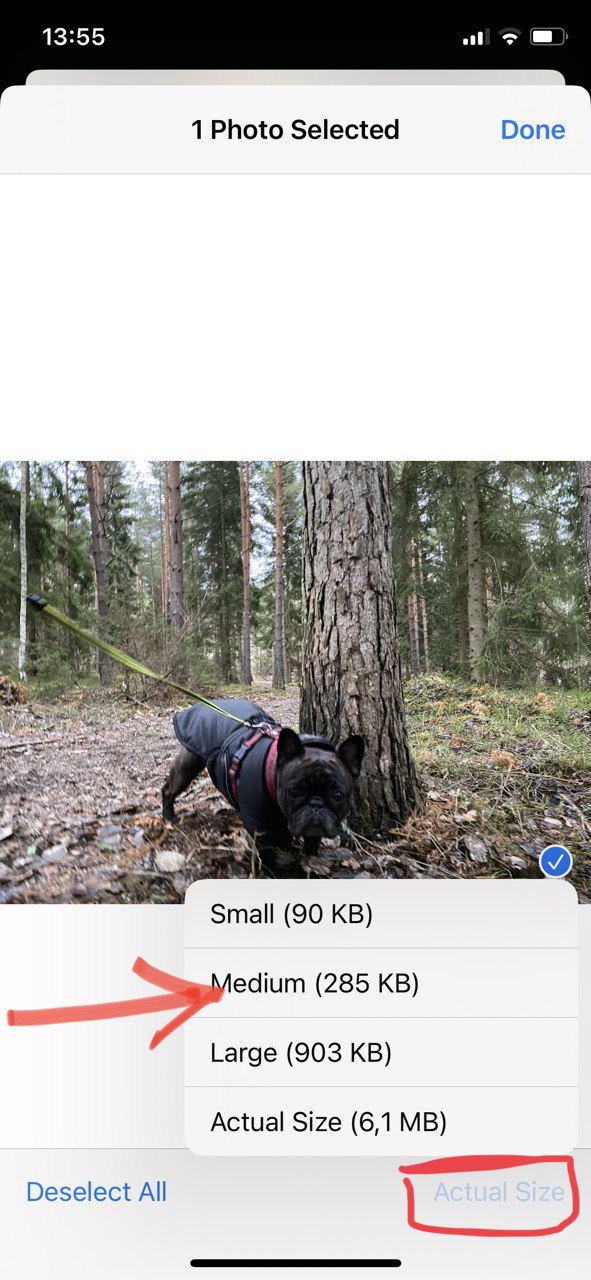
One way to lower resource usage on servers (and save on bandwidth in general) is to not upload original size photos.
On iPhone, when uploading, you can click where it says ”Actual size” and change it to Medium for example. It’s a fraction of the size but often good enough for sharing and many won’t see the difference.
My intent is not to police your choices. If you want to upload for the purpose of high quality you should do so. This is a tip for the times when good enough works.
#FediTips
@jamescridland
Ha, very cool. Kudos for doing this.
@danyork
@christian
1) Embed is a great example. Apps can even implement this menu item without it being a standard feature of the Fediverse. So I embed someone else’s content on my blog post. Can I say I did this with consent? That they should have expected it? In my reasoning is it still isn’t consent if I haven’t asked for their permission. I could argue they should have expected it as a possibility, but I don’t have their explicit consent to publish their post within my decided context. Could of course still be legal or within publishing rights.
2) Also a good example about fediblocks. What is reasonable for people to expect if they hear they learn that they can block and defederate? In this case it makes sense for people to expect to be able to feel safe form the other party seeing their posts when they block. The fact that they truly aren’t safe from others viewing their posts via a web browser doesn’t mean they have consented to repurposing of their content.
The person implementing the web scraper likely understands that people intentfully block others, but decides to disregard this circumstance. Again, the tech allows it and a lot of people understand it works this way, but not everyone. Is that enough to decide that everyone has consented? My reflection: Not if there is a chance some people would say no if asked.
The other scenario is where public timelines on an instance are not in fact displayed publicly, but that’s more clear-cut. Then you actually do need to ”infiltrate” through a covert follow bot that collects posts.
Instances can also be set to not allow indexing, which of course is one of the standard practices you mention in your first post. Best case that is then describes in the instance rules, but still doesn’t protect. In that case I agree 100% with you, that when those signals are ignored, it is also more clear-cut abuse.
I guess to sum up, my stance is that I see very few cases where it doesn’t make sense to ask for permission, to confirm informed consent.
@christian
Gotcha. But how is consent then confirmed? How can I document consent when taking action on another person’s published content?
If we can confirm consent then yes, it is not missing. But otherwise it appears to come down to drawing assumptions about what another person intends or expects when they post their content.
My concern is that taking action on content that another person’s has posted and repurposing it for use or display in ways that the person could not be expected to intend or expect, can lead to harm that could have been avoided with proper consent.
I feel many are arguing that one should always expect online content to be able to be copied and pop up anywhere (not saying you are). I understand this sentiment. But it assumes a lot of general understanding that I don’t believe is fair for a broad population. It also disregards the need for groups of people to participate without being subjected to this consequence.
So if a person did not expect repurposing of their content, and did not approve it, at what point is it considered consent, if there is no confirmation or advisement they can become aware of before posting.
The interesting thing here is that there are likely a myriad of ways that content can be repurposed in ways that do not harm and are respectful. But that does not mean there was consent.
I’m hoping for a broader recognition that there are many things happening where consent is not present, and that there are likely ways that people get hurt because of this that is often not considered, or considered to ”not matter enough” because of the ”few numbers” of people potentially being put in harm’s way.
(The main trigger for my post was search engines being created by following people and then putting their posts in a database - posts then becoming searchable by people from instances that they had blocked)
Note, because it’s me, I’m talking about ethics rather than law, as there are many countries where there is a huge lack of protection under law, which of course is one of the dilemmas of participating online.
So when I talk about consent I refer to the act of working with the intent of non-maleficence rather than what is necessarily regulated by law in a given context.