
↪ Replying to @unknown
@FDRsOldSpecs @DONTUCOMEFORUS @hamdia_ahmed This is a start. en.wikipedia.org/wiki/List_of_k…
In 2015, 837 people were killed by law enforcement in the US.
↪ Replying to @unknown
@FDRsOldSpecs @DONTUCOMEFORUS @hamdia_ahmed This is a start. en.wikipedia.org/wiki/List_of_k…
In 2015, 837 people were killed by law enforcement in the US.
↪ Replying to @coconutlime
@coconutlime @SarahPinsker I had to look it up. The Exorcist was released on December 26 (1973). So that oddly makes Christmas sense.
From the archives, an adaptation of a talk I did in 2013.
Explaining UX with a glass of lemonade.
axbom.blog/ux-lemonade/
In a great example of ethical policy, @Netflix will now offer to cancel subscriptions automatically when they are not being used. No more drawing money from your account in perpetuity for something you don't need.
media.netflix.com/en/company-blo…
I acknowledge this is a tiny dent in expenses. But that only goes to show that doing the right thing often makes financial sense. More importantly, it embeds itself in culture and teaches people to question the status quo.
↪ Replying to @berkun
@berkun I wasn’t aware of these being called golden and platinum rules before. Thank you for that nugget :)
↪ Replying to @berkun
@berkun I conversely believe that it is important not to assume that others would like to be treated as I would like to be treated. The fallacy is believing that everyone should be treated the same (the way I would like to be treated). I see lack of communication as the core problem.
↪ Replying to @unknown
@opassande Medhåll. Hennes beteende var frutansvärt. Men ingen som dömer henne har pratat med henne. Eventuella bakomliggande trauman, ohälsa och sammanhang finns inte att tillgå. Offentliga skampålar av det här slaget är många gånger otäcka.
↪ Replying to @kjellhaglund
@kjellhaglund Piratpartiet gjorde en bra genomgång när den släpptes. piratpartiet.se/nyheter/ny-sve…
@kjellhaglund Med över 6 miljoner användare i Australien har en liknande app lyckats hjälpa en (1) person på en månad. theguardian.com/world/2020/may…
@kjellhaglund Skulle så gärna också ta del av riskanalyserna för MSB:s app-projekt. svt.se/nyheter/inrike…
Listening to "Is Elon Musk a Fraud?" with @mehdirhasan and @LorenaSGonzalez overcast.fm/+MIPxg2TFY
↪ Replying to @j_helleday
@j_helleday Vi har ju alltid kuf, tänker jag.
Per was quirky.
Per var en kuf.
↪ Replying to @unknown
@hpux735 No fight from me on that point ;)
@hpux735 Although these points from Zoe are important to stress that there are still challenges that need to be addressed. It's not the endgame but rather a start.
x.com/z_rose/status/…
↪ Replying to @Scott_Matter
@Scott_Matter For me, this is what many people misunderstand about nudges. Removing choices, or choosing for them, is never a nudge. With the broad brush people are using to refer to nudges, they are evading essential discussions of morality and ethics - as ’nudging’ is socially accepted.
@Scott_Matter And I agree that nudges, in certain scenarios, are much more powerful than the definition appears to indicate, which makes them potentially even more dangerous.
@Scott_Matter And sometimes they are given way too much credit, as there is never a guarantee of nudges working. They are usually just behavioral experiments, and there are no quick fixes to steering people while maintaining fredom of choice - the world is way too complex.
@Scott_Matter The only book I’ve read so far that addresses this moral dilemma with maintained credibility is Engaged by @amybphd. We interviewed her on @uxpodcast a while back. Highly recommend the interview and her book of course, if you haven’t read it already 😊
uxpodcast.com/232-design-psy…
↪ Replying to @Scott_Matter
@Scott_Matter Good call. This is the gist of it isn’t it? I would argue that in a situation with a form the individual is still exercising autonomy, given that the form is designed in a way that they understand what they are responding to. In the second scenario this autonomy is removed, >>
@Scott_Matter albeit briefly. Here is where it gets interesting. Freedom of choice is maintained in both scenarios, but in the case of the law the change of current choice could never be seen as voluntary. A nudge supposedly permits freedom of choice while it is steering people.
@Scott_Matter Richard Thaler and Cass Sunstein write ’To count as a mere nudge, the intervention must be easy and cheap to avoid. Nudges are not mandates.’
’Cheap to avoid’ is key here. While freedom of choice is maintained (people can opt out), significant labor is added to do so.
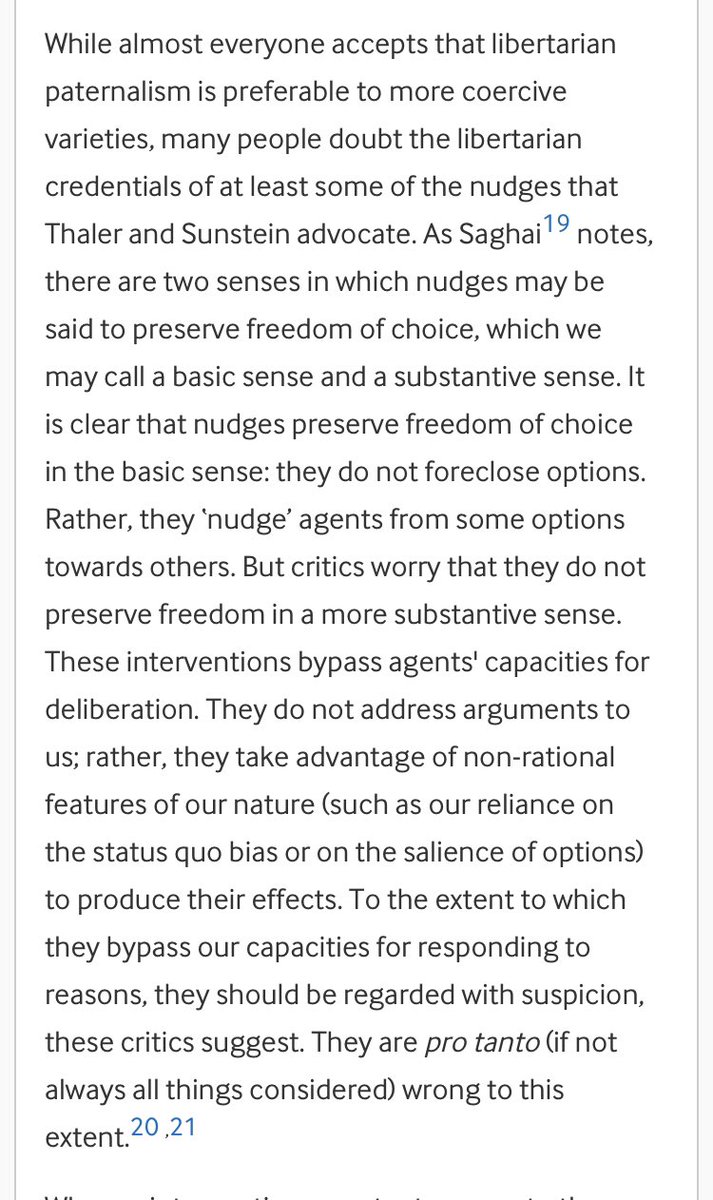
Another day, another struggle with my aversion to the concept of nudging. I bid you good night and leave you with this thought-piece.
Nudging, informed consent and bullshit.
jme.bmj.com/content/44/8/5…
#nudging
Another good paper, on nudges to reason, but also with a great background on how reasoning works. A good one to ponder when making things easy deflates analytic reasoning and friction activates it.
jme.bmj.com/content/43/8/4…
↪ Replying to @Letsgorich
@Letsgorich I will concede that within this definition it works, and that the generally vague definition of nudging may not enable consensus on a true answer here, but am enjoying the discourse. Also not sure if ”simulating thinking” is a sick burn or a typo. 😂
↪ Replying to @rilan
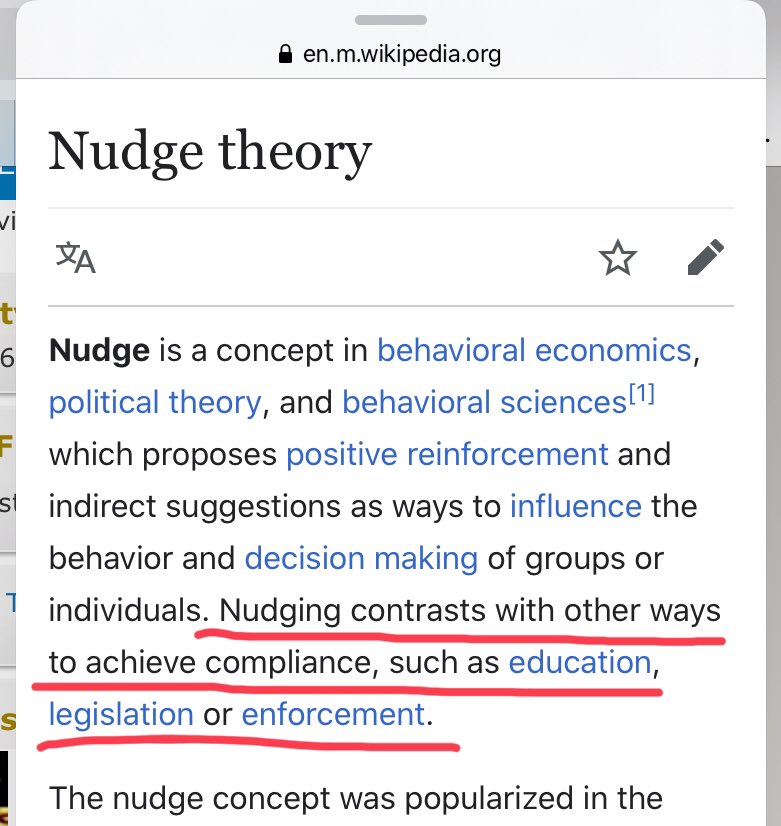
@rilan It’s true I have a real grudge against ’nudging’ - and seeing this used as an example of successful nudging for me gives unwarranted praise to a technique that merits itself on reaching positive outcomes without requiring enforced regulation. It winds me up. Likely to no avail.
@rilan As to whether or not it reaches results there are some interesting research papers provided by others in the thread. I’ve learned a lot, also about soft and hard opt-outs. I do enjoy the unpredictable nature of Twitter and how sometimes missing a core point brings new insights.
↪ Replying to @louisrosenfeld
@louisrosenfeld Roses are red,
violets are blue
Twitter's the place for
happy birthday to Lou.