Tagged: reply

Per Axbom reply Twitter

↪ Replying to @deeped

@deeped Ett av förslagen på bordet, det som kallades ”Sparing sharing”, var designat för att motverka obalansen som skapas av så kallade super sharers, som ofta innebär att extremistiskt innehåll får oproportionerlig synlighet.

Ska läsa färdigt hela rapporten hos WSJ, och blogga :)

@deeped Men rent generellt så finns mycket inom design som kan göras för att uppmuntra till tydligare reflektion och eftertanke i samband med delningar. Jag kan inte komma från hur mycket bättre jag gillade när vi körde manuella retweets.

@deeped Eller ja, manuellt är det ju fortfarande, men alltså när vi var tvungna att skriva ’RT’ :)

🔗 Originally posted on Twitter

Per Axbom reply Twitter

↪ Replying to @kjellhaglund

@kjellhaglund Piratpartiet gjorde en bra genomgång när den släpptes. piratpartiet.se/nyheter/ny-sve…

@kjellhaglund Med över 6 miljoner användare i Australien har en liknande app lyckats hjälpa en (1) person på en månad. theguardian.com/world/2020/may…

@kjellhaglund Skulle så gärna också ta del av riskanalyserna för MSB:s app-projekt. svt.se/nyheter/inrike…

🔗 Originally posted on Twitter

Per Axbom reply Twitter

↪ Replying to @Scott_Matter

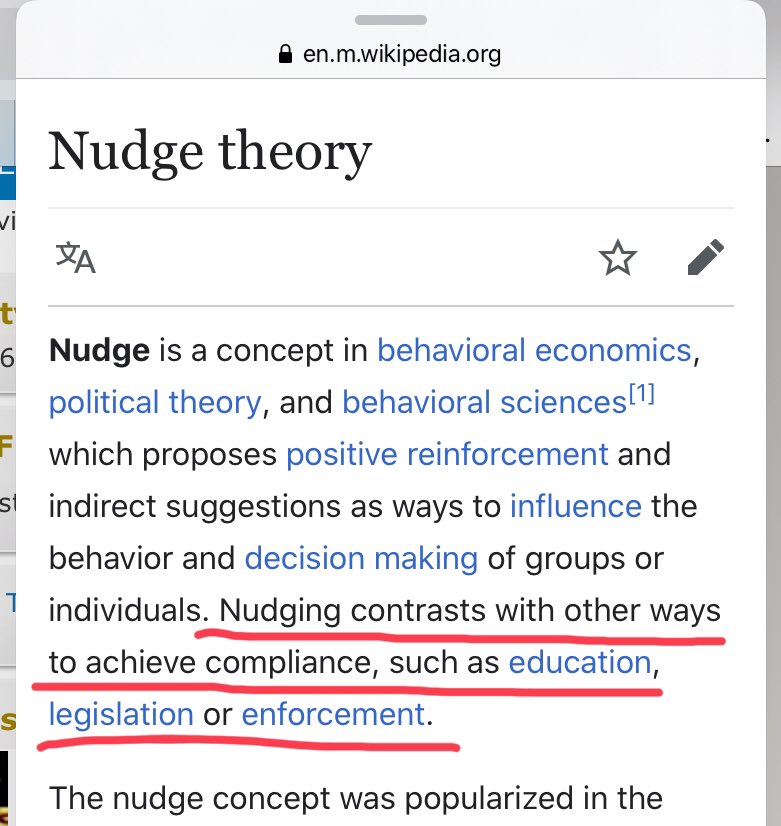
@Scott_Matter For me, this is what many people misunderstand about nudges. Removing choices, or choosing for them, is never a nudge. With the broad brush people are using to refer to nudges, they are evading essential discussions of morality and ethics - as ’nudging’ is socially accepted.

@Scott_Matter And I agree that nudges, in certain scenarios, are much more powerful than the definition appears to indicate, which makes them potentially even more dangerous.

@Scott_Matter And sometimes they are given way too much credit, as there is never a guarantee of nudges working. They are usually just behavioral experiments, and there are no quick fixes to steering people while maintaining fredom of choice - the world is way too complex.

@Scott_Matter The only book I’ve read so far that addresses this moral dilemma with maintained credibility is Engaged by @amybphd. We interviewed her on @uxpodcast a while back. Highly recommend the interview and her book of course, if you haven’t read it already 😊

uxpodcast.com/232-design-psy…

🔗 Originally posted on Twitter

Per Axbom reply Twitter

↪ Replying to @Scott_Matter

@Scott_Matter Good call. This is the gist of it isn’t it? I would argue that in a situation with a form the individual is still exercising autonomy, given that the form is designed in a way that they understand what they are responding to. In the second scenario this autonomy is removed, >>

@Scott_Matter albeit briefly. Here is where it gets interesting. Freedom of choice is maintained in both scenarios, but in the case of the law the change of current choice could never be seen as voluntary. A nudge supposedly permits freedom of choice while it is steering people.

@Scott_Matter Richard Thaler and Cass Sunstein write ’To count as a mere nudge, the intervention must be easy and cheap to avoid. Nudges are not mandates.’

’Cheap to avoid’ is key here. While freedom of choice is maintained (people can opt out), significant labor is added to do so.

🔗 Originally posted on Twitter

Per Axbom reply Twitter

↪ Replying to @rilan

@rilan It’s true I have a real grudge against ’nudging’ - and seeing this used as an example of successful nudging for me gives unwarranted praise to a technique that merits itself on reaching positive outcomes without requiring enforced regulation. It winds me up. Likely to no avail.

@rilan As to whether or not it reaches results there are some interesting research papers provided by others in the thread. I’ve learned a lot, also about soft and hard opt-outs. I do enjoy the unpredictable nature of Twitter and how sometimes missing a core point brings new insights.

🔗 Originally posted on Twitter