
@chiasm
There are no details I have seen. But my expectation is that the car - detecting incomplete data- stops until it receives confirmation from a human that it can continue.
@garymarcus
Tagged: Akkoma
By way of @garymarcus newsletter I was made aware of the following:
In a New York Times article on the self-driving company Cruise that recently suspended its cars, some interesting figured were revealed:
”Half of Cruise’s 400 cars were in San Francisco when the driverless operations were stopped. Those vehicles were supported by a vast operations staff, with 1.5 workers per vehicle. The workers intervened to assist the company’s vehicles every 2.5 to five miles, according to two people familiar with is operations. In other words, they frequently had to do something to remotely control a car after receiving a cellular signal that it was having problems.”
That’s a human intervention every 4-8 kilometres. More and more people are becoming aware of how many people are involved in the development, maintenance and running of machine-learning models. It’s safe to assume that machine-controlled cars are no different.
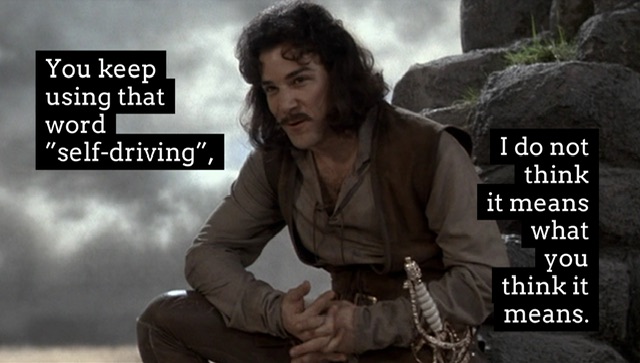
Most of the world is talking about self-driving and autonomous as if those are apt descriptions of what is already happening. Reality begs to differ. I think we need words that better describe what is really going on, and for media (and evangelists) to stop parroting whatever the companies feed them.
Autonomous used to mean something. Let’s ask the companies what they intend for the words to mean, and urge them to disclose the number of humans involved in making something appear ”autonomous”.
In light of these numbers being talked about, Cruise CEO Vogt clarifies (on Hacker News) that Cruise AVs are remotely assisted 2-4% of the time on average.* Interestingly he also says: ”This is low enough already that there isn’t a huge cost benefit to optimizing much further.” He also goes on to say that they are intentionally over staffed ”in order to handle localized bursts of RA demand”.
So maybe that’s what self-driving means.
—————
*Note that the numbers ”every 2.5 to 5 miles” and ”2-4% of the time” are not necessarily in conflict, especially in San Francisco.
LET ME KNOW what other terms you find have been invented or shifted to mean something else to obscure limited functionality. I may have to make a glossary. ”Hallucination” is for example another one of those for me.
1) Gary Marcus’ writeup of his reflections around these figures, using the Theranos scam as a metaphor: https://garymarcus.substack.com/p/could-cruise-be-the-theranos-of-ai
2) The New York Times article, by Tripp Mickle, Cade Metz and Yiwen Lu: https://www.nytimes.com/2023/11/03/technology/cruise-general-motors-self-driving-cars.html
3) Cruise CEO Vogt on Hacker News, giving his context for those numbers: https://news.ycombinator.com/item?id=38145997
4) Reddit thread discussing the whole matter and how the numbers may add up, or not: https://www.reddit.com/r/SelfDrivingCars/comments/17nyki2/kyle_vogt_clarifies_on_hacker_news_that_cruise/
#DigitalEthics #AIEthics
I had this essay by @karawynn saved in my bookmarks and I just re-read it.
It’s very, very, very good and covers so much of my thinking on this subject. Going to make it compulsory reading for my ethics course next year.
https://karawynn.substack.com/p/language-is-a-poor-heuristic-for
Getting geared to watch Nineteen Eighty-Four (1984) today and reading up a bit on the controversy around the Eurythmics track ”Sexcrime” – composed for the movie and used in the trailer but which never made it into the movie. For reasons.
As part of the irony that only humans can deliver, the song ”Sexcrime” was also met with resistance in the US and many American radio stations actually banned it from their playlists.
The album featured a hype sticker when released, with the text ”Censored by the Thought Police”.
Original Trailer: (YouTube): https://www.youtube.com/watch?v=T8BA7adK6XA
Diffuser: The Messy History of the Eurythmics’ ’1984’ soundtrack: https://diffuser.fm/eurythmics-1984-soundtrack/
Beat: Eurythmics ’1984 (For the Love of Big Brother)’: https://vocal.media/beat/eurythmics-1984-for-the-love-of-big-brother
@Zeugs
You may be interested in my post from a few weeks ago:
Benefits and risks of synthetic video and audio
https://axbom.com/synthetic-video-benefits-risks/
@Zeugs
Not sure I follow.
I've mentioned the effects on my own interpretation and emotion, which can happen regardless if others would agree that it represents me, or regardless of whether the output can be deemed "good" according to some definition of that metric. Outer representation is a tricky subject. I mean, people can be led to believe that an empty rubber glove is their own hand.
Perhaps if you let me know your goal with the line of questioning, or your own assumptions/hypothesis/conclusions, this would go easier. 😁
> why are you suspecting that GenAI video's are good?
Did I express this within the context of this conversation? Not sure what "good" refers to here either?
@Zeugs
> how good are you in judging your Own outer representation?
I wouldn't know how to judge good or bad in that respect.
> Could you judge if it's good Korean?
Nope (but I am one month into studying Korean with Duolingo. 😅)
> Does a voice identifier, identify you as the speaker of the generated Korean?
That's an interesting one. I'll have to check with some different ones. It wouldn't surprise me if the answer to that is different for different identifiers.
@Zeugs This is a great philosophical question. What I’ve used here is the basic version of something that can be more powerful for a hundred bucks. Sure I think I could identify these videos as fake if someone else made them, but it all depends on context.
I do think we’ll get to a point where people will start questioning themselves and their own memory. But even if I can see it’s fake, what happens when a majority of other people thinks it isn’t? Can they gaslight me into accepting that it’s real?
But already I feel at odds with what I’m seeing. I can even catch myself thinking, ”Wow, my Korean pronunciation is really good!” even though I logically know I’m not voicing those words at all.
@kefir Sure, this is all HeyGen. I've shared some more here:
https://axbom.com/synthetic-video-benefits-risks/
It's possible to pay to get better quality.
@salixsericea Thanks for the feedback. Yeah, I really agree about how it looks like a dubbed movie. Apparently customers of HeyGen can pay to get better lip sync. Of course…
Makes me think of the animated film Robots and hunting for upgrades.
https://www.youtube.com/watch?v=99DeRHisQtI
@Zeugs Not that I watch them that regularly, but across the years many of my talks have been recorded and posted online, so it happens. I do regularly listen to myself, since I run a couple of podcasts and do production for them.
@onepict I've been toying with the idea of giving someone control over "me" for a few weeks. But this also feels terrifying. And that's coming from a middle-aged privileged white dude.
Probably why I should do it.
@onepict We have a situation now in Sweden where the leader of the far-right party is about to publish a video (he has announced) where he is speaking Arabic and telling people they are not welcome here…
@onepict They're also AI-generated. Including voices. Except one, where I uploaded my actual Swedish voice.
You can see the whole showcase here:
https://vimeo.com/showcase/10723290
@onepict Agree about the uncanny valley. I see a lot of risks amongst the benefits.
https://axbom.com/synthetic-video-benefits-risks/
@Mabande Good reference!
@ojala That's a really good and relevant observation. Thanks.
I read the executive order on AI from the White House, wrote a summary and used an AI-powered video generator to create the appearance of me presenting it. In accordance with suggestions in the order, the video is clearly labeled.
https://vimeo.com/880661920
Remember that while audio and video are synthetic, the script has been written without any AI assistance. That's all me. 😊
This is part 1 of 2 and part two is out soon, but you can already read the full script of my summary on https://axbom.com/aiorder.
As we are all learning together right now, I would love to hear your impressions and reflections after watching and listening to a summary where my likeness is synthetic.
#AIEthics #DigitalEthics
I have to say, I've generated a fair few number of videos of myself over the past weeks and it's doing something really weird with my perception of myself. I can struggle acknowledging that it's actually not me talking and moving, even though I one hundred percent know that it isn't.
I don't think we as humans are well-suited to cope with this technology.
Weird experience today chatting with customer support for the newspaper I subscribe to. The person had several spelling mistakes, and... wait for it: that made me trust them more!!
I used to be very particular about spelling. But now that typos give the impression of a human response – at least in a typed chat context – I rather like it.
@clive @mollyanglin Thanks Clive! It's funny, a friend of mine pointed this out exactly about email when we talked about it yesterday. For many of us it has left a mark.
@lisamelton Wow, I'm so glad to be able to read a story like this in these times. Thank you for sharing.
@mollyanglin @clive Wow, that was bleak. But good writing. Thanks for sharing!