
@ianbicking Not my intent.
I would love for these voices to talk more about the value they are creating and how they are receiving feedback from the people they are hoping to help. What I'm questioning is the idea that working faster necessarily means more value created.
The work being done IS often valuable, and we risk losing sight of that value when speed becomes the prioritised metric.
I do my best work not when I work faster but when I spend time truly understanding the context and expectations of the people I hope to help.
The factory analogy can be helpful when considering how me suddenly working faster can affect the next person who has to manage my output.
Tagged: Akkoma
@rodet Definitely. I was just discussing backlogs in another forum around this topic. And this works if we are certain the more “efficient coding” doesn’t create other issues by way of documentation and traceability.
Of course, if the documentation and traceability was never there to begin with there is not much of a difference. 😁
@autiomaa Good example! I really can work so much faster if I do a poor job.
Meanwhile, if I work slower my quality generally improves, I make better decisions and I save others a lot of time.
@autiomaa Exactly. In an organisation that works in silos one department can increase their output, be praised, win awards, receive more funding and the employees get raises. Meanwhile the department that has to deal with the sudden decrease in quality has a much harder time getting their work done, and suffer the consequences for it.
If a person says that AI saves them 8 hours per week but they do not work less, their claim is that their output is 8 hours more worth of work in the same 40 hours.
Disregarding the lack of a baseline, I am genuinely curious as to where these hours supposedly go.
If the output of one person is higher does that mean that the input of another person is also higher? Likely so. In turn we can actually assume, in a digital world, that the increased output of one person can affect the input of many other people.
Now, if the people on the receiving end do not have tools that help them consume or manage this content faster, their workload has actually increased. They may lose hours of worth per week because of it.
So when people say they are becoming much more "efficient" thanks to AI, it's safe to assume this may be to the detriment of others.
A few people becoming more efficient does not mean the community becomes more efficient. Sometimes it's the opposite.
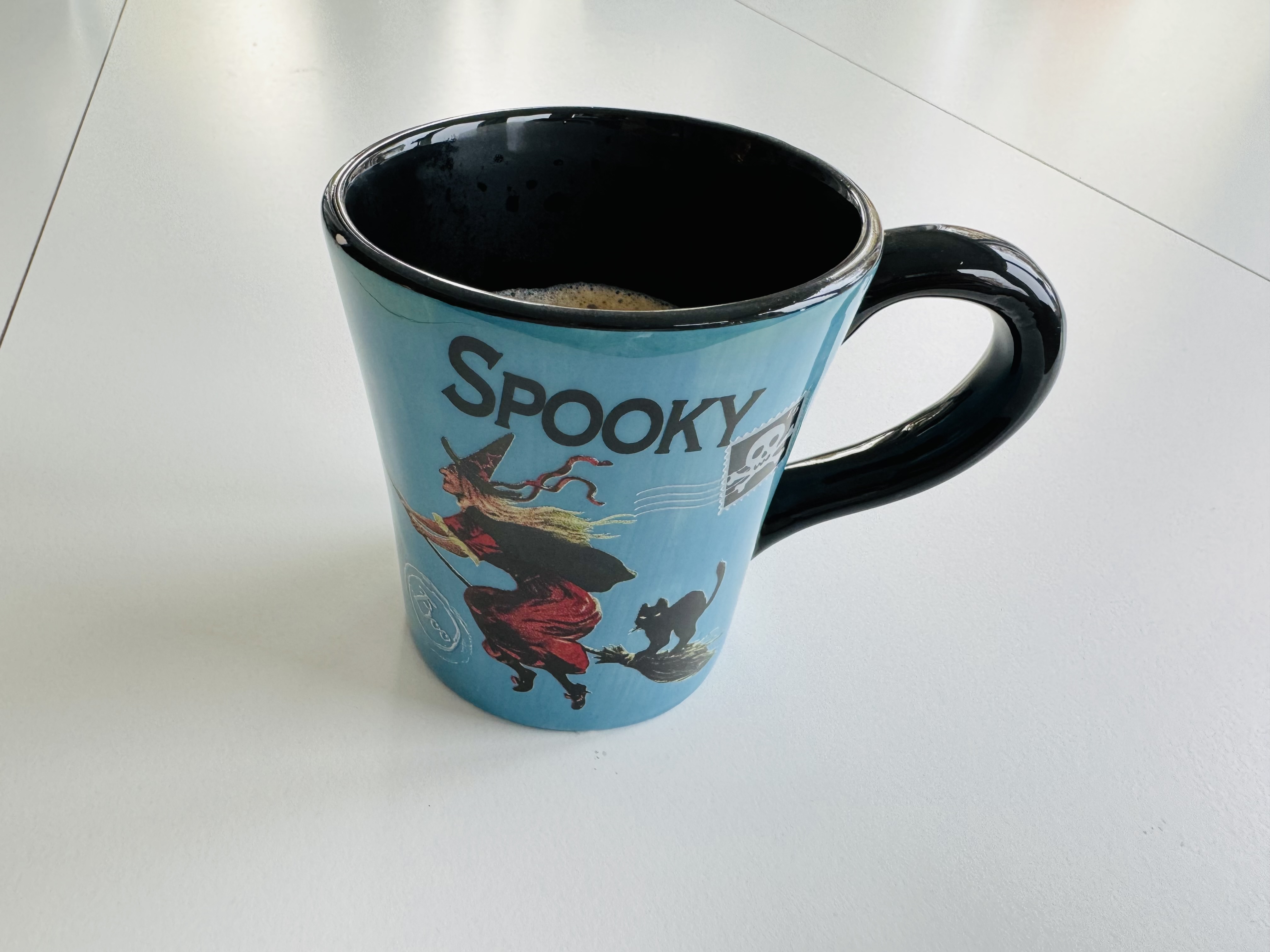
This week my coffee mug takes on another appearance. It's the little things in life…
#Halloween
US White House expected to release an executive order on AI regulation tomorrow.
It’s still unclear what this will include, so your guess is as good as mine. Including what impact US regulation may have on the rest of the world.
What I do feel is becoming more and more clear is a growing need for organisations to adopt a well-defined role around the area of anti-discrimination oversight.
With increased use, and increased liability, organisations will have to be accountable for the discrimination that everyday use and output may proliferate.
« the Oct. 23 draft order calls for extensive new checks on the technology, directing agencies to set standards to ensure data privacy and cybersecurity, prevent discrimination, enforce fairness and also closely monitor the competitive landscape of a fast-growing industry »
According to leaked drafts, Biden’s order will also direct ”the Federal Trade Commission, for instance, to focus on anti-competitive behavior and consumer harms in the AI industry”.
https://www.politico.com/news/2023/10/27/white-house-ai-executive-order-00124067
#AIEthics #DigitalEthics #AIRegulation
@hbuchel Wow, I feel this so much it hurts. Thank you for writing it!
@ludens ”its not a bug, it’s proof of sentient life” 😁
All these stories saying
you are not enough.
You are not learning fast enough.
You are not using the new tools enough.
You are not publishing enough.
You are not in nature enough.
You are not caring enough.
You are not being social enough.
You are not putting away your phone enough.
You are not practicing enough.
You are not recycling enough.
You are not protesting enough.
You are not planning enough.
You are not moving quickly enough.
All of this is wrong.
So very wrong.
You are you.
You matter.
So much.
And you are enough.
Always.
Enough.
Imagine a computer following its programming and its programmers getting away with calling unwanted outputs a ”hallucination”.
And then other people start calling anything they didn’t want or expect from the computer a hallucination. As if the programmers are completely unaccountable for their programming.
It’s happening every single day and its like an adventure in Wonderland.
@alexanderdyas Exactly, it’s the Ouroboros.
If our goal is a world reduced to stereotypes, generative AI is certainly an answer.
Since nobody seems tuned into what generative AI is for, and the actual purpose it is being tested for is still unknown, perhaps we need to start figuring out what the question was.
”Hey, computer, can you help me accelerate the reduction of all humans to neat little boxes based on stereotypical traits?”
…
https://restofworld.org/2023/ai-image-stereotypes/
Gotta consider how you may be training AI tools for your job just by performing your everyday work.
That is: Your employer forces you to use AI tools. Said AI tools are simultaneously trained on your work as you are using them. At some point the tool simply replaces you.
"Enter corporate spyware, invasive monitoring apps that allow bosses to keep close tabs on everything their employees are doing—collecting reams of data that could come into play here in interesting ways. Corporations, which are monitoring their employees on a large scale, are now having workers utilize AI tools more frequently, and many questions remain regarding how the many AI tools that are currently being developed are being trained.
Put all of this together and there’s the potential that companies could use data they’ve harvested from workers—by monitoring them and having them interact with AI that can learn from them—to develop new AI programs that could actually replace them. If your boss can figure out exactly how you do your job, and an AI program is learning from the data you’re producing, then eventually your boss might be able to just have the program do the job instead."
https://www.wired.com/story/corporate-surveillance-train-ai/
Don't s**t where you eat.
The one adage they forgot to "teach" AI.
https://www.wired.com/story/fast-forward-chatbot-hallucinations-are-poisoning-web-search/
@danhon
Sorry. 😅
Although I’m so on board with that statement…
@danhon
You’re likely looking for something like Renderform.
https://renderform.io/
You can likely also do this with a PHP script if it’s always the same image :)
@Beantin
I think that they are by some people intended to be two different aspects of controlling and allowing what goes into the machine instruction. Like this:
1. Prompt design is about writing prompts to get the desired output.
2. Prompt engineering is about the operational management of controlling what prompts are possible, i.e. restricting certain prompts to specific roles within a company in order to maintain data integrity and security, or controlling output length to manage computational costs.
Distinguishing between these two can be useful and set the right expectations, but I do see that prompt engineering is being used as a catch-all phrase. In that sense I would call prompt engineering the umbrella term for both the design/wording of prompts and the construction of rules for prompting.
But given that language is shaped by the people who use it we can only wait and see where these definitions end up. OpenAI themselves seem to use them interchangeably.
Sound reflections from an illustrator on the topic of generative AI.
"AI is existing as it's supposed to exist," says McKernan. "I think it has had a lot of potential to make our lives easier, to make workflows more effective. My issue is that the implementation of it, especially with AI art, hasn't been ethical, in my opinion because of the way it is built off a massive data set with 5.1 billion images, and taxpayers' data, all of which was culled from the internet without consent."
https://www.creativebloq.com/features/ai-art-the-impact-of-generative-AI