
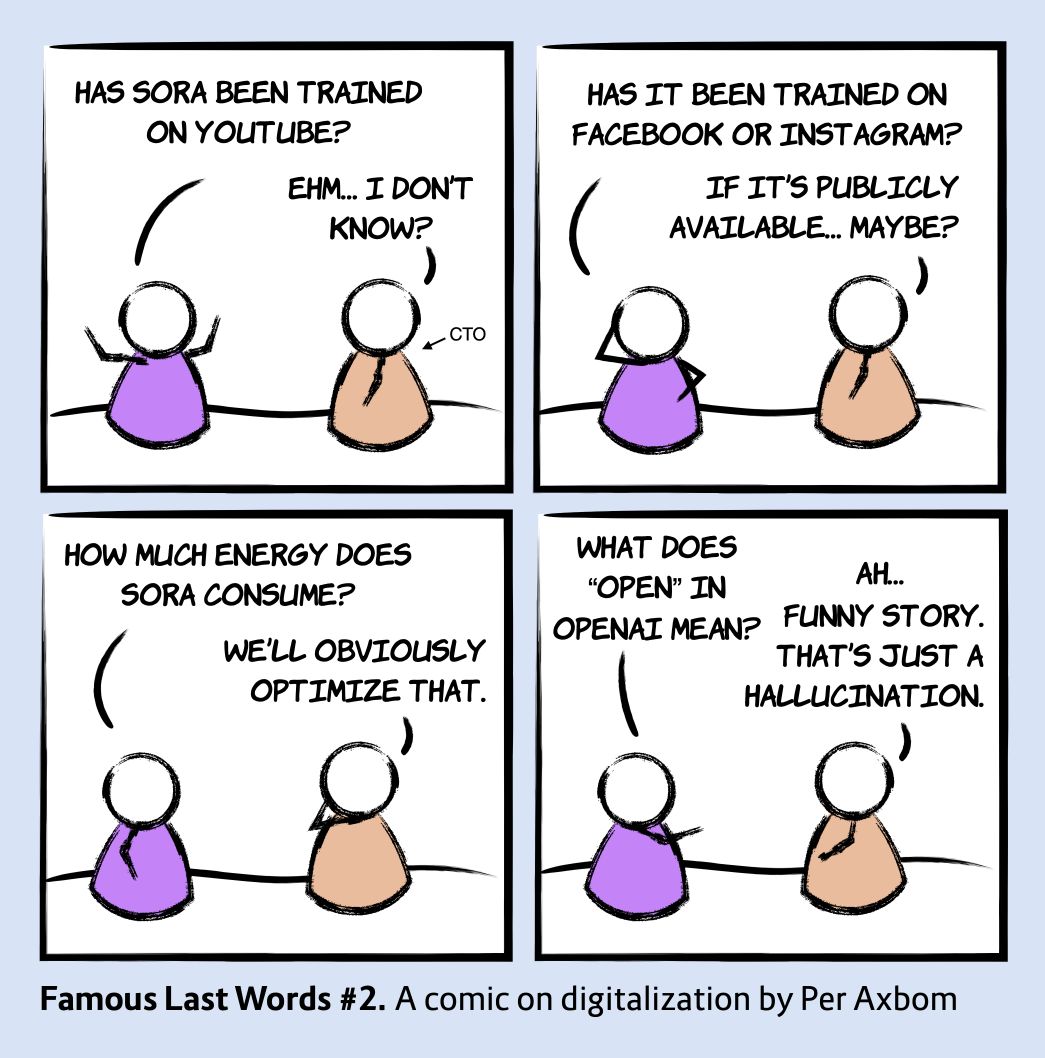
Famous Last Words number 2. A comic on digitalization by Per Axbom
Two people talking.
Person 1: Has Sora been trained on YouTube?
Person 2 (CTO): Ehm, I don' t know?
Person 1: Has it been trained on Facebook or Instagram?
Person 2: If it's publicly available… maybe?
Person 1: How much energy does Sora consume?
Person 2: We'll obviously optimize that.
Person 1: What does "Open" in OpenAI mean?
Person 2: Ah… Funny story. That's just a hallucination.
"Wait, grandpa!? You wanted to solve the climate crisis so you built tools that consumed even more electricity, and made the crisis happen even FASTER!?"
"Well, yes… efficiency was always the game. Exactly what we made more efficient wasn't really an issue. We did fuck up REALLY fast didn't we...? Imagine how many things we can improve now though…"
@sy Is the image description the prompt you used?
@sy Thanks, would it be okay to add this as a comment to the post?
It's good to give the complete picture of how different tools will fare on different prompts. The uncertainty of what tool will be able to do what is an important insight.
Generative AI can not generate its way out of prejudice
The concept of "generative" suggests that the tool can produce what it is asked to produce. In a study uncovering how stereotypical global health tropes are embedded in AI image generators, researchers found it challenging to generate images of Black doctors treating white children. They used Midjourney, a tool that after hundreds of attempts would not generate an output matching the prompt. I tried their experiment with Stable Diffusion's free web version and found it every bit as concerning as you might imagine.
https://axbom.com/generative-prejudice/
#AIEthics #DigitalEthics
@mia Thanks, fixed it now in the online version (it went out as a newsletter as well 😅)
This is a typo that several people have reached out about now, haha.
Generative AI can not generate its way out of prejudice
The concept of "generative" suggests that the tool can produce what it is asked to produce. In a study uncovering how stereotypical global health tropes are embedded in AI image generators, researchers found it challenging to generate images of Black doctors treating white children. They used Midjourney, a tool that after hundreds of attempts would not generate an output matching the prompt. I tried their experiment with Stable Diffusion's free web version and found it every bit as concerning as you might imagine.
https://axbom.com/generative-prejudice/
#AIEthics #DigitalEthics
If your concern is that humans are standing in the way of technological progress, your understanding of the purpose of tech should perhaps be the subject of consideration.
@isotopp Thanks for the quick feedback! 🙏
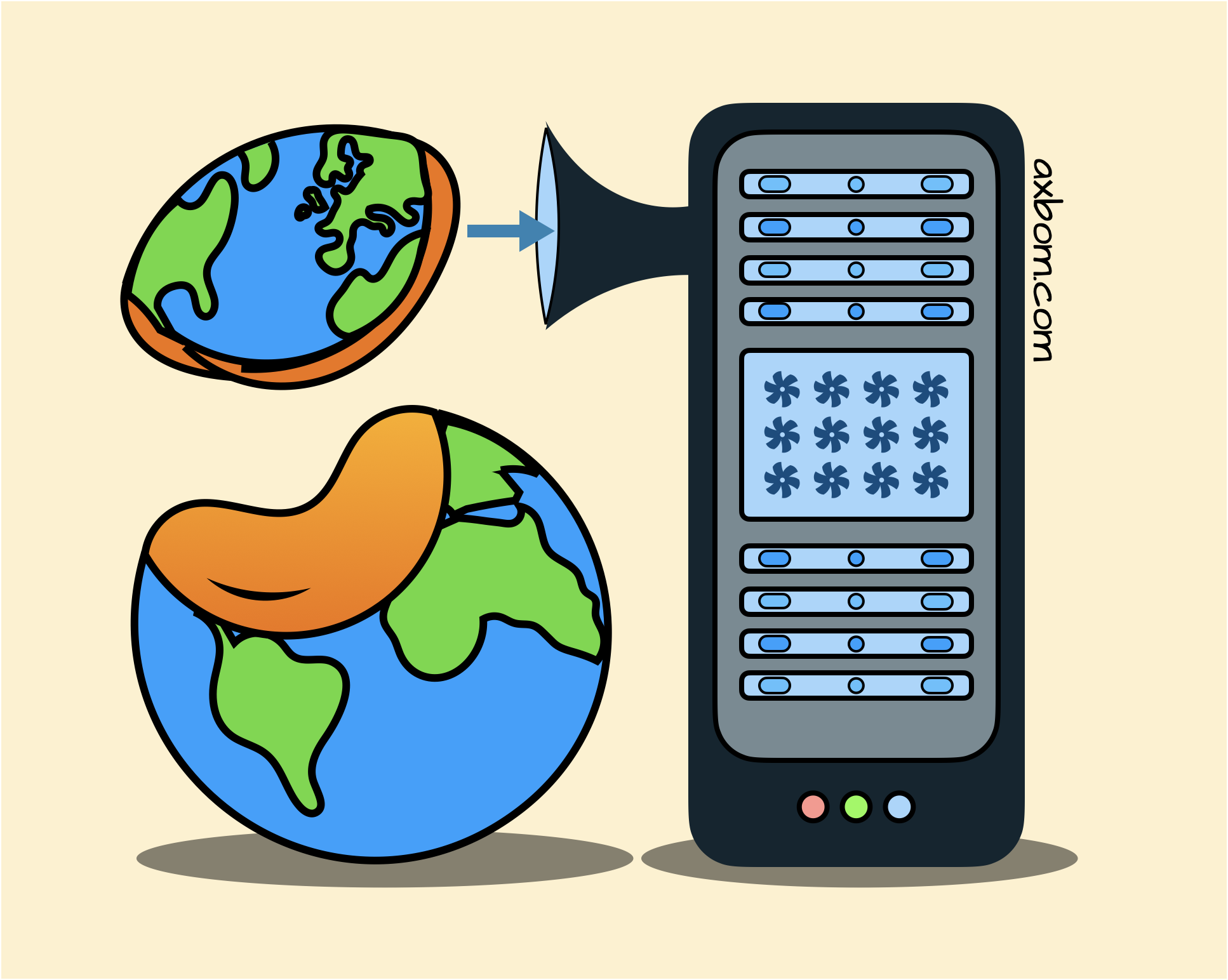
Quick sketch of an AI being trained on only bits of the world. Makes sense?
"I dagsläget finns inget beslut om att Skatteverket ska köpa in Microsoft 365 och Teams. Vi har påbörjat en undersökning om införande och användande", säger Peter Nordström, sektionschef på Skatteverket.
Det finns alltså inget beslut om att Skatteverket ska börja använda Teams. Man har påbörjat en utredning som inte är klar ännu. Detta kan man läsa i Skatteverkets eget pressmeddelande från 1 mars.
Ändå skriver flera tidningar som om Skatteverkets "beslut" har förändrat synen på myndigheters användning av amerikanska molntjänster. Och de som säljer tjänsterna drar förstås stora växlar på detta.
Som vanligt är det bra med lugn och is i magen. Och att läsa underlaget. Utredningen finns att ladda ner. Och det som utretts hittills är en tillämpning med kraftiga begränsningar. Bland annat skriver man i sin egen utredning att det inte finns "reell möjlighet att utöva sitt arkivansvar enligt 4 § arkivlagen, om Skatteverket övergår till M365Apps, Teams och Entra ID".
Det som kanske fascinerar mig mest, eftersom jag intresserar mig för människans interaktion med it-system, är hur Skatteverket förändrat sin syn på hur lätt det är att styra vilken information myndighetens medarbetare delar i dessa verktyg.
2021: Skatteverket bedömer att det inte kommer vara möjligt för myndigheten att skriva bestämmelser som tydliggör för alla deras 12 000 anställda exakt vilken information de får och inte får dela i ett Teams-möte.
2024: Skatteverket säger att de är medvetna om att det finns risk för att personuppgifter i slutändan kan hamna hos amerikanska myndigheter. För att hantera det ämnar Skatteverket ge medarbetarna instruktioner om vilken information som kan/får delges under olika typer av Teams-möten och i olika funktioner.
"I de delar av Teams, till exempel chatten och externa möten där det inte är möjligt att använda E2EE-kryptering kommer medarbetarna instrueras att inte behandla sekretesskyddade uppgifter" – Citat från Bilaga 3, Analys av Microsoft Teams
Nästa steg blir att fundera över, och kanske utreda, hur medborgares förtroende för Skatteverket påverkas av det ena eller andra synsättet – och framtida vägval.
Skatteverkets pressmeddelande med länkar till utredningen och dess bilagor: https://skatteverket.se/omoss/pressochmedia/nyheter/2024/nyheter/skatteverketspreliminarabedomningavmolntjanster.5.2fb39afe18dabf1e4d21f7f.html
I have now started reading Joseph Weizenbaum’s increasingly relevant book from 1976, ’Computer Power and Human Reason: From Judgment to Calculation’.
I expected to like it but 23 pages in I can already say I love it. On page 23 he quotes Hannah Arendt about recent makers and executors of policy in the Pentagon:
”They were not just intelligent, but prided themselves on being ’rational’… They were eager to find formulas, preferably expressed in a pseudo-mathematical language, that would unify the most disparate phenomena with which reality presented them; that is, they were eager to discover *laws* by which to explain and predict political and historical facts as though they were as necessary, and thus as reliable, as the physicists once believed natural phenomena to be… [They] did not *judge*; they calculated… an utterly irrational confidence in the calculability of reality [became] the leitmotif of the decision making.”
@deadsuperhero @BeAware
Glad someone else is testing with Akkoma. I couldn't find the account either.
@danhon Good evening.
@dkmj They had a lot of first-mover advantage and of course have always been children of their time... My perhaps biggest criticism is an unwillingness to grow, acknowledge missteps and to listen to other voices, even as they preach how important it is to make those voices heard. This is an interesting one on Norman:
https://www.fastcompany.com/90868431/the-problem-with-don-norman
I've personally found Norman better at reasoning around potential weaknesses in his own thinking (I've interviewed him twice) but then slowly realised that he never acts on that seemingly sensible reasoning. In his later writings he is essentially saying that he got a lot of his early stuff wrong, but when doubling down on a flavor of co-creation and 'reinventing design education' I haven't seen examples of bringing that thinking to his own practice.
Nielsen's work I've always had a hard time understanding why people latch on to. So much of it is oversimplification and bold assertions based on data that is rarely supporting the exact conclusion he makes. I also take issue with how often he talks about IQ in ableist ways, which definitely biases me against him.
@dkmj That would be awesome. 😁
@devolute
Haha, that is exactly how I felt on the Thursday that I read it. "This will break my Friday planning...", and it did. Thanks for sharing!
It's sometimes good to remember that many people have been debunking several
of Nielsen's assertions about usability for more than two decades. Not least the one about only needing to test with five users.
Here's a good study from 2001 (yes, 23 years ago) about page load times. By Christine Perfetti and Lori Landesman.
Remember when Amazon took 36 seconds to load over a 56kbps modem?
https://web.archive.org/web/20130501084018/http://www.uie.com/events/roadshow/articles/download_time/
#ux #uxdesign
More recent, but still 12 years ago...
https://www.wired.com/2012/04/why-jakob-nielsen-is-wrong-about-mobile-websites/
En presschef på en myndighet kan inte lämna ut sms till en pågående utredning för att dessa är raderade. Som skäl har presschefen angett att de tog för mycket plats på hans telefon. Låt oss räkna på det ➡
1 sms = i genomsnitt 0,2 kB
1 foto = i genomsnitt 2,5 MB (lågt räknat)
Det går i detta exempel 12 500 sms på ett foto.
Om du skickar 10 sms i jobbet varje dag så är det 3 650 sms på ett år.
För att frigöra lika mycket utrymme som upptas av ett enstaka foto måste du då radera sms över en period på tre och ett halvt år.
En typisk minnesstorlek på en modern telefon är 64 gigabyte. Om 5% av det utrymmet (alltså 3,2 GB) togs upp av sms så skulle det motsvara 16 miljoner sms. Eller mer än fyra tusen års sms:ande om man skickar 10 per dag.
Ja, du fattar. Att radera just sms för att spara utrymme är inte den bästa användningen av din tid.
En förmildrande omständighet skulle kunna vara om presschefen är tilldelad en Philips Fizz från 1996 som tjänstetelefon. Jag föreslår då en uppgradering.