
It was a weird friggin' year. My open heart surgery and new mechanical heart valve of course a central part of it. Thankful for medicine keeping me around for a bit longer.
All I know now is my intent is to write more in 2025. And listen more. Looking forward to the experience.
Take care, all. ❤️
It was a weird friggin' year. My open heart surgery and new mechanical heart valve of course a central part of it. Thankful for medicine keeping me around for a bit longer.
All I know now is my intent is to write more in 2025. And listen more. Looking forward to the experience.
Take care, all. ❤️
Due to miscommunication I was not aware on Sunday that I was supposed to be teaching a class yesterday (Mon, Dec 30). Luckily a student asked for the meeting link on Sunday eve. And I was able to scramble materials. But jeepers was I stressed out on Sunday night. 😬 Thankfully I do love teaching.
↩ Replying to @triketora.com
I was pleased to find this Hello Kitty sign for tourist guidance when I was in Tokyo with my son earlier this year. 😊

↩ Replying to @anildash.com
💯 When I teach digital ethics students really appreciate this exercise, writing down their values – with an opportunity to discuss them with their peers. They practice articulating their goals and become better prepped when facing important decisions, incl. interviews. And I practice with them!
↩ Replying to @fnyosv.bsky.social
Jag har i år fått en mekanisk hjärtklaff inopererad. Det ger en enorm trygghet att kunna få rapporter om förändringar i puls och andningsfrekvens över tid. Även gångstabilitet. Att den larmar 112 vid fall gillar jag. Min plan har varit att lämna mobilen hemma oftare men det har inte hänt ännu. 😬
En vän kunde tidigt upptäcka arytmi som sedan mynnade ut i att han fick en pacemaker.
Så vi hjärtpatienter känns som en stark målgrupp… vilket förstås kan vara vem som helst innan man vet om det.
För tydlighetens skull: jag kollar alltså verkligen inte puls varje dag (kanske gjorde det 1-2 veckor efter operationen). Men jag uppskattar notiser som kan komma med några månaders mellanrum och tala om att en signifikant förändring skett i t ex den genomsnittliga vilopulsen.
Remember this folktale? ”Posing as weavers, two con-men offer to supply the emperor with magnificent clothes that are invisible to those who are incompetent or stupid.”
We are now waiting for enough people to point and say they can’t see the ”AI”. There are so many emperors wearing nothing at all.
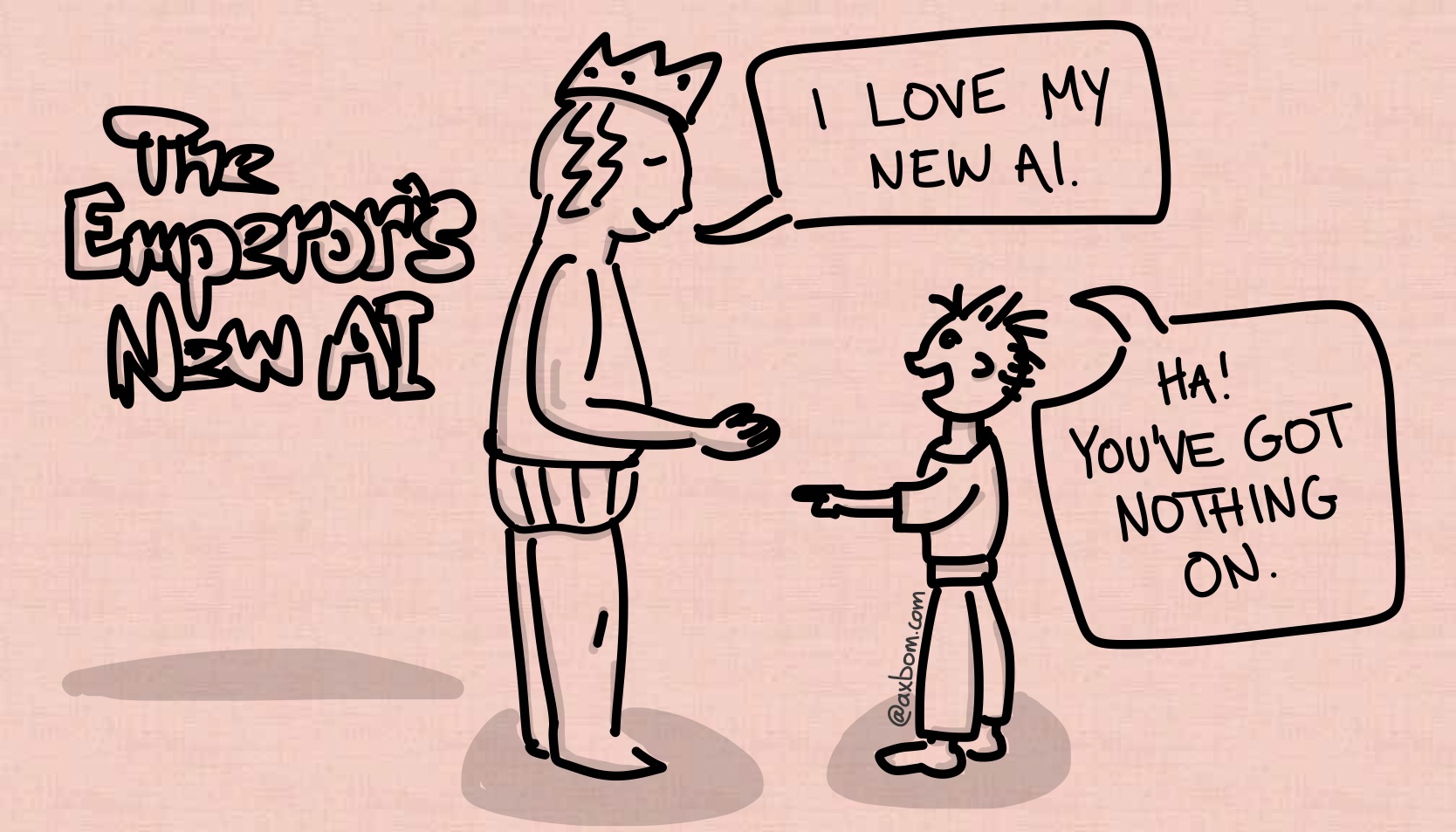
Remember this folktale? ”Posing as weavers, two con-men offer to supply the emperor with magnificent clothes that are invisible to those who are incompetent or stupid.”
We are now waiting for enough people to point and say they can’t see the ”AI”. There are so many emperors wearing nothing at all.
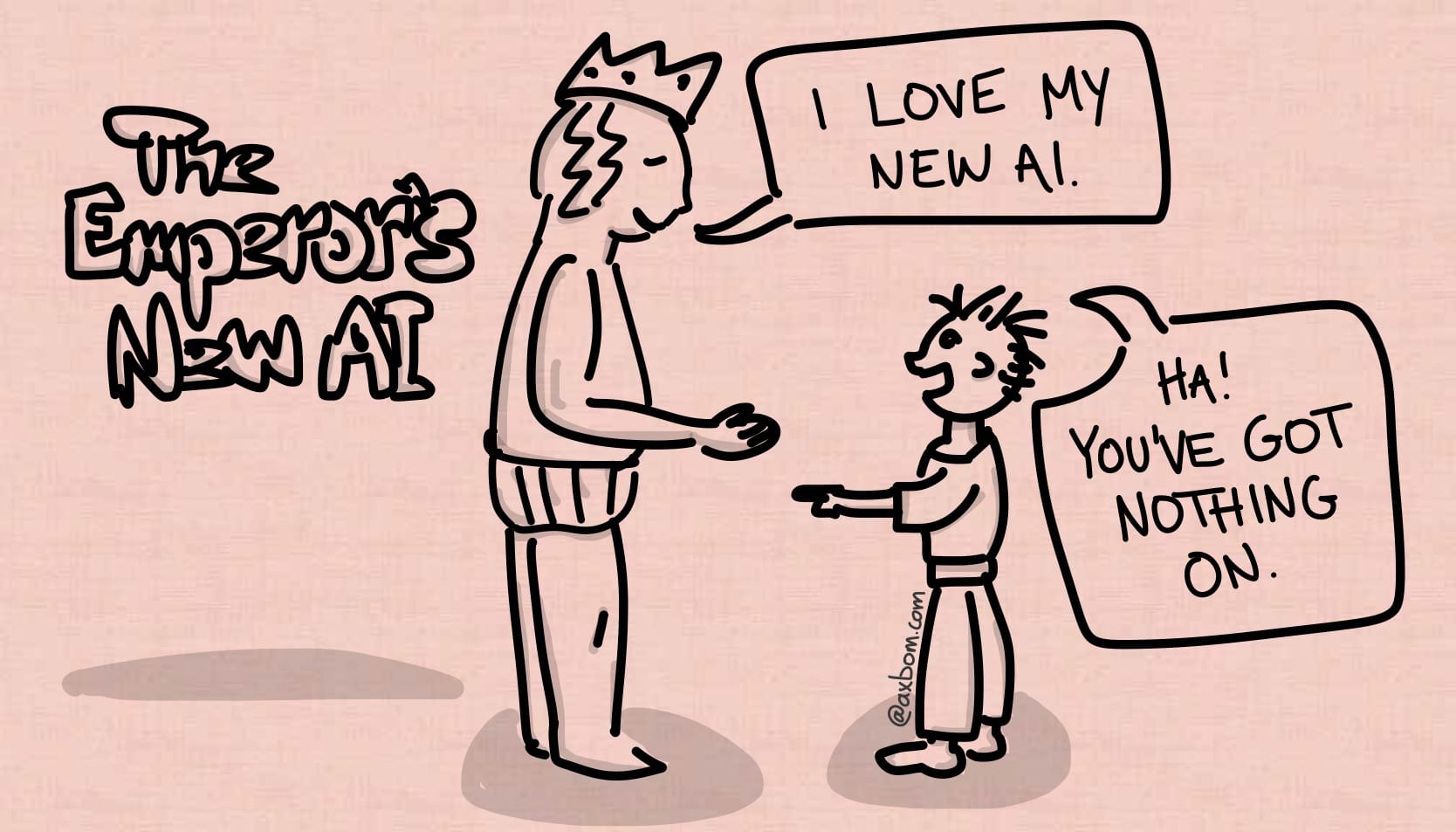
"[…] the "AI" industry refers to the inner workings of systems as existing in black boxes. Nobody can see or understand how they really function, and no explanations for outputs and conclusions are requested by decision-makers. A baffling number of managers and leaders express that this is fine."
@axbom.com: ”Reducing humans into data points immediately feels scientific and awe-inspiring to people in power. Human complexity becomes neat, binary and void of gray areas. Information is encoded in templates known as profiles. If those profiles are correct, fair or relevant becomes secondary.” per.ax/ds
View original post
"A correct output on a test of a stochastic system only evidences that the system has the capability to respond correctly to this input, but not that it will do this always or frequently enough."
@baldurbjarnason.com: “Does current AI represent a dead end? | BCS” www.bcs.org/articles-opi... > From the perspective of software engineering, current AI systems are unmanageable, and as a consequence their use in serious contexts is irresponsible.
View original post
”Reducing humans into data points immediately feels scientific and awe-inspiring to people in power. Infallible. Human complexity becomes neat, binary and void of gray areas. Information is encoded in templates known as profiles. If those profiles are correct, fair or relevant becomes secondary. As long as we can output a number through some formulaic assumption. Numbers are so much easier to read than people. And difficult to dispute. Especially when you are kept from tracing their origins.”
Read the most recent issue of my newsletter here:
Data Shadows in Government Erase Human Worth
”Reducing humans into data points immediately feels scientific and awe-inspiring to people in power. Human complexity becomes neat, binary and void of gray areas. Information is encoded in templates known as profiles. If those profiles are correct, fair or relevant becomes secondary.”
per.ax/ds
”You have many data shadows today. These are vague summaries of you as a person that authorities, banks and insurance companies use to assess your suitability for things like employment, benefits, sick pay, discounts and credit. In many contexts, you are merely a risk, the question is how big, and a 'data-driven' organization places great importance on your shadow to determine this.!”
”Reducing humans into data points immediately feels scientific and awe-inspiring to people in power. Infallible. Human complexity becomes neat, binary and void of gray areas. Information is encoded in templates known as profiles. If those profiles are correct, fair or relevant becomes secondary. As long as we can output a number through some formulaic assumption. Numbers are so much easier to read than people. And difficult to dispute. Especially when you are kept from tracing their origins.”
https://axbom.com/data-shadows/
↩ Replying to @mariusz.cc
I was looking at one of those as well 🫣. My wife, who does not drink coffee, asked how much space I was going to take up in the kitchen 😅
↩ Replying to @mariusz.cc
Very cool. I still have my training wheels on, so I just realised I need a drip scale.
If you truly want to understand the OpenAI o3 and ARC-AGI debacle this is the post I recommend.
Professor Melanie Mitchell provides history, context and theory, backed with extensive experience. Mitchell is the author or editor of six books and numerous scholarly papers in the fields of artificial intelligence, cognitive science, and complex systems.
In her post you get to understand…
- the purpose of the ARC-AGI competition, why she likes the ARC domain as a challenge for AI systems, and how the use of ”AGI” muddies the waters
- the importance of inference-time compute
- the differences between Deep Blue (the chess-playing computer) and AlphaGo
- what OpenAI never tells us and experts can only speculate around
- how humans are still demonstrably better at abstraction and reasoning
- and why we need to avoid Goodhardt’s law when developing a measure of intelligence
Also note that o3 is not eligible for testing on ARC’s fully private set, because o3 requires access to the internet. To be eligible for the Arc Prize, the winner’s program must run on the test set in at most 12 hours on the competition’s servers, with no internet access, and the code has to be open-sourced at the end of the competition.
As Mitchell describes, all of the ways the ARC-AGI competition has been approached negate the core assumptions of ARC with regards to amount of training, the required number of examples of grid transformations, and the computational resources used.
”Indeed, o3’s performance on ARC is quite amazing, even though it violates the assumption that solving these tasks shouldn’t require huge amounts of computation at inference time. But I’m most curious about an even more pressing question: Is o3 (or any of the other current winning methods) actually solving these tasks using the kind of abstraction and reasoning the ARC benchmark was created to measure?”
For Christmas this year I got a pour-over coffee maker.
I believe that slowing down aspects of my life, adding more friction and more craft, will enrich my life and improve my connection to body and environment.
Inefficiency can boost wellbeing.
Pushing one button for coffee can be inefficient.
If you read just one post to understand the whole OpenAI o3 - ARC-AGI debacle, I'd say this is a strong choice.
@melaniemitchell.bsky.social: Some of my thoughts on OpenAI's o3 and the ARC-AGI benchmark aiguide.substack.com/p/did-openai...
View original post