Just unbelievably saddened by a LinkedIn video promoting use of animated gifs in presentations where a speaker in the video announces "Anyone that suffers epilepsy, please leave the building. Anyone that doesn't know they suffer from it, too bad." Followed by huge laughter.
😢
Posts in English
Sorry to have to point this out, but the joking and ensuing laughter about epilepsy in the beginning of this video is honestly very off-putting. "Anyone that suffers epilepsy, please leave the building. Anyone that doesn't know they suffer from it, too bad."
A corporate culture of having a laugh about neurological disorders is not one that invites diversity and inclusive thinking.
Is me. At @UXCopenhagen
linkedin.com/pulse/first-de…
#uxcopenhagen #uxconfcph
1) When I'm quick with 4x4 captchas (e.g. 'select all squares with traffic lights'), I've found myself having to do several in a row.
I'm now deliberately filling them in slowly and only having to complete one.
I've altered my behavior to appear more human to a computer.
2) This exemplifies well the reasons for strong backlash against surveillance.
* False positives and the lives this affects
* Covert, dictated norms for acceptable behavior
* Suppressing all deviating or experimental behavior
* Perpetual fear of being targeted by the system
3) Going further. One success story is sometimes retold in relation to automated surveillance in schools. The system noticed the same girl spending her lunch hour in the restroom every day. The school intervened and was able to stop the bullying that contributed to this.
4) This sounds great, but does not encourage reflective reasoning.
* How should schools monitor the well-being of their students?
* What does "stop the bullying" mean, and how is long-term well-being supported?
* Should students have the choice of not telling their story?
5) In the end, really, I guess it will all come down to:
* What choices do I have, and
* What choices have you taken away from me?
I'll proceed slowly. Maybe to make sure the computers don't flag me as an impostor.
6) You can hear more on this example, and student surveillance in general, in this podcast episode of Reset with @rebeccaheilweil
Students are being watched. Closely.
overcast.fm/+UC_UlHfbs
The recommendations for maintaining brain plasticity, starting at 15:30 and ending at 16:35, should be compulsory listening.
overcast.fm/+CYFR9yg0
Just so much good stuff in this episode of All in the Mind with brilliant guest @HanCritchlow.
There is no research showing that students are safer thanks to camera surveillance and tracking. But of course the numbers show a rise in surveillance system profits. And an obvious decline in student privacy. overcast.fm/+UC_UlHfbs
↪ Replying to @round
@round The Art of Scent
smithsonianmag.com/arts-culture/t…
Critical insights about research and data science shared by @writingprincess
dscout.com/people-nerds/m…
↪ Replying to @beantin
@beantin @mulegirl Yes, I was beginning to wonder if some nitrous oxide had started leaking in your office. 😂
↪ Replying to @unknown
@SarahJagrowski @beantin Wow, thank you Sarah! 🙏
↪ Replying to @Marm_Design
@brightspaceux That’s more self-compassion 😊
↪ Replying to @Marm_Design
@brightspaceux Rather than pass blame, my intent is to shine light on conditions that are obscure. I believe a lot of people feel too much guilt over individual actions that are difficult to avoid because of systemic conditions. And this is part of the harm(!)
@brightspaceux In my ethics class I stress that every action that one thinks to regret is an opportunity to share, discuss, learn and plan for alternative paths.
Convenience obscurity. I obviously need to write a blog post to claim the term... 😉 x.com/axbom/status/1…
In my quest to also find an equivalent Swedish word for this phenomenon I have just now settled on
bekvämlighetsdunkel.
Swedish rocks.
↪ Replying to @math_rachel
@math_rachel @marykinva I've started calling this convenience obscurity. I'm certainly prone to it myself. The idea is that when something becomes very convenient for one group of people - often the already privileged - they find it harder and harder to see how it harms others, or even themselves.
This has been one of the most worrisome podcasts I've listened to in a fair while...
Human eye-contact and touch. We can not dismiss how much this means for well-being.
With @DrFionaKerr from Neurotech Institute.
overcast.fm/+CYHGAkoE
I remember learning how many convicted criminals live in Trump Tower, and how that was an eye-opener for me.
telegra.ph/The-terrible-t…
@dcondrau Thanks for the retweet, though I deleted that one to correct a spelling error :)
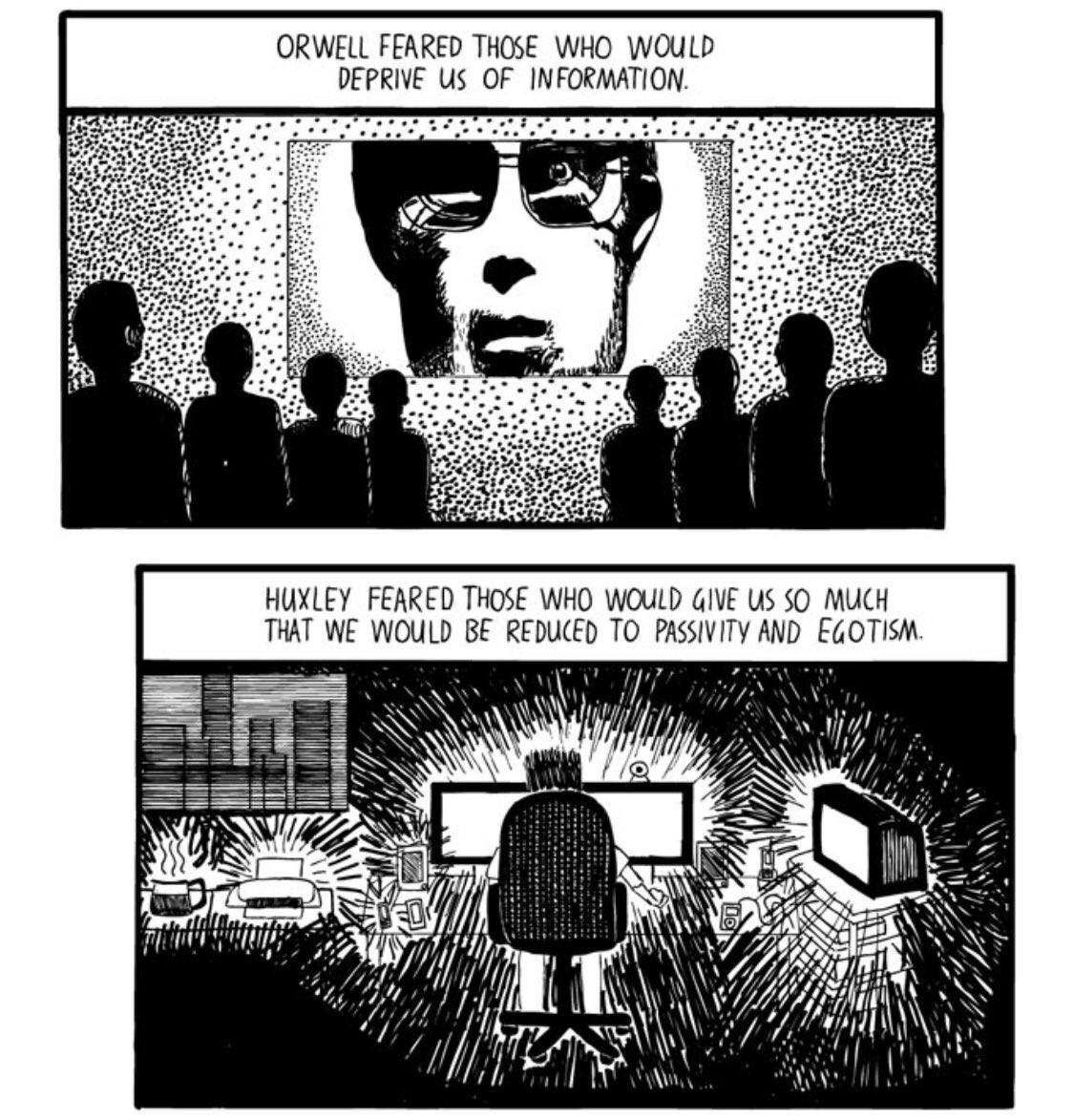
Cartoons to understand the critical differences between 1984 and Brave New World.
"Orwell feared those who would deprive us of information. Huxley feared those who would give us so much that we would be reduced to passivity and egotism."
More here:
highexistence.com/amusing-oursel…