Published earlier today: Deepfake porn using any person on Instagram
When we can no longer control where our face appears, what happens to our perception of identity? The technology is constantly getting better in its deceptive quality, is more widely available and at ever lower costs. The porn industry is growing in all directions. As it stands, today everyone is a potential porn star against their own will.
Yeah, sorry about that. I honestly have a hard time writing about stuff like this but I feel like it will only be worse if it's ignored and/or not talked about.
Just published: Deepfake porn using any person on Instagram
When we can no longer control where our face appears, what happens to our perception of identity? The technology is constantly getting better in its deceptive quality, is more widely available and at ever lower costs. The porn industry is growing in all directions. As it stands, today everyone is a potential porn star against their own will.
”By simply existing as women in public life, we have all become targets, stripped of our accomplishments, our intellect, and our activism and reduced to sex objects for the pleasure of millions of anonymous eyes.”
My previous article in Swedish on deepfake porn can be found here:
I can not see who you are conversing with (likely a limit in place) but it is far from my intent that anyone feel this poster implies Africa to be inferior (myself born in Liberia and have lived in Tanzania).
I'm happy to change wording if there is a suggestion?
And yes you are correct in assuming this rather calls out digital colonisation issues.
Many of these topics are explained further in my blog post on The Elements of AI Ethics:
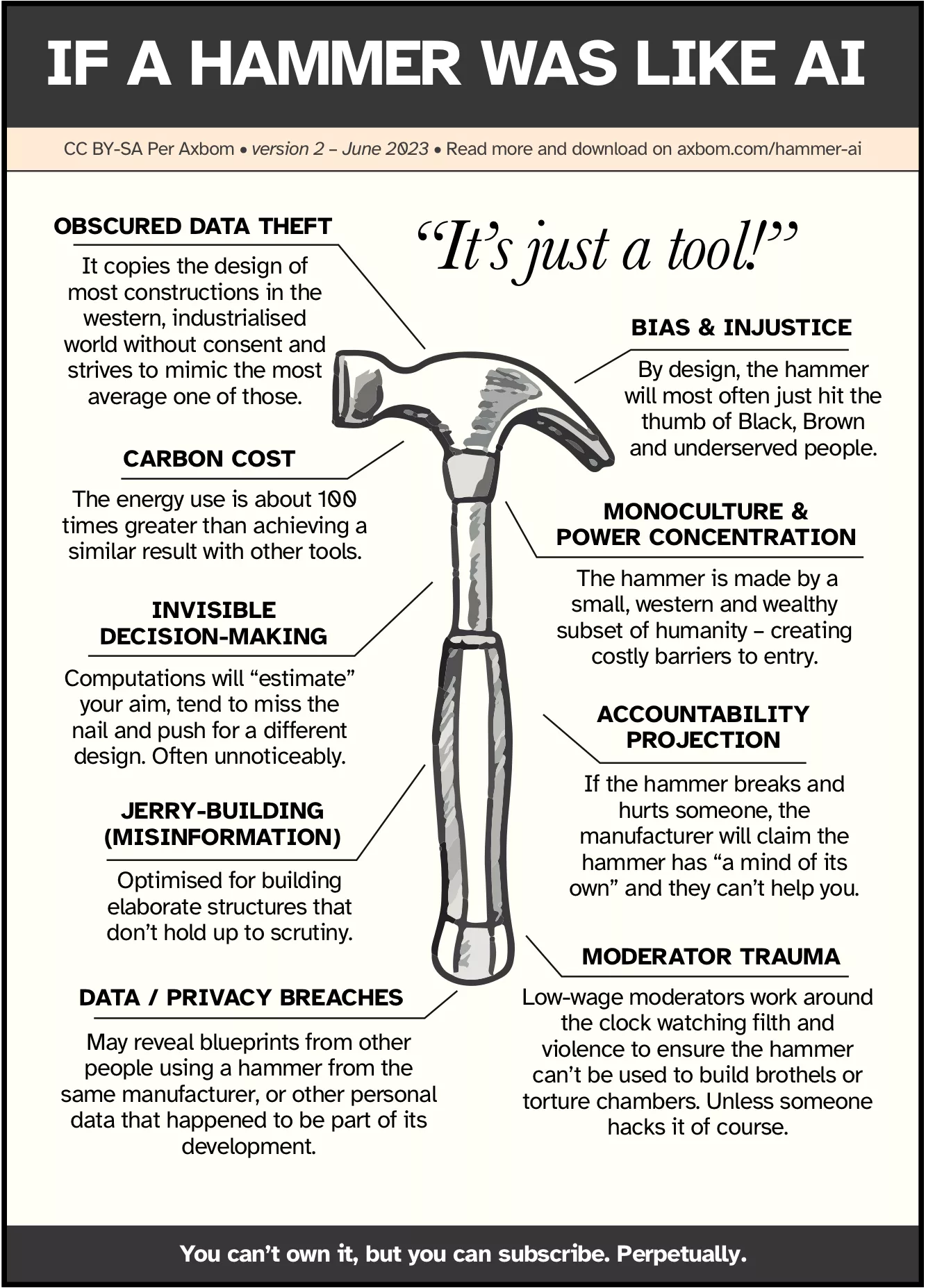
A common argument I come across when talking about ethics in AI is that it's just a tool, and like any tool it can be used for good or for evil. One familiar declaration is this one: "It's really no different from a hammer". I was compelled to make a poster to address these claims. Steal it, share it, print it and use it where you see fit.
**UPDATE**: The poster has been updated for readability and clarity (with regards to a couple of topics). Can't update the image here on LinkedIn, but it's available on the blog post: https://axbom.com/hammer-ai
Image description:
Title: If a hammer was like AI
Illustration of a hammer (a line drawing) and the quote "It's just a tool".
Various topics surround the hammer and have lines drawn to the hammer, as if explaining what it is made of.
Obscured data theft.
It copies the design of most constructions in the western, industrialised world without consent and strives to mimic the most average one of those.
Bias & injustice.
The hammer will most often just hit the thumb of Black, Brown and underserved people.
Carbon cost.
The energy use is about 100 times greater than achieving a similar result with other tools.
Monoculture and power concentration.
The hammer is made by a small, western and wealthy subset of humanity – the only ones with the resources to build it.
Invisible decision-making.
It will mostly “guess” your aim, tend to miss the nail and push for a different design. Often unnoticeably.
Accountability projection.
If the hammer breaks and hurts someone, it’s only because the hammer has
“a mind of its own”.
Jerry-building (Misinformation)
Optimised for building elaborate structures that don’t hold up to scrutiny.
Data/privacy breaches.
May reveal blueprints from other people using a hammer from the same manufacturer, or other personal data that happened to be part of its development.
Moderator trauma
Low-wage moderators work around the clock watching filth and violence to ensure the hammer can’t be used to build brothels or torture chambers. Unless someone hacks it of course.
The footer reads: "You can’t own it, but you can subscribe. Perpetually."
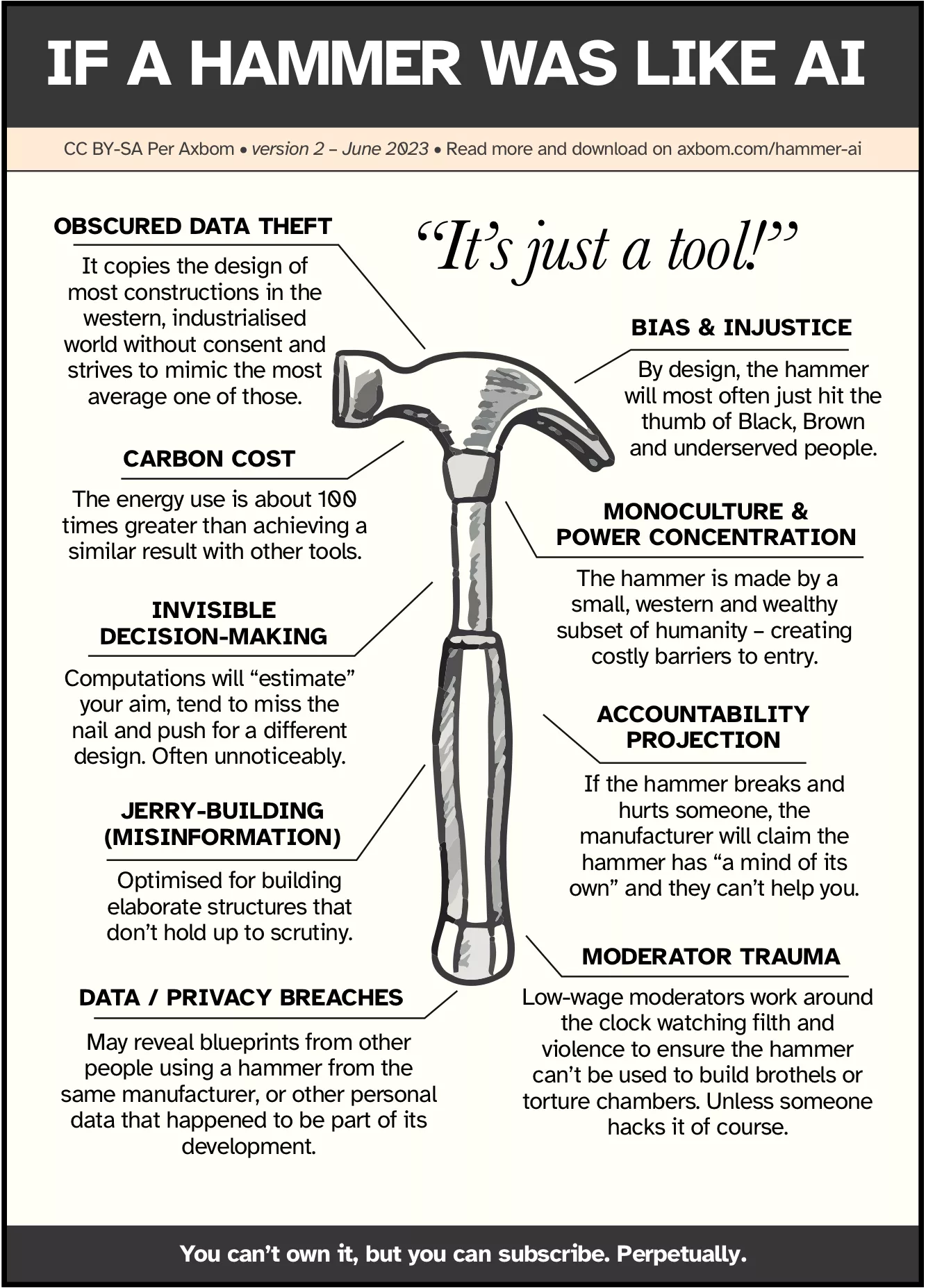
A common argument I come across when talking about ethics in AI is that it's just a tool, and like any tool it can be used for good or for evil. One familiar declaration is this one: "It's really no different from a hammer". I was compelled to make a poster to address these claims. Steal it, share it, print it and use it where you see fit.
I'll add clarifications regarding some of the topics to this thread. 👇
Regarding Monoculture. Today, there are nearly 7,000 languages and dialects in the world. Only 7% are reflected in published online material. 98% of the internet’s web pages are published in just 12 languages, and more than half of them are in English. When sourcing the entire Internet, that is still a small part of humanity.
76% of the cyber population lives in Africa, Asia, the Middle East, Latin America and the Caribbean, most of the online content comes from elsewhere. Take Wikipedia, for example, where more than 80% of articles come from Europe and North America.
Now consider what content most AI tools are trained on.
Through the lens of a small subset of human experience and circumstance it is difficult to envision and foresee the multitudes of perspectives and fates that one new creation may influence. The homogenity of those who have been provided the capacity to make and create in the digital space means that it is primarily their mirror-images who benefit – with little thought for the wellbeing of those not visible inside the reflection.
Regarding Power concentration.
When power is with a few, their own needs and concerns will naturally be top of mind and prioritized. The more their needs are prioritized, the more power they gain. Three million AI engineers is 0.04% of the world's population.
The dominant actors in the AI space right now are primarily US-based. And the computing power required to build and maintain many of these tools is huge, ensuring that the power of influence will continue to rest with a few big tech actors.
Regarding Invisible decision-making.
The more complex the algorithms become, the harder they are to understand. As more people are involved, time passes, integrations with other systems are made and documentation is faulty, the further they deviate from human understanding. Many companies will hide proprietary code and evade scrutiny, sometimes themselves losing understanding of the full picture of how the code works. Decoding and understanding how decisions are made will be open to infinitely fewer beings.
And it doesn't stop there. This also affects autonomy. By obscuring decision-making processes (how, when, why decisions are made, what options are available and what personal data is shared) it is increasingly difficult for individuals to make properly informed choices in their own best interest.
Regarding Bias and injustice.
One inherent property of AI is its ability to act as an accelerator of other harms. By being trained on large amounts of data (often unsupervised) – that inevitably contains biases, abandoned values and prejudiced commentary – these will be reproduced in any output. It is likely that this will even happen unnoticeably (especially when not actively monitored) since many biases are subtle and embedded in common language. And at other times it will happen quite clearly, with bots spewing toxic, misogynistic and racist content.
Because of systemic issues and the fact that bias becomes embedded in these tools, these biases will have dire consequences for people who are already disempowered. Scoring systems are often used by automated decision-making tools and these scores can for example affect job opportunities, welfare/housing eligibility and judicial outcomes.
Regarding Content moderator trauma.
In order for us to avoid seeing traumatitizing content when using many of these tools (such as physical violence, self-harm, child abuse, killings and torture) this content needs to be filtered out. In order for it to be filtered out, someone has to watch it. As it stands, the workers who perform this filtering are often exploited and suffer PTSD without adequate care for their wellbeing. Many of them have no idea what they are getting themselves into when they start the job.
Regarding Data / Privacy breaches
There are several ways personal data makes its way into the AI tools. First, since the tools are often trained on data available online and in an unsupervised manner, personal data will actually make its way into the workings of the tools themselves. Data may have been inadvertently published online or may have been published for a specific purpose, rarely one that supports feeding an AI system and its plethora of outputs. Second, personal data is actually entered into the tools by everyday users through negligent or inconsiderate use – data that at times is also stored and used by the tools. Third, when many data points from many different sources are linked together in one tool they can reveal details of an individuals’ life that any single piece of information could not.
If you speak French, here is a podcast episode taking you through the different topics in the hammer diagram. My French is unfortunately not good enough to follow along 😅
Osynkade kugghjul kan förklara varför det blir fel när du inte lyfter blicken.
Tidigare idag kommenterade jag nyheten att vården larmar om hur yngre söker vård i onödan, och passade på att koppla det till systemtänkande. Den texten finns nu som blogginlägg, kompletterad med min förklaringsmodell: Osynkade kugghjul.
"Att göra endast en kugge i din maskin mer effektiv kommer att utsätta din övriga organisation för oväntad press. Felbelastning och sprickor uppstår. Utan tillsyn kommer andra delar av organisationen slitas ut och plötsligt gå sönder. Människor blir utmattade och slutprodukten blir sämre än innan.
Verklig effektivitet handlar inte om att röra sig snabbare. Det handlar om att röra sig tillsammans."
Vårdens bekymmer med personer som söker vård för minsta lilla åkomma ger oss en lektion i vikten av systemtänkande. Och hur förenklingar medelst digitalisering kan slå tillbaka.
– Om vi förenklar saker så kommer människor att röra sig i den riktningen – mot förenklingen.
– Om hela organisationen inte är beredd på en ökning av användning givet en planerad förenkling så skapar vi i stället en flaskhals.
– En förenkling eller effektivisering som leder till en flaskhals kan i stället försämra det vi försöker förbättra (eller försämra en annan del av organisationen).
”Är det inte bra att vården är lättillgänglig?”
”– Jo, men vi har inte blivit fler resursmässigt. Så det här innebär att färre kan jobba med den fysiska vården, dit de svårast sjuka oftast vänder sig, säger Tuutma.”
Det finns fler saker att beröra i det här ämnet, som skälen till att personer inte längre får med sig egenvård från hemmet. Eller att vi eventuellt tappat sociala band som tillåter oss att prata om vardagsbekymmer med nära och kära i stället för en vårdchatt.
Men det viktiga jag vill förmedla här är att när någon pratar om förenklingar och effektiviseringar så finns skäl att vara skeptisk och noggrann i undersökningen av följdeffekter. En förenkling/effektivisering handlar ofta bara om att styra om ett flöde, och det är inte säkert att vi har koll på alla platser som kan svämma över.
För vet du, de problem vi har idag kommer förstås från de lösningar som byggdes igår (Senge, 1990). Och lösningar idag blir ofta någon annans problem imorgon. Att något kallas för en lösning innebär inte att aktiviteten inte också kan vara skadlig.
Tidigt i pandemin gjorde jag en systemkarta över åtgärder och deras effekter. Jag använder den ibland för att illustrera hur svårt det är att förutspå vilka kostnader en åtgärd egentligen leder till. Det är mycket man måste hålla ögonen på för att tidigt upptäcka när en förbättringsåtgärd egentligen leder till försämringar och besvär:
This year I have been consulting, teaching and… studenting 😁
I haven't been very vocal about it but alongside my day job I've been studying the remote Profile course Media, Communication and Sustainable Development at Umeå university.
The course covers different perspectives on sustainable development and what significance media, communication and journalism play when it comes to social change and sustainability.
The final assignment was two parts and I've published them on my blog.
The first paper is a critical review of an existing communication activity. In my case the Reach for Zero campaign by the Reach publishing group - an example of solution journalism. https://axbom.com/solution-journalism-reach-for-zero/
This year I have been consulting, teaching and… studenting 😁
I haven't been very vocal about it but alongside my day job I've been studying the remote Profile course Media, Communication and Sustainable Development at Umeå university.
The course covers different perspectives on sustainable development and what significance media, communication and journalism play when it comes to social change and sustainability.
The final assignment was two parts and I've published them on my blog.
The first paper is a critical review of an existing communication activity. In my case the Reach for Zero campaign by the Reach publishing group - an example of solution journalism.
Att namnge något kan öka antalet personer som blir medvetna om det som ett problem som förtjänar deras uppmärksamhet. När jag sammanställt Elementen inom AI-etik har jag fått hitta nya namn för att beskriva de problem jag beskriver.
Ett av dessa är ansvarsprojicering.
Det är inspirerat av begreppet "Moral outsourcing" men tar det ett par steg längre.