
@iamlayer8 @vincent @emilymbender
+1 for Pocket Casts. I also use filters to group different podcasts. This also means I can have two different filters with the same podcast in them.
https://blog.pocketcasts.com/2019/09/24/filters/
Posts in English
How harmful does something need to be for people to stop using it? How much do you yourself need to benefit to choose to ignore the harm done to others?
These are not always easy questions, but I think its beneficial to your own (and others'!) wellbeing to reflect on them…
https://axbom.com/ignoring-harm/
This is a great walkthrough of the ways generative AI is stealing (and storing!) content. And placing clear efforts on stealing (removing watermarks for example).
Long read, 3 parts. Entertaining and maddening. Lots of reference links.
With the ongoing lawsuit against OpenAI it’s good to boost awareness.
https://johancb.substack.com/p/sam-altman-and-the-sorcerers-stone
#DigitalEthics #AiEthics
I had an epiphany yesterday. I know some (many?) people perceive me as overly and naively critical of tech, even though I myself of course love tech and have since I started programming on my Sinclair ZX81 in 1982.
A great deal of my content often turns out to be about calling out harm done unto others. Because that is something I detest and am disappointed to see being such a big and overt part of the industry I love. Human rights issues are very dear to me.
So an unbalanced amount of what people see from me is the criticism.
What people don’t tend to see, and what I think I've been bad at internalising, are all the ways I am actually working to help people and organisations find ways of designing and developing tech that avoids and mitigates negative impact to wellbeing.
I do talks, I teach courses and workshops, and I consult for months at a time with amazing organisations that see the immediate value of efforts placed on foresight, inclusive design, risk management and monitoring systemic effects.
Organisations that truly see how they are accountable for the things they make and want to make sure they do not contribute to harms like prejudice, abuse and inequity. Who are okay with stumbling along the way but will keep moving towards that clear vision.
In the end of course most of us are just people with all the challenges of being human in many different contexts of a complex life. So when people get upset with me for calling out tech problems, I have to remember they’re not seeing all of me.
And I should perhaps do a better job of balancing my messaging.
The reason for my epiphany was that I started writing my own bio related to *maybe* producing an online course. I realised all the fun and awesome ways I am using tech to streamline my work and communicate better. A whole other side of what I’m doing that I could teach to help others improve their relationships with digital services.
And my bio certainly wasn’t reflecting the full extent of my ambitions. And just changing a couple of sentences made me see myself in a new light.
Imagine that, being stuck in my own limited perception of myself.
So here’s my concrete advice: have a look at your bio. How are you describing yourself? How is that description perhaps limiting how others, but more importantly you yourself, think about your work?
The summer is a great time to reflect. Reflecting on and changing your bio description in various places may actually change the way you approach work, and how you feel about yourself. You may want to do it together with someone else.
When was the last time you looked at and revised your LinkedIn bio?
Give it a try and let me know what happens!
P.S. About to enter my own period of summer reflection and rest so this was a good gateway to that. My intent is to take a break from digital platforms for a few weeks. I’ll obviously let you know how that goes 😅 And then my 3-week course in design ethics at Nackademin takes off in August. Yay! ❤️
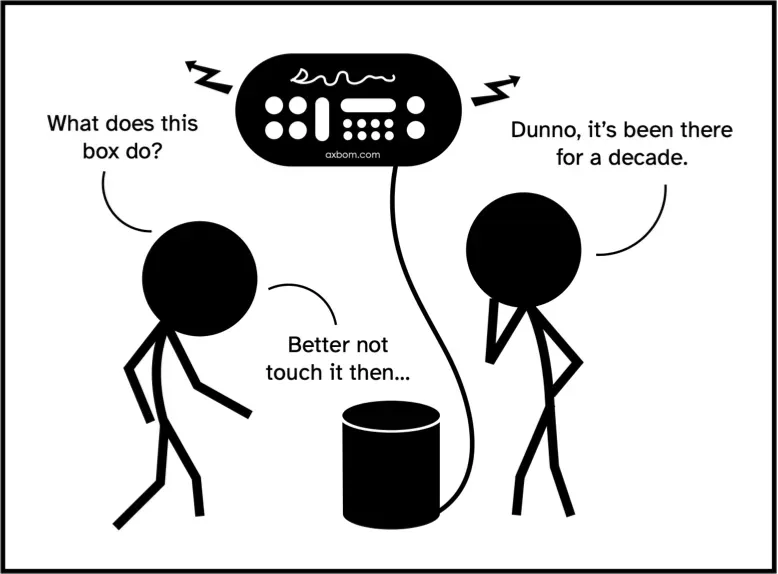
Some tasks that are being handed over to automation should arguably never have been tasks in the first place. Or should at least be revised regularly. But instead of questioning and reinventing tasks, many will now be automated to run perpetually. And with no human involved, why would someone then question its validity?
I believe this is part of the non-intuitive aspect of AI and automation, that it will actually in many instances resist change rather than encourage it.
People will forget why that machine is running and worry that cutting its power will break something.
When, in fact, it might *free* something.
#Automation #AiEthics #DigitalEthics
Some tasks that are being handed over to automation should arguably never have been tasks in the first place. Or should at least be revised regularly. But instead of questioning and reinventing tasks, many will now be automated to run perpetually. And with no human involved, why would someone then question its validity?
I believe this is part of the non-intuitive aspect of AI and automation, that it will actually in many instances resist change rather than encourage it.
People will forget why that machine is running and worry that cutting its power will break something.
When, in fact, it might *free* something.
https://axbom.com/automation-change/
#AiEthics #DigitalEthics
Your regular reminder that tech should work FOR YOU, sure, but *also* not against those who are already underserved.
En del svårsmälta sommarprat hittills...
Av de fem jag lyssnat på hittills gillar jag Jessie Sommarströms mest, tätt följd av Axel Gordh Humlesjö - som var något av det svåraste jag lyssnat på.
Jag gör en ansats att lyssna på alla och betygsätta för mig själv. Hjälper mig att förstå vad jag värderar. Och kanske vågar jag utforska varför.
#sommar #SommariP1
FYI. If you have a micro.blog account you can import your Twitter archive there, giving you online access to all your tweets (videos not included).
https://help.micro.blog/t/importing-tweets/1677
@m I've been using Raindrop for a few years now. Absolutely love it.
It's also how I share my digital ethics links on a public page:
https://raindrop.io/axbom/digital-ethics-6334413
Bra debattartikel om AI-etik i vården. Det är det område där jag ser enorm potential för att rädda liv, men också oerhörda risker med obalans i vems liv som prioriteras. Ansvarsfrågan blir fruktansvärt viktig att reda ut innan systemen tas i bruk.
David Sundemo och Sam Polesie lyfter ansvarsfrågan på ett tydligt sätt:
"Ansvarsfrågan kan exemplifieras på följande sätt; Rut genomgår en röntgenundersökning. Ett AI-system bedömer att det inte finns något avvikande och Rut får lugnande besked. Ett år senare söker hon vård igen och det visar sig att hon har en tumör i höger lunga. Vid eftergranskning framgår att tumören kunde ses redan på den första bilden. Vem är ansvarig? Är det ingenjörerna som utvecklade algoritmen, är det den som köpte in systemet, eller är det läkaren som förmedlat beskedet?"
Hur dessa system tränas blir också en nyckelfråga. Då vita mäns hälsa och kroppar länge har fått stå modell för sjukvårdens forskning så är det också denna data som många AI-system matas med. Det blir då en underrepresentation av träningsdata för personer som ofta utstår diskriminering i andra sammanhang också.
"En läkare som exempelvis bara tränar på att bedöma hudförändringar hos ljushyade blir duktig på det, men mindre bra på att bedöma förändringar hos mörkhyade. I databaser för träning av hudbedömningsalgoritmer är personer med mörk hud kraftigt underrepresenterade. Om detta fortsätter är risken stor att hälsomässiga ojämlikheter cementeras."
Jag brukar uttrycka det så här:
Hur ska en dators värderingar förändras när människors värderingar förändras över tid? Modellerna vilar nämligen ofta på decennier av fördomsfullt informationsunderlag – och oerhört begränsade underlag ur ett globalt perspektiv. Att förflytta beslutsfattande till maskiner riskerar alltså att öka beslutsfattande som är grundat i värderingar många människor vill komma ifrån.
Till sist poängterar Sundemo och Polesie okså hur läkare måste vara mer involverade i utvecklingen av verktygen. Vi riskerar annars att patienter reduceras till datapunkter som behandlas som statistiska fenomen.
Jag vill nog påstå att patienter och vårdsökande måste vara mer involverade också. Det är de som alla andras makt mest tydligt drabbar. Och då gärna de som har särskild erfarenhet av att diskrimineras och bli bortglömd i alla tekniksprång som ska förbättra världen för alla, men ofta bara gör det för ett särskilt urval.
https://lakartidningen.se/opinion/debatt/2022/08/ai-etik-en-nyckelfraga-for-etiskt-hallbar-vard/
#AiEtik #DigitalEtik #DigitalOmtanke
Is there a controlled vocabulary for AI governance? Why yes, yes there is. 🔥
@m
Exactly. I know this is a sensitive topic in the design industry, but as I’ve always coded I know and appreciate the huge benefits of something that behaves like the final product.
And I don’t think all designers should be able to do this (but to at least understand the material they are working with), but my feeling is that the deep feature set of FIgma is becoming more akin to coding than designing. Which can be alright if it creates value that is not better achieved another way, it’s just a different type of profession. And I’m an old geezer trying to make sense of the world. 😅
Really good, concise segment on the US perspective of regulating AI. And the type of AI that we should be encouraging and supporting. 👏
For more AI wisdom you should be following Dr. Joy Buolamwini and signing up for her newsletter. For those not familiar with her work she is based at MIT Media Lab and founder of The Algorithmic Justice League
@esbenrahbek Tack Esben!
@simeon This is fair. I think I'm mostly concerned about how much effort is put into high fidelity. I often do rough sketches with a pen, move stuff around, test, get feedback. Combinations of paper, digital whiteboards and Keynote (quirky I know, but also extremely fast). Then I head to HTML :)
I feel the learning curve for all of Figma's features is similar to the learning curve of learning HTML and CSS, but I do acknowledge there are collaboration benefits.
I know my process is far from "standard" 😅
As I'm reading about the ever-increasing complexity and feature-set of Figma I can't help but wonder if it wouldn't be easier if designers just learned HTML and CSS. There seems to be an awful lot of work going into creating the likeness of something (a web page) without it being that thing.
I am likely too grumpy about this.
So much good content that could've been published as HTML (a web page) is being published as PDF documents. 😭
Often great reports on important topics are published in 2-column PDFs which are just impossibly awkward to zoom and find your way in. They also suffer from low accessibility, taking up space on your computer (and in email!) and just generally being harder to find.
Now imagine that same report as a web page, nicely formatted with headings, a screen-friendly font and a width that adjusts to the phone or computer browser. And it works with screen readers and magnifying tools. You can set it up so you can send a link directly to specific sections. For extra points, you can offer dark mode and high-contrast mode to help even more people read your findings.
Honestly, let me help you make your report into a web page if you're stuck in a PDF mindset. Not really my day job, but wouldn't it be great with a service set up to help with something like this...
Image description:
Close-up of hands navigating a phone lying flat on a notebook on a table next to a coffee cup and a pen. The screen is displaying a black-and-white two-column PDF where you can see one column and part of the second column.
Title on image: Your report as a PDF – Common issues
Text on image:
- Awkward to navigate
- Low accessibility
- Fills up inboxes and hard drives perpetually
- Gets lost and is hard to find again
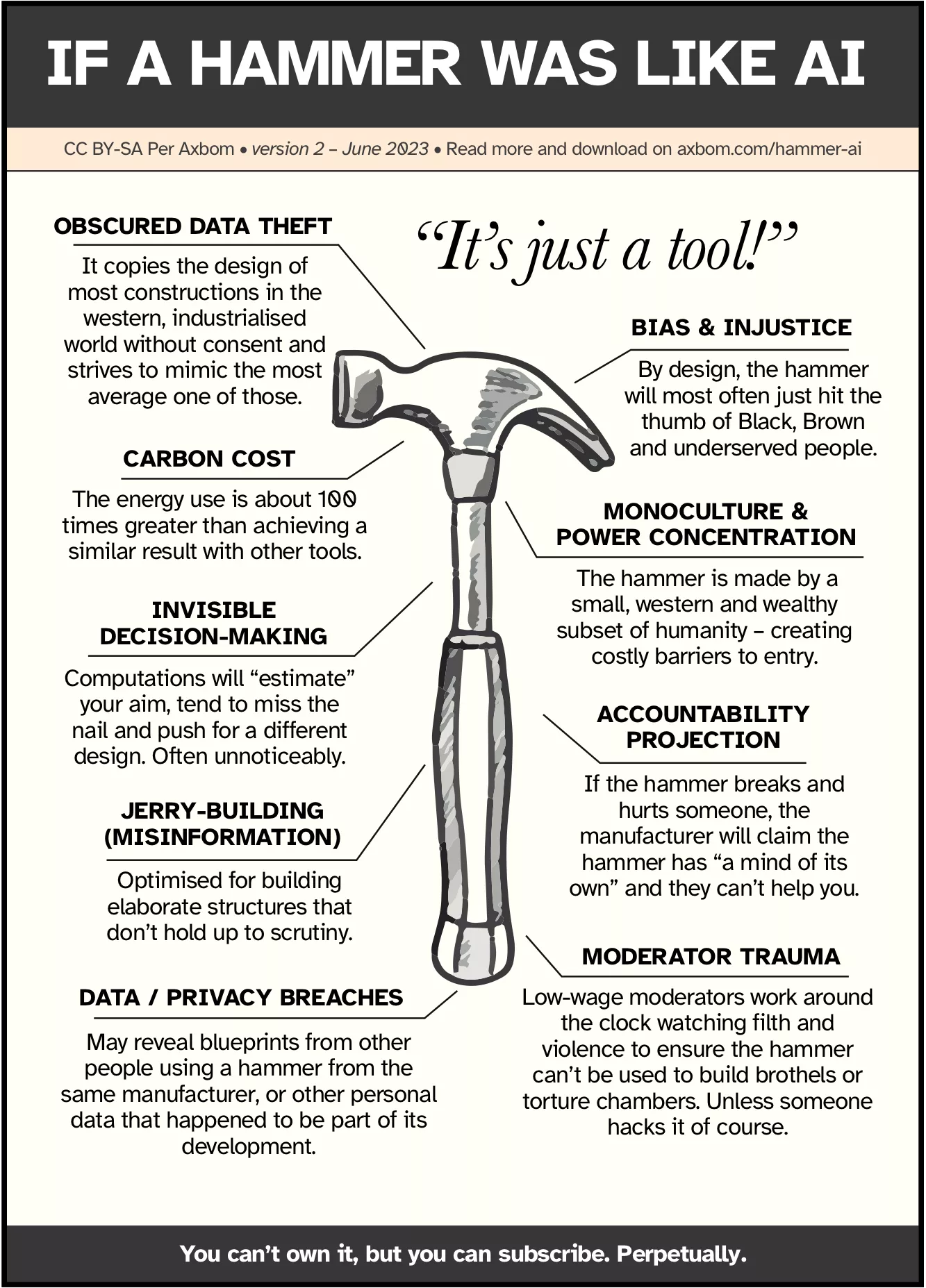
Updated the "If a hammer was like AI"-poster with a better font and some tweaks to topic texts to make them less ambiguous.
The font is Atkinson Hyperlegible, a free font designed for greater legibility and readability for low vision readers
PDF and PNG images available:
https://axbom.com/hammer-ai
#AIEthics #DigitalEthics
When you make one part of a system more efficient, or even friction-free, other parts of the system may wear out and break. What do I mean by this?
Making only one cog in your machine more efficient will put unexpected pressure on the rest of the organisation. And this can and will apply to phenomenons outside your organisation, albeit within the system you are interacting with. When external functions are taken by surprise and struggle to cope with added effort, the output of the system you were trying to improve may instead deteriorate.
I've been reading news about the effects of the crash detection feature implemented in Apple's phones and watches, and likely present in devices by other manufacturers as well. It's been shown how often these detection systems falsely trigger a call to emergency services, increasing the load on operators who are trained to take every call seriously. The number of "silent calls" to emergency services in Sweden (112) has increased by 40% in just one year. And last week the 112 service released data from an investigation saying that long wait times _may_ have contributed to 5 deaths last summer.
There is no way of determining the phone feature was a contributor to this finding. But it certainly wasn't of help to the stability of the system. And should raise alarms for continued operations with no maintenance efforts.
Driving innovation through compassion for me means:
* seeking counsel with the organisations/people you are targeting and affecting,
* applying strategic foresight to identify these types of issues before they happen,
* monitoring and taking responsibility for – and being prepared to walk back – ideas that didn't work out,
* working for systems where cogs are monitored and built for harmonious movement rather than disconnect.
Yes, we can find cases where these features have saved lives. But it's unclear at what cost this change is happening, or even how crucial this exact feature was in those cases. It's likely relevant to consider if the ownership of a specific phone should be what determines who receives attention.
Likely there are many ways to address this issue. Meanwhile, accountability is largely missing for the changing work environment of emergency call operators.
IMAGE DESCRIPTION:
Three aligned, interconnected cogs with labels.
Cog number 1 (in good condition).
Label: Phones and watches auto-calling emergency services
News clipping: Skiing triggers crash detection on latest Apple Watch and iPhone
Cog number 2 (showing wear and tear).
Label: Increase in "silent calls" due to false emergencies
News clipping: Huge increase in misdials to emergency services
Detail: Up 40% in Sweden in one year.
Cog number 3 (showing wear and tear).
Label: Longer wait times for people in real emergencies
News clipping: 5 people died waiting several minutes to reach emergency services
#DigitalCompassion #SystemsThinking #ResponsibleInnovation
@steveportigal Oh wow I had no idea they were shutting down.