
↪ Replying to @MrAlanCooper
@MrAlanCooper @markusandrezak I’ll see you soon in Lyon, Alan!
↪ Replying to @MrAlanCooper
@MrAlanCooper @markusandrezak I’ll see you soon in Lyon, Alan!
↪ Replying to @unknown
@5u5anCarey No time. I bought the alien figures. But it is very much my own style :)
@5u5anCarey But if you’re asking about the composition that’s all me ;)
It’s safe to say that the field of psychology has some cleaning up to do:
”Professor Philip Zimbardo used the media to turn his Stanford Prison Experiment into the best-known psychology study of all time. It was a sham.”
medium.com/@benzblum/the-…
Another listening recommendation. ”The marshmallow test is one of the most well-known studies in all of psychology, but a new replication suggests we've been learning the wrong lesson from its findings for decades.”
overcast.fm/+CuhumMpu4
Please listen to this episode of Radiolab with a walkthrough of the famous Milgram experiments. In this case it's not about poorly performed experiments but many years of misinterpretation (over-simplification).
overcast.fm/+J5QRFk
ht @jocke
Boom. 800 scientists call for scrapping the concept of 'statistical significance'.
nature.com/articles/d4158…
via @cjforms
It appears in sociology, criminology and psychology textbooks, and in the media as a truism – but what if we take a closer look at the research around "the bystander effect"?
aeon.co/essays/it-look…
The replication crisis is good for science. We just need to acknowledge it and talk about it more.
theconversation.com/the-replicatio…
Bystander Effect debunked
x.com/lisaehlin/stat…
More on the weaknesses of the bystander effect (paywall):
wsj.com/articles/bysta…
Backfire effect. That's when people's opinions are contradicted by facts, but the opinion doesn't change - instead it only grows stronger.
But this review suggests the backfire effect is in fact quite rare, and not the norm.
fullfact.org/blog/2019/mar/…
If you clench a pencil between your teeth, this will force a smile that makes you feel more positive emotions.
Hmmm. But will it really? A registered replication report (RRR) appears to debunk this common notion from social psychology.
theeconomyofmeaning.com/2016/08/20/fam…
x.com/axbom/status/9… x.com/axbom/status/9…
People set goals to walk 10,000 steps today because a Japanese watch company in the 1960s made the wearable step-counter manpo-kei, which translates as “10,000-step meter”. The number 10,000? It just ”felt” good. And now it feels good to Fitbit et al.
theguardian.com/lifeandstyle/2…
More debunked behavioral truths.
Under scrutiny: Loss Aversion.
"The popular idea that avoiding losses is a bigger motivator than achieving gains is not supported by the evidence"
via @JesperBylund
blogs.scientificamerican.com/observations/w…
A paper mill is a company that fabricates scientific papers on demand. They sell these to people who need to have a scientific paper published in an international journal. @MicrobiomDigest and team found >400 papers seemingly part of a mill.
scienceintegritydigest.com/2020/02/21/the…
ht @beantin
Really long podcast but so many good nuggets on bad science in the medical field, on the "10,000-Hour Rule", training and also parenting. An interview with David Epstein, Author of Range and The Sports Gene.
overcast.fm/+NmiSH8ZM8
'Stockholm syndrome' is a misogynistic invention by a psychiatrist who found his authority questioned. And which was then popularised by the media. As explained by @jessradio in her book about domestic abuse: 'See What You Made Me Do'.
x.com/sezmohammed/st… twitter.com/sezmohammed/status/125…
This tweet was detached from the thread. Adding it here so you don't miss it.
x.com/axbom/status/1… x.com/axbom/status/1…
Interesting and relevant recent interview with @rcbregman, author of Humankind - on @mehdirhasan's Deconstructed. They talk about some of the problematic experiments mentioned earlier in this thread (Stanford Prison, Milgram) and more.
overcast.fm/+dcvDvcqYc
Also mentioned in the Deconstructed podcast is how the fictional(!) Golding book Lord of the Flies has contributed to ideas of inevitable human destructive behavior.
This story shows another, real-life, outcome: theguardian.com/books/2020/may…
”Studies in top science, psychology and economics journals that fail to hold up when others repeat them are cited, on average, more than 100 times as often in follow-up papers than work that stands the test of time.”
theguardian.com/science/2021/m…
Keeping an eye on machine learning papers. x.com/random_walker/…
Sometimes replication is impossible because the original study is based on fake data. This debunking of Dan Ariely studies (yes, plural - read the full article) is worth your time.
buzzfeednews.com/article/stepha…
"Something is wrong with science that’s causing established results to fail. One proposed and long overdue remedy has been an overhaul of the use of statistics."
m.nautil.us/issue/74/netwo…
This long-read by @aubreyclayton on how statistics and eugenics are intertwined is the perfect addition to this multi-year thread on misleading science. Highly recommended.
via @mer__edith
m.nautil.us/issue/92/front…
"An eight-year-long study reveals that only about half of early-stage cancer experiments are able to produce the same results as the initial experiment."
smithsonianmag.com/smart-news/its…
"What does the research say?"
When people repeatedly ask this it seems they are asking "What are the facts?".
But shouldn't they also ask:
* Who paid for the research?
* Who performed the research?
* Who was part of the research?
* Has it been replicated?
🤔
In 2010 the term "replication crisis" was coined when scientists kept finding that the results of many scientific studies are difficult or impossible to replicate/reproduce on subsequent investigation, either by independent researchers or by the original researchers themselves.[
Here's the Wikipedia article on that term, replication crisis.
en.wikipedia.org/wiki/Replicati…
Here's an interesting article from 2015 regarding this phenomenon: Scientists Replicated 100 Psychology Studies, and Fewer Than Half Got the Same Results
smithsonianmag.com/science-nature…
Although all scientific fields are under scrutiny, psychology is at the center of the controversy and social psychology specifically.
I find this interesting because I attend conferences where many of these popularised social psychology experiments are at the heart of the message from many speakers providing advice on how to design for humans.
My fear is that designers place too much trust in the work of others, essentially drawing conclusions about how to design - based on studies that can not be replicated. Thus turning the design itself into a huge [unethical] social experiment...
That's all for now. :)
The oft-quoted ”nudge” example of making hotel plates smaller to make people consume less food is dangerous because:
1) It assumes all people should consume less.
2) It does not follow @R_Thaler’s rule of transparency.
3) It is also wrong.
theconversation.com/do-smaller-pla…
It turns out all the studies claiming small plates lead to less consumption come from the same research group, one that happens to be under scrutiny for self-plagiariam and data misrepresentation.
theguardian.com/science/head-q…
I am however confident I will, for many years to come, witness speakers on stage claiming the plate - consumption causation and then using that as evidence of some unrelated design solution being the way to go.
Another important article, this time on medical science: Evidence-Based Lies.
medium.com/@BlakeGossard/…
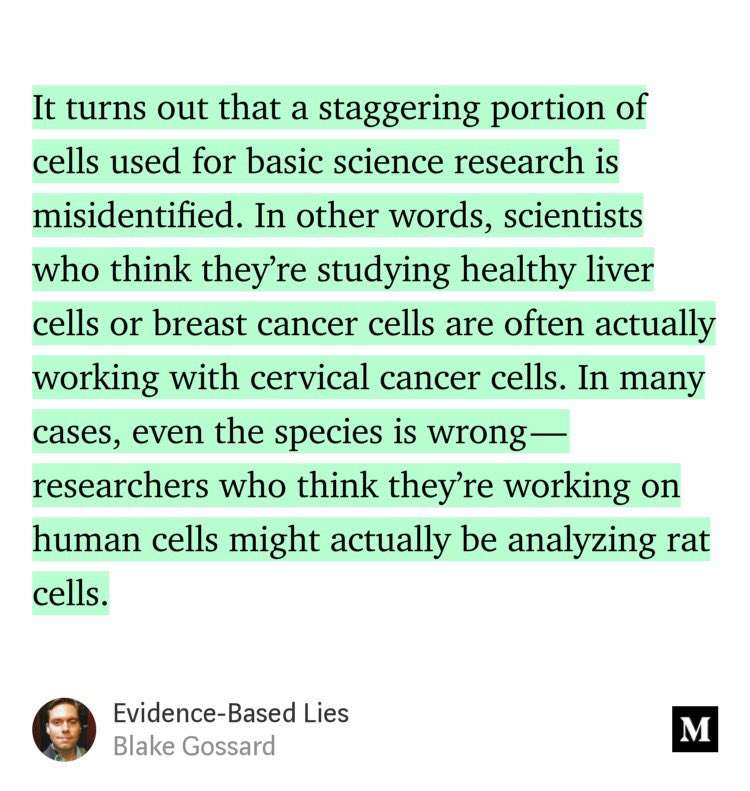
Noteworthy quote from this article.
”News headlines abound proclaiming that new “data” support this or that position. In many cases, these “data” are derived from surveys, which are highly susceptible to basically every bias known to science.”
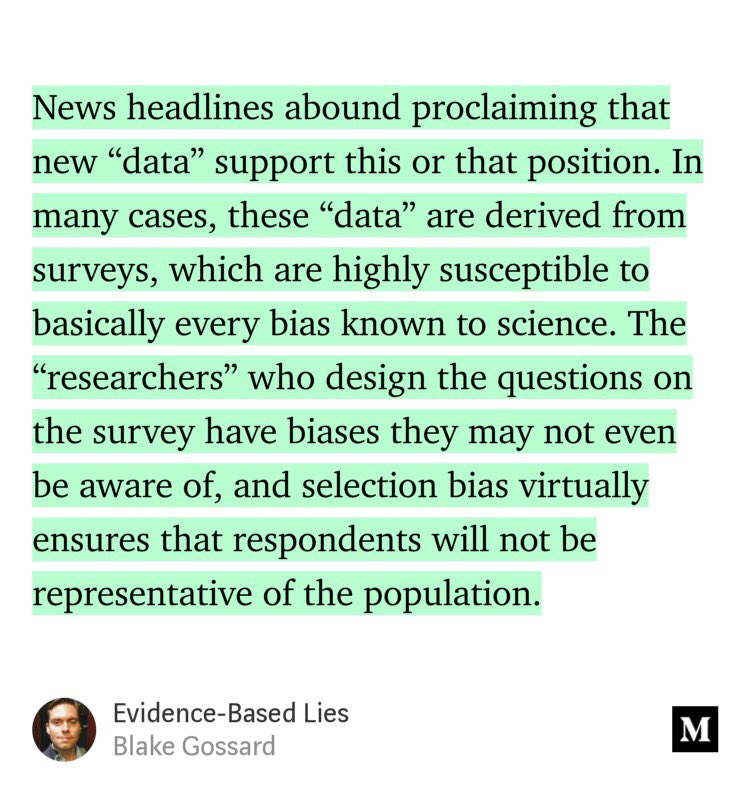
Another one for the mix, on the lack of insights about cross-cultural psychology and on the dangers of assuming human traits are global and ageless. ht @letterpress_se
theconversation.com/how-knowledge-…
The problem with Science. Good podcast from @guardianscience weekly. overcast.fm/+F8mLIo2DM
Another must-listen podcast A Neuroscientist Explains: psychology’s replication crisis overcast.fm/+MFGeMgJbg
↪ Replying to @nattchah
@nattchah @WIAD_Zuerich @MaevisConsult @WIADToulouse So many conferences to keep track of! Looking like an excellent day in Switzerland, a country I've never visited.
@nattchah @WIAD_Zuerich @MaevisConsult @WIADToulouse Although many have assumed that's where I'm from, since the difference between Switzerland and Sweden seems to be hard to grasp for quite a large number of people when I'm off travelling. 😂
Election year in Sweden. I will be tidying up this page on How to Vote over the coming months. I will also be looking for translators to more languages. Fact checkers and feedback artists are welcome. howtovote.se #val2018 #dinrost
↪ Replying to @markusandrezak
@markusandrezak @MrAlanCooper This is sooo good!
↪ Replying to @WIAD_Zuerich
@WIAD_Zuerich @nattchah @MaevisConsult Haha, well done! Now a speaker spot would be lovely consolation prize :)
↪ Replying to @WIAD_Zuerich
@WIAD_Zuerich @zeplin_io Good clue. Makes me think of Hotjar, but I haven’t figured out 1917 then.
↪ Replying to @WIAD_Zuerich
@WIAD_Zuerich My guess: Zeplin @zeplin_io
@WIAD_Zuerich @zeplin_io Because Ferdinand von Zeppelin was born in 1917.
It's as if every startup now is founded as a solution to try and correct the negative impact caused by previous startups. How about we just stop for a moment and think about that...
↪ Replying to @dweinberger
@dweinberger It’s perfectly ok not to remember all the fans ;). I did translate the first manifesto as well back in 2005, and it has led to many rewarding conversations since, so thank you for that.
Been noticing some sad use of stock photos lately. It’s beginning to bother me in a big way and, I realize, subtracting from my trust in the source.
Reminder: Not every article needs a picture. theoutline.com/post/2485/not-…
Found reason to re-read the New Clues (following on the Cluetrain Manifesto) by @dweinberger and @dsearls.
102. Yeah, the Internet hasn’t solved all the world’s problems. That’s why the Almighty hath given us asses: that we might get off of them.
Go read newclues.cluetrain.com
@dweinberger @dsearls For my Swedish followers: of course I translated it!
axbom.se/cluetrain-nya
↪ Replying to @dweinberger
@dweinberger I agree. It truly is interesting considering how many are now arguing that humans today are more reminiscent of cyborgs described in mid-1900’s science fiction. And being drained of empathy... behavioralscientist.org/the-assault-on…
↪ Replying to @glwulff
@DisobeyToCreate Those could very well be the most important steps towards a mind at peace.
↪ Replying to @belola
@belola My idea is to only schedule 6 tasks on 9 blocks per day, precisely to have time for both rest and catch-up :) Usually one block per day is about rebooting the brain.
@belola Granted, this is much easier for me as a freelancer deciding I do not work 8 hours a day.