
@newslettrs I am writing a blog post recommending different services for managing newsletters. Do you have any information on future pricing models/tiers or will your service be always free?
Also, would it be possible to add an Invite Code in the post?
Tagged: Twitter
↪ Replying to @Feb30Games
@Feb30Games Aren’t we always? 😉 But I would not have believed the size of this one.
↪ Replying to @themitak
@themitak Well yes, real science with a humorous twist. :)
en.wikipedia.org/wiki/Ig_Nobel_…
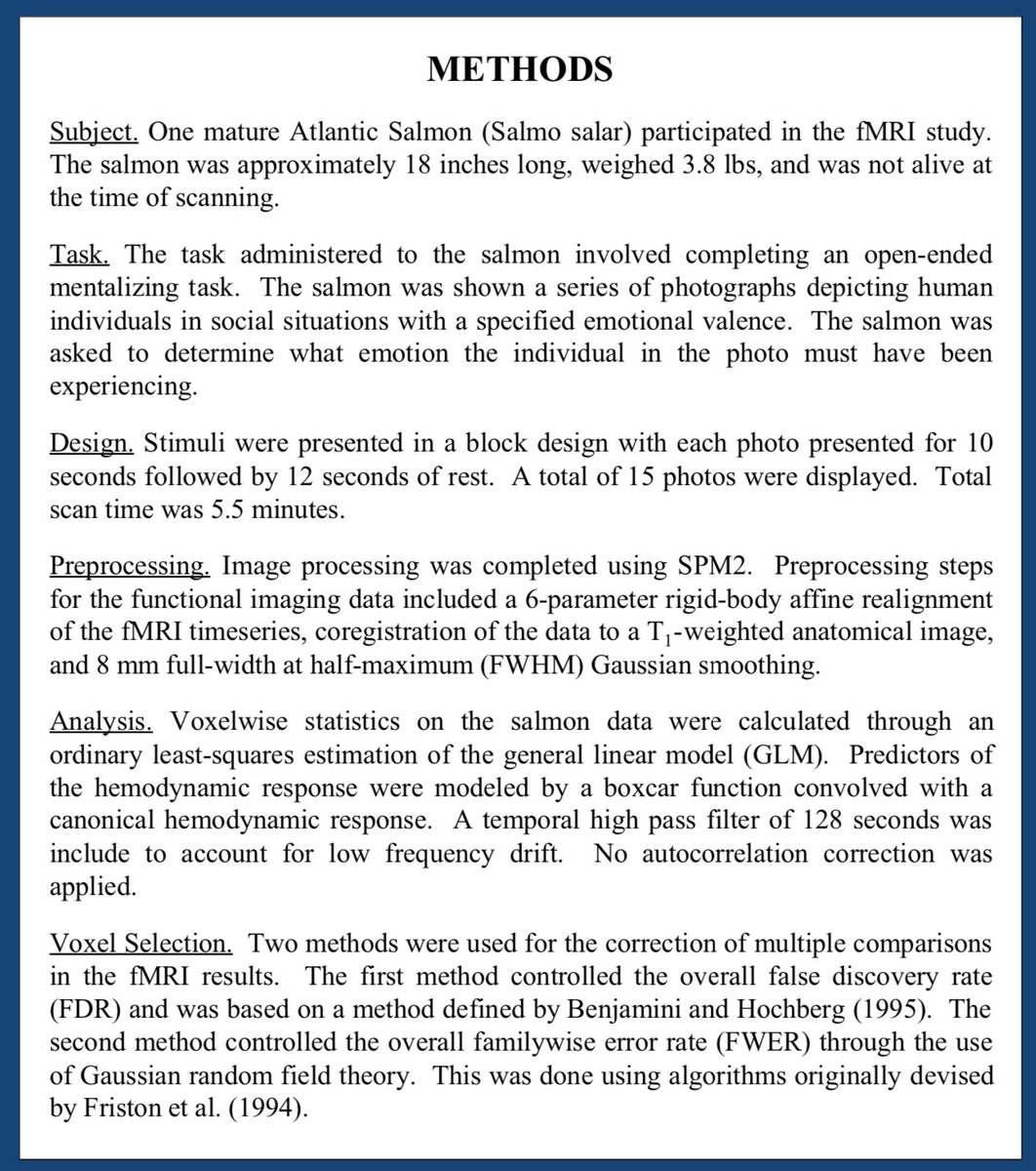
1) In 2008 a salmon (yes the fish) was put through an MRI scanner. The salmon was shown a series of photographs of humans in social situations, and asked to determine the emotion of the person in the photo (yes, really).
2) Running the data through SPM processing showed 3 significant voxels aranged along the midline of the salmon's brain.
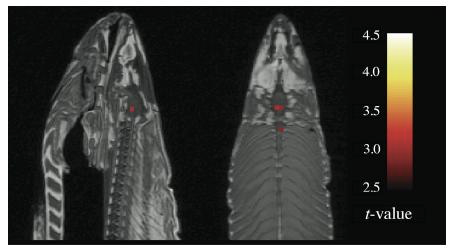
3) Without running through multiple comparisons correction (which isn't always done) one could conclude that that the salmon was in fact reacting to the photographs.
4) Here's another fact about that salmon though: it was dead and frozen at the time of the scan.
The experiment was really just a test of the machine. After testing with a pumpkin and a Cornish game hen, they settled on the fish, which had several types of tissue.
5) As the story goes, the lead author of this study, Dr. Craig Bennett had headed into the store first thing in the morning and proclaimed:
"I need a full length Atlantic Salmon. For science."
6) It was not until after a long while, when the another author of the study was running a seminar on how to properly analyze fMRI data, that the significance of the salmon data became a useful example. The salmon study was born.
7) If you do a lot of tests, at least some of them will come out positive, even if they are not real. These are called false positives, and they are something you really want to watch out for.
8) To be clear, the salmon study doesn't show that fMRI is bogus. It shows the huge importance of correcting your stats.
There are good and bad ways of doing all science.
9) When the poster for this study was presented, between 25-40% of studies on fMRI being published were NOT using corrected comparisons. But by the time these authors won the Ignobel Prize, that number dropped to 10%.
That salmon is a hero.
10) Reminder: when we see images with areas of the brain in bright colors, that’s not necessarily telling us that one part of the brain is active and the rest isn’t. They’re probability maps. They show the likelihood of activity happening in a given area, not proof of activity.
11) Colorful brain images have powerful persuasive powers. As does most stats.
It's just generally good advice to understand what you're looking at.
12) Here's more info on when they won the IgNobel Prize: blogs.scientificamerican.com/scicurious-bra…
And please also read this interview with two of the authors: it's brilliant:
boingboing.net/2012/10/02/wha…
Craig Bennet is also on Twitter: @prefrontal
13) Moral of the story: don't go fishing unless you' re prepared to not catch any fish.
prefrontal.org/files/posters/…
14) If you enjoyed this thread you may also appreciate my thread on the replication crisis: x.com/axbom/status/9…
Wow! So happy about the interest in this brilliant and funny example of science and the illusiveness of data.
If I've piqued your curiousity about my reflective reasonings you might want to try my newsletter: Pandamonium 🐼
Have a great day. 🙌
axbom.eu/newsletter/
16) To everyone saying that scanning live salmon wouldn't work anyway, it has been done :)
discovermagazine.com/mind/fmri-scan…
17) To be even more clear: fMRI does not measure activity in the brain. You'd need electrodes implanted in the brain to do that. It measures magnetic disruption in the brain, based on oxygenated and deoxygenated blood having different magnetic properties. Hence false positives.
18) "There's all kinds of noise that gets entered into the signal. It'll pick up your own heart beating. We once had a lightbulb going bad in the scanner suite that was introducing specific signal in our data set. You have to get enough data [...] to separate signal from noise."
19) "More than a couple papers have been sesationalistic. There have been comparisons of Republican and Democratic brains. That's ridiculous and it's a misuse of fMRI."
Do read the interview with the authors if you didn't already.
boingboing.net/2012/10/02/wha…
I scribbled down some thoughts on the tech addiction debate.
axbom.blog/tech-addiction/
↪ Replying to @unknown
@vareservoir @uxpodcast Thank you for this! I reacted exactly the same way to that "paternalistic" objection.
Keep your IoT devices on a separate WiFi network from your computers and smartphones. Obviously everyone knows how to do this.
zdnet.com/article/fbi-re…
Gah this is soooo weird to me, and also really valuable to understand these basic differences. x.com/fitzsimple/sta…
The story to explore here seems to be why it took so long for Apple to explain this...
#digitalethics
techcrunch.com/2019/12/05/app…
↪ Replying to @d8en
@d8en @UXTweets Exactly! And that would imply that "lovable" isn't a general requirement from the start 😊
↪ Replying to @d8en
@d8en @UXTweets Maybe, or I was in a weakened state of mind when I read it. 😊 It does remind me of how ”delight” pops up often in UX, while delight is not necessary for something to be useful or valuable. That word has also been extensively debated, as our industry loves to dissect words :)
↪ Replying to @d8en
@d8en @UXTweets I believe MVP is always dangerous territory. As a term it often confuses more than it helps. For myself it relates to making just enough to test a hypothesis and learn from it. So whether or not something needs to be lovable depends on what you’re trying to learn.
@d8en @UXTweets So if there is no intent to learn and/or learning does not happen, there is no MVP. In my mind, ”viable” relates not to robustness but to the ability of learning enough. And it’s possible what you’re trying to learn is if ”lovable” is important for a specific product.
@d8en @UXTweets I’m personally at odds with the definition of MVP that the article seems to put forward so I don’t feel like I’m helping. 🤨 The dating/marriage metaphor didn’t work for me either.
@d8en @UXTweets To sum up, I think if we focus on co-creation and inclusion, we won’t need to assume what ”lovable” entails for someone else. Instead we’ll have a common focus on value-creation, which may or may not include someone’s definition of ”love”.
In the name of efficiency and cost-savings, @McKinsey recommended cutting spending on food for migrants, as well as on medical care.
propublica.org/article/how-mc…
↪ Replying to @palace
@palace Lite som Consequentialism då? en.m.wikipedia.org/wiki/Consequen…