
Important point about "vulnerable people" is that it's not inherent qualities that makes anyone vulnerable, but rather how someone is treated, or ignored, by society and those with power and privilege.
It's primarily about power imbalance and prejudice, not intrinsic ability.
Tagged: Twitter
In a two hours I will start watching Star Wars: The Rise of Skywalker with my oldest son, and I'm suddenly struck with the weight and gravity of that.
For me, it's huge. These movies have always been with me. Final episode people. I have to sit down. Oh, I am...
↪ Replying to @beantin
@beantin @jmspool @uxpodcast I love the "No" parts of that transcript. 😂
"Jared says no" is my new "talk to the hand".
↪ Replying to @jmspool
@jmspool @beantin Awesome, I was wondering if you did that in your head or quickly hit a calculator. Very impressed by your math skills!
↪ Replying to @beantin
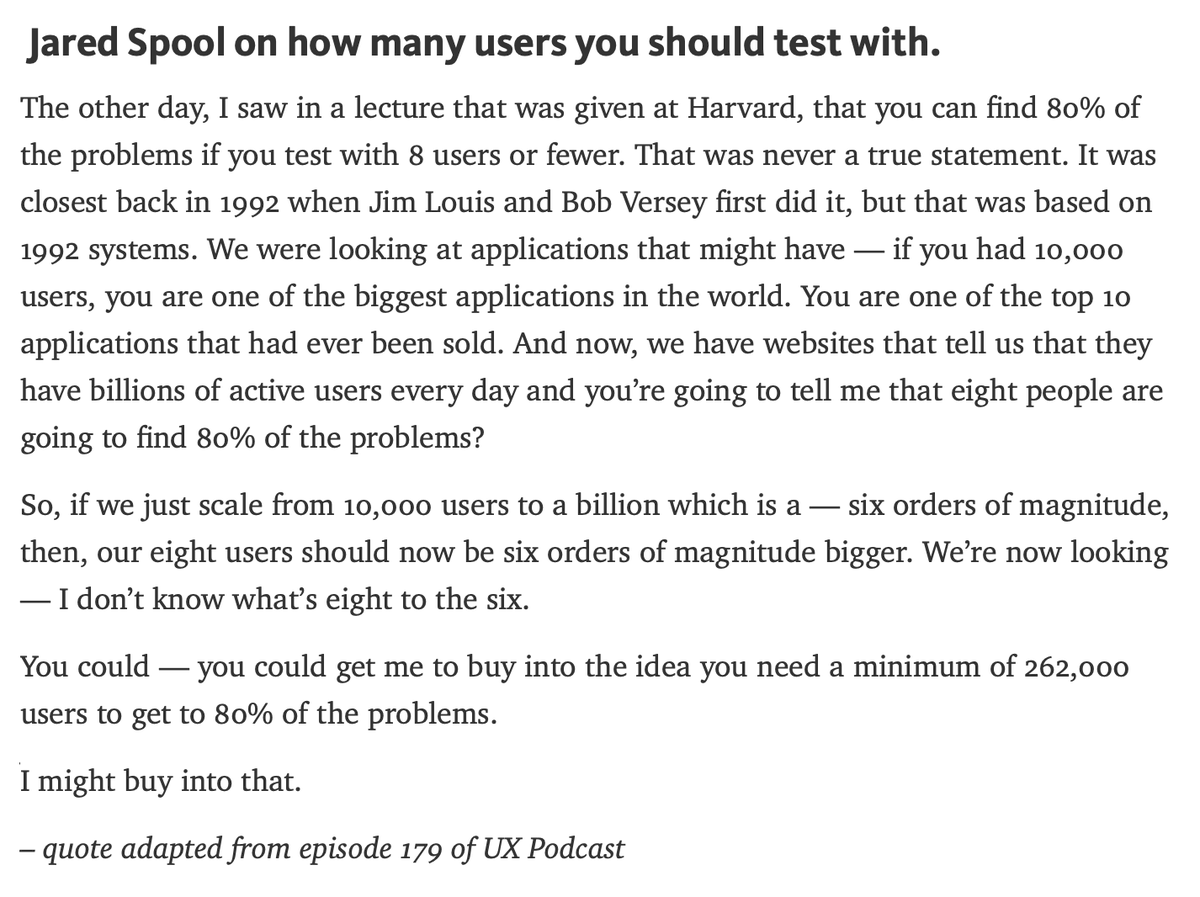
@beantin @jmspool I made a Jared quote from that! 😀 @jmspool
telegra.ph/Jared-Spool-on…
↪ Replying to @unknown
@m8rt Thank you! This is what @waxle sent me as well.
@m8rt @waxle This image is lovely.
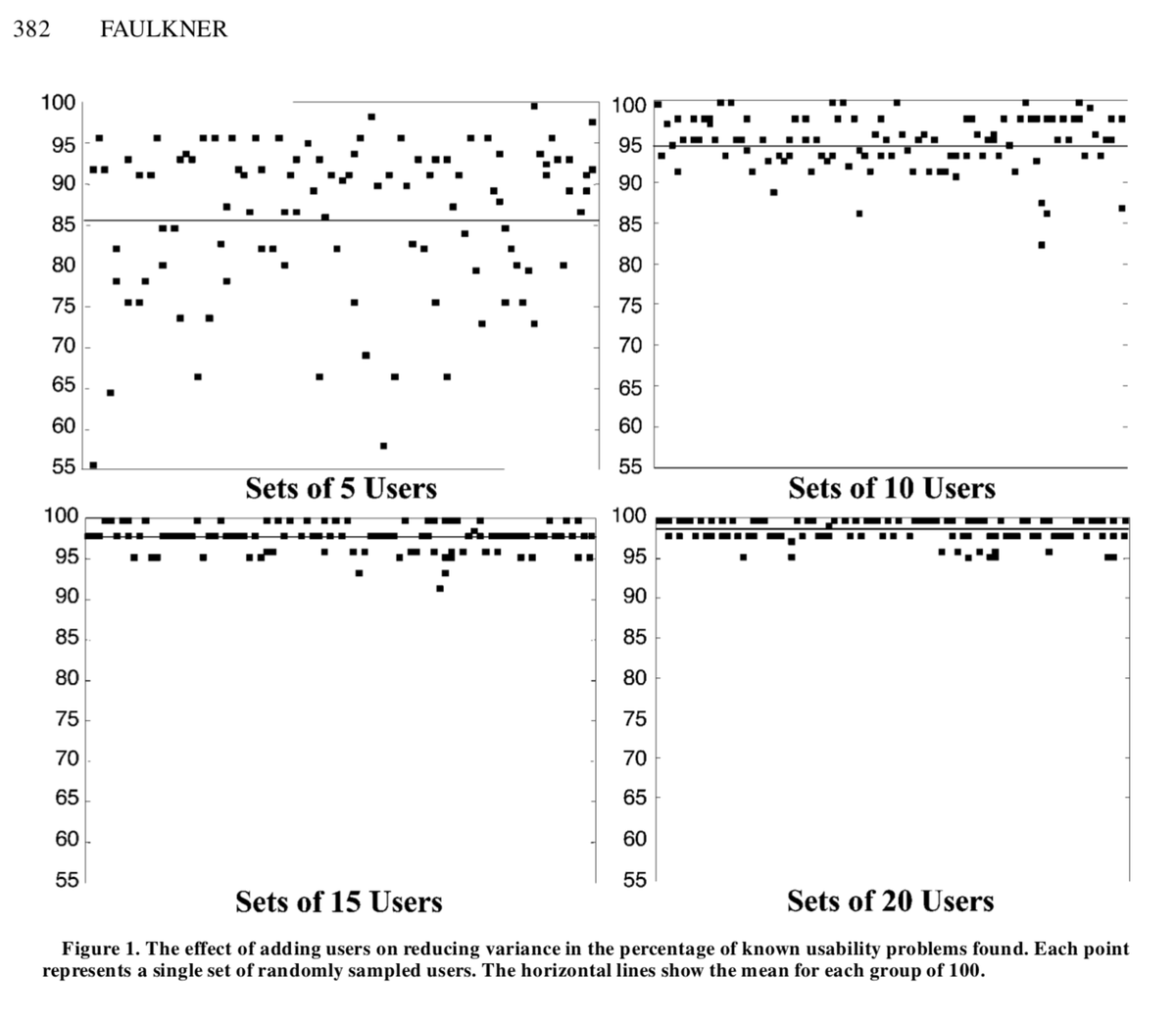
Has anybody written a good take-down of the "Testing with 5 users is enough" fallacy?
#usability
↪ Replying to @Silanota
@Silanota Gah, thanks for that Silanota. Will append a note when I'm at my computer.
↪ Replying to @unknown
@iamalsoandy Thank you for reading and sharing Andy 🙏
↪ Replying to @unknown
@heather_ia Great suggestion, thank you Heather!
1) In Digital Compassion I outline seven ways in which people experience negative impact from tech and digital services. Number six is what I call ”neglect of ecosystem”.
2) "Neclect of ecosystem" is harm based on the failure of an organisation to assume responsibility for people occupying the extended ecosystem necessary for the development and use of its services and products.
3) For example, many thousands of miners in the Democratic Republic of Congo work each day to excavate cobalt by hand, for the benefit of lithium-reliant companies such as Apple, Alphabet (Google), Microsoft and Tesla. Roughly 60% of the world's cobalt originates in DR Congo.
4) Many of these miners are children working extremely dangerous mining jobs at the expense their educations and futures. They are being regularly maimed and killed by tunnel collapses and other known hazards common to cobalt mining in the DRC.
5) A US lawsuit in Washington DC is now being brought against several tech companies, arguing how they have failed to acknowledge and protect child laborers. Children are undoubtedly part of the supply chain needed for the everyday devices these companies profit from.
6) On behalf of 14 parents and children from the DRC the companies are accused of aiding and abetting the mining companies that profit from child labor in dangerous conditions, that ultimately has led to death and serious injury.
7) I encourage you to read the lawsuit. But be warned that it contains many heartbreaking stories and images of children whose legs have been crushed by collapsed tunnels and falls. One child was, without warning, shot in the back by a guard.
(Links at the end)
8) Microsoft has stated that ‘tracing metals such as cobalt up through multiple layers of our supply chain is extremely complex.’ Yet, compared to the supply chain due diligence that many companies have started to develop in relation to 3T and gold, cobalt is no more difficult.
9) Many of these companies claim to have a zero tolerance policy when it comes to child labor in their supply chains. They have not provided details of investigations and checks that they have undertaken to identify and address child labor in their cobalt supply chains.
10) On March 3, 2017 it was reported that Apple had temporarily suspended purchasing DRC cobalt from Huayou Cobalt because of continued documentation that young children were performing hazardous work, and Huayou Cobalt was indifferent to this.
11) But, in Apple Supplier Responsibility 2018 Smelter and Refiner List, Apple continues to list “Zhejiang Huayou Cobalt Co., Ltd.” as a supplier of DRC cobalt and claims to have conducted a “third party audit.”
12) "Apple, Microsoft, Dell, and Huayou Cobalt may manipulate the various middlemen of their supply chain to deceive and distract the public, but the parties remain participants in a 'venture' to ensure that [they] will have a steady supply of cobalt from Huayou Cobalt" — lawsuit
13) The lawsuit does its due diligence in outlining the exploitation of DRC starting with 16th-19th century slave trade, King Leopold's forced labor and terror for extracting ivory and rubber, finishing on the new wave of tech exploitation of the powerless, starving Congolese.
14) From the lawsuit again: "Defendants know and have known for a significant period of time the reality that DRC’s cobalt mining sector is dependent upon children, with males performing the most hazardous work in the primitive cobalt mines, including tunnel digging."
15) "These boys are working under stone age conditions for paltry wages and at immense personal risk to provide cobalt that is essential to the so-called 'high tech' sector,dominatedb y Defendants and other companies."
16) "For the avoidance of doubt, every smartphone, tablet, laptop, electric vehicle, or other device containing a lithium-ion rechargeable battery requires cobalt in order to recharge."
17) The action is brought on behalf of the plaintiffs themselves but also all other similarly situated current and former child workers. A fund is requested to fund appropriate medical care for Plaintiffs and members of the class who were injured while mining cobalt.
18) I also want to mention that being exposed to cobalt is itself hazardous. A respiratory disease caused by exposure, cobalt lung, is a form of pneumonia which causes coughing and can lead to permanent incapacity and death. This is why it's one of the worst forms of child labor.
19) There is a compelling case outlining how it is clear that the companies are well aware of the child labor, giving examples of programs that have been announced in the name of human rights allowing "people to anonymously voice concerns in their local language".
20) Again, from the lawsuit: "Apple and the other companies are relying on largely illiterate, desperately poor, and exceedingly vulnerable people to figure out Apple’s complaint mechanism and report supply chain violations when they certainly cannot afford ->
21) personal computers or iPhones and they do not have internet or cell phone access to connect to the outside world within the context of a violent regime that does not tolerate dissent and an unregulated industry that could retaliate with impunity against any whistleblowers."
22) Before I start sharing links I want to make something abundantly clear:
- If you build apps, you are reliant on cobalt-mining for the functioning of those apps.
- If you own a phone you are reliant on cobalt-mining
Many of us share in the responsibility.
23) What you can do:
* Buy used phones and laptops
* Keep your phones and laptops for longer
* Bring your old phones and laptops in for recycling and re-use
* Help create awareness of ongoing exploitation
* Hold exploitative companies accountable
24) Source: Class complaint for injunctive relief and damages
iradvocates.org/sites/iradvoca…
"Defendants Apple, Alphabet (Google), Dell, Microsoft and Tesla are knowingly benefiting from and aiding and abetting the cruel and brutal use of young children in Democratic Republic of Congo"
25) US Department of Labor, List of Goods Produced by Child Labor or Forced Labor: dol.gov/ilab/reports/c…
26) THE COBALT PIPELINE
Tracing the path from deadly hand-dug mines in Congo to consumers’ phones and laptops (from 2016)
washingtonpost.com/graphics/busin…
27) Is your phone tainted by the misery of the 35,000 children in Congo's mines?
"My field research shows that children as young as six are among those risking their lives amid toxic dust to mine cobalt for the world’s big electronics firms"
theguardian.com/global-develop…
28) CNN Freedom Project: Child miners face death for tech (from 2013)
thecnnfreedomproject.blogs.cnn.com/2013/06/26/chi…
29) Companies respond to questions about their cobalt supply chains (from 2016)
washingtonpost.com/business/econo…
*Neglect
30) Brief educational video from @FreetheSlaves
Conflict minerals from the Democratic Republic of Congo (DRC) find their way into the supply chain of products we use every day—like laptops, cell phones and batteries. Slavery also exists.
vimeo.com/freetheslaves/…
↪ Replying to @Beastankar
@Beastankar Jag borde kanske ha varnat bättre.
When you build something and allow this to happen, at this scale, you’re building it wrong.
#digitalethics
medium.com/@sloane_ryan/i…
↪ Replying to @JohanOrdf
@JohanpolisBD @c_dahlstrom Förstår att det kan upplevas som mycket tid. Jag känner själv att det är bra att vara nyfiken (inte kritisk) och ställa öppna frågor, av typen:
* Vad får du hjälp med?
* Vad gör att du känner förtroende (trots att forskarna menar att det är direkt vilseledande)?
* Ser du risker?
@JohanpolisBD @c_dahlstrom Det här är förstås också en bra början: vof.se/utmarkelser/ti…
↪ Replying to @JohanOrdf
@JohanpolisBD @c_dahlstrom Du ber dem lyssna på podden och ger dem några veckor att smälta den. :)
open.spotify.com/episode/04CzhX…
↪ Replying to @unknown
@AngelosArnis Write more. Even more blogging. Focus on my newsletter. Start up an e-mail discussion group.
Basically party like it's 1999.
We are always fighting so many psychological effects and biases that very few set aside time to check if they are even real.
Ironically, this is already called the Don Quixote effect. And so we come full circle.
I'm not sure it gets better than this.
(Ambiguity of my assertion intended.) x.com/catherine39572…
But remember, you also have to acknowledge that the backfire effect may, in fact, be rather weak.
x.com/axbom/status/1…
I am so on board with this thread.
And of course now I have to do the same with my students! Brilliant idea.😀 Keep an eye out in February for #designethics memes. ⚡️ twitter.com/ana_gram_/status/12052…