
@clacke I agree with this sentiment, it does feel a roundabout way of looking at it and I haven't dug deeper into the forums to understand more about background or how it will actually appear in the interface.
What I would find interesting is if the idea is a view showing quote posts that is separate from the thread view but easily reachable from the thread view.
It's not unlikely that I would be interested in your tangent if I am reading the thread.
Tagged: Akkoma
As I saw @nazgul point out, the tools for finding your Twitter friends’ Mastodon accounts will likely stop working next week, when Twitter API usage starts costing money.
You may want to run them again to find new accounts since you ran them last.
These are the four tools I’ve seen people use, in case you want to find your way back to the one you tried earlier:
Reading the changelog for the next release of Akkoma (the software I'm running instead of Mastodon).
This caught my eye:
"Quote posts are now considered as part of the same thread as the post they are quoting"
Yes, Akkoma has always had quote posts though I've never really used them. The interesting thing here is that now it won't create a completely new thread and they will all be transparent for everyone looking at the thread.
Will be interesting to try this out to see how it will work and look. I expect to be able to upgrade within two weeks.
Of course, it's yet another example of how different flavors of Fediverse software choose to implement different features. However it looks for me won't be the same way it looks for you, if you're on Mastodon.
Today, there are nearly 7,000 languages and dialects in the world. Only 7% are reflected in published online material. 98% of the internet’s web pages are published in just 12 languages, and more than half of them are in English.
76% of the cyber population lives in Africa, Asia, the Middle East, Latin America and the Caribbean, but most of the online content comes from elsewhere. On Wikipedia, for example, more than 80% of articles come from Europe and North America.
Related to an issue I'm having at the moment: Building translation features into your software is a question of #HumanRights
https://www.bbc.com/future/article/20200414-the-many-lanuages-still-missing-from-the-internet
@aral
Wow...
"We want to be able to choose the unethical route without you calling attention to it..."
It's just wild that people go to these lengths to silence anyone holding them accountabile to their own professings.
🙄
@rlpaulprodn Huh. That is odd. Maybe it's a constraint in the app you're using. Sorry to have misled you then. This is how it works on my iPhone.
@rlpaulprodn
My understanding was that you were having trouble uploading to Mastodon and having to retry multiple times. My suggestion is that it may help when you upload to Mastodon to select a smaller image size of the photo you choose from your library.
Making the photo smaller within that step of uploading to Mastodon is what my post explains.
@rlpaulprodn
I have written here about how to do it on an Iphone on image upload. It's two taps :) Not intuitive but simple enough when you know it.
https://axbom.me/notice/AS8jpnx7joSGLHGk5Y
@skalman
Väldigt fint skrivet. Att man blir upprörd över en människa som delar sin sårbarhet på det sättet gör mig än mer ledsen.
@jemostrom
@chrisnoessel Don’t think it’s the word you’re looking for, but I do like the word quiddity. I need to find more opportunity for using it 😊
@rlpaulprodn
Sounds like your instance has some issues :)
On Akkoma I can add and edit alt text when editing a post after the fact. Not sure why Mastodon still doesn’t appear to allow this. It’s a shame.
One thing to consider is reducing the size of your photo before uploading it, as upload challenges may be related to heavy images.
@mjgardner
Awesome, thanks for the clarification, will edit!
@gizmomathboy @w3c
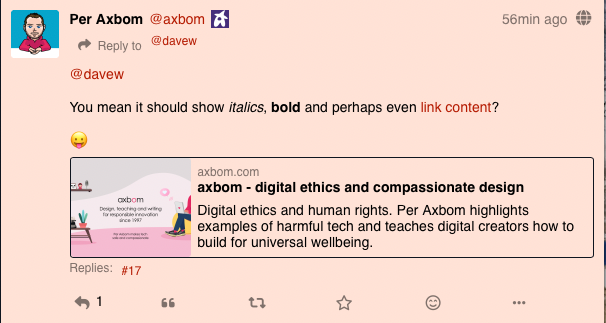
You mean it should show italics, bold and perhaps even link content?
😛
@quadratur
I understand what you mean but when people were using it for tooltips they were not describing images in the correct way. It created a lot of confusion as to the purpose of alt texts. I don't think I could go as far as calling it a feature ;)
As you rightly point out, title had this purpose.
I agree completely with your observation about exclusive content. I love having access to all alt text visibly here in my Fediverse instance. I'll be making exactly this point in my talk later today.
It's a huge shortcoming in browsers that it's so difficult to view for most people.
@grin I loved trying out Lynx and showing it off in some of my early accessibility talks :)
Some photos I see posted here are worth attention. I will, however, not repeat/boost the ones without image descriptions. And I see examples of those every day.
My wish is for #accessibility to be given more priority when posting images in social networks. In my personal experience it’s gotten a bit worse with the growth of the fediverse.
Later today I’m running an hour long session on writing Alt text and image descriptions, for people enrolled in Ambition Empower*.
Thinking perhaps I should do a public access one as well, if there’s interest. Image descriptions can benefit everyone.
*If you’re a designer or design leader, the Empower program may interest you:
https://ambitiongrp.com/empower/
I just visited 15 blogs about dogs. I wanted to see how well they described all the fun pictures of dogs and their owners. As it turns most alt texts were less than adequate, if they even had any. Some were just stuffed with keywords, and some appeared to be written by AI's, failing to add context.
After 14 sites visited, I finally I found a blog about dogs that does a great job with alt text. Would it surprise you to learn that it is a website about leader dogs?
#accessibility #a11y
https://www.leaderdog.org/
A bit of trivia about alt text.
The ALT attribute for describing images was introduced in a 1993 Internet Draft about HTML. At this time many people online were still using text-only browsers and people wanted to know what the images were about. Some people just couldn't afford to wait for them to download.
In 1999, with the release of HTML 4.01, the ALT attribute was made to be a requirement for the img and area tags.
1999 is also the year Web Content Accessibility Guidelines (WCAG) 1.0 were published. The very first checkpoint starts like this:
"1.1 Provide a text equivalent for every non-text element (e.g., via "alt", "longdesc", or in element content)."
What should be a point of internet embarrassment: Microsoft's Internet Explorer rendered the ALT attribute in the wrong way, as a tooltip, all the way until 2009 when IE8 was released. Microsoft got the standard wrong for ten years. This of course also led to many developers using it incorrectly as a tooltip.
Fast forward to 2023 and the ALT attribute is unfortunately still something not many people who build websites care much about. And I rarely see it in the curriculum of courses that provide education for web editors and writers.
#accessibility #a11y
Edits: Removed reference to HTML 1.2 (this was not a html version but a version number of the Internet Draft). Also changed HTML 4.1 to 4.01. See comments by @mjgardner
@janboddez No worries at all, I enjoy discussing and thinking about this.
@janboddez
😊 This is clear-cut to me as all users can not be expected to understand that their comment on a social media post will end up on a blog page. Thus this happens without consent as the understanding is not there unless the social media post itself has a disclaimer. That does not mean it's illegal, just that it's not fair to expect that all users are okay with this.
(Full disclosure, I've implemented tools like this in the past with Twitter, pulling in all mentions of a blog post. I also thought it was cool when not fully considering impact and consequences)
The other interesting issue is that automated stuff like this will mean that the blog owner may have illegal content posted to their page through the same mechanism. Comments can mention third parties by name and use hateful language, or include copyrighted material for example.
I think some of the most common errors of assumption when going ahead with these tools are:
1. It's technically possible, so must be okay.
2. Everybody who posts on social media wants to be seen as broadly and widely as possible in any context
3. If you're here you must accept that your content will be republished all over the place
4. Nobody could possibly be harmed
5. It's legal so there is no problem
6. It's cool…