↪ Replying to @amaliaberglof
@amaliaberglof Hugh Laurie. För mig är han alltid Bertie Wooster 😀

@amaliaberglof Se serien! 👍

Jorge Ramos was kicked out of Trump's press conference in 2015. Watch this. In Spanish with English subtitles. ted.com/talks/jorge_ra…
I also love the emphasis on buttons being disabled rather than people. 🙌 x.com/axesslab/statu…

@QuittrBot Why is it so hard to leave?
Still one of my favorite pieces of art. I want one... Family of elephants carved in the lead of a pencil. cindychinn.com/blog/elephant-…

↪ Replying to @unknown
@gkionify I was born in Liberia and lived in Saudi Arabia and Tanzania a fair while. I do prefer global citizen to Swedish but a lot has rubbed off :)
This was the best test of Swedishness I've seen. I checked off 68 out of 142. buzzfeed.com/violag2/how-st…
Five solutions whose survival depends on our continued mistreatment of our bodies. What could possibly go wrong. x.com/fastcompany/st…
Thread about "write every day". x.com/chenoehart/sta…
Tennis match on the border between Mexico and USA. #TennisAcrossBorders #BorgOpen youtube.com/watch
↪ Replying to @mazemilian
@mazemilian Yes!
@mazemilian But also, make sure you always budget time and money for addressing the findings. ;)
↪ Replying to @mazemilian
@mazemilian The lack of clarity around what a usability test encompasses - what it is - makes the rule less useful.
↪ Replying to @mazemilian
@mazemilian I agree. There is a law of diminishing returns in more tests. But: does a "usability test" mean that I am testing 1 feature or 20 features?
@mazemilian By relying on rules like this I believe orgs are testing with too few target groups and not repeating studies often enough.
@mazemilian Because of course the usage obstacles will change not only when redesigning but also by external factors.
↪ Replying to @mikeosswald
@mikeosswald Important to define what a usability test is, e.g. how users are relevant, how long it runs and how many features are included.
@mikeosswald As I see it, we shouldn't be counting usability issues, we should be always searching critical obstacles to goal fulfillment.
@mikeosswald Also, the rule gives no clues on how fast issues should be fixed and how soon the next study should run...
↪ Replying to @studioanisa
@studioanisa I'm not sure if you noticed but this turned into a thread/rant :) I did link to the original Nielsen article.
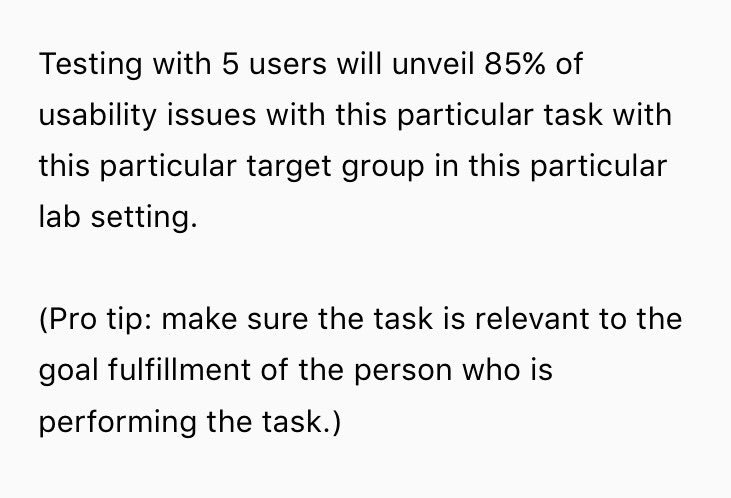
I keep hearing "testing with 5 users unveils 85% of usability problems". Who defines 100% ?! Is there an endgame? Seriously curious. #ux
And I know the original source is Nielsen, but there is very little info on what a usability test is; magnitude, time or number of features.
In this article: nngroup.com/articles/why-y…
The premise at least seems to be that all things remain equal between studies... which in my experience is rarely the case in real life.
There seems to be a lot of assumption about when a usability test is carried out (w/ regards to website lifespan) and how it is carried out.
I understand how the math makes sense in a lab environment ceteris paribus, but UX is affected by many factors not even addressed in tests.
My worry here is that this "rule" tends to undercut what UX brings to the table.
Companies will go: "let's test with 5 users and fix 85% of the problems". And be done with it and not test again in a year.
"Fixing" will of course create new problems as will changes in environment, other touchpoints and competing activities.
Making UX a numbers game diminishes a need to always be chasing design faults. They are never 100% fixed because the world is never static.
Yes, I get what Nielsen means but the approach needs to be much more clarified and wrapped in disclaimers.
Our focus has to be goal fulfillment, not measuring how many usability problems are fixed.
There, I think I'm done now... 😂
If you want to read the original article and study: dl.acm.org/citation.cfm?i…
Working on a revised wording...