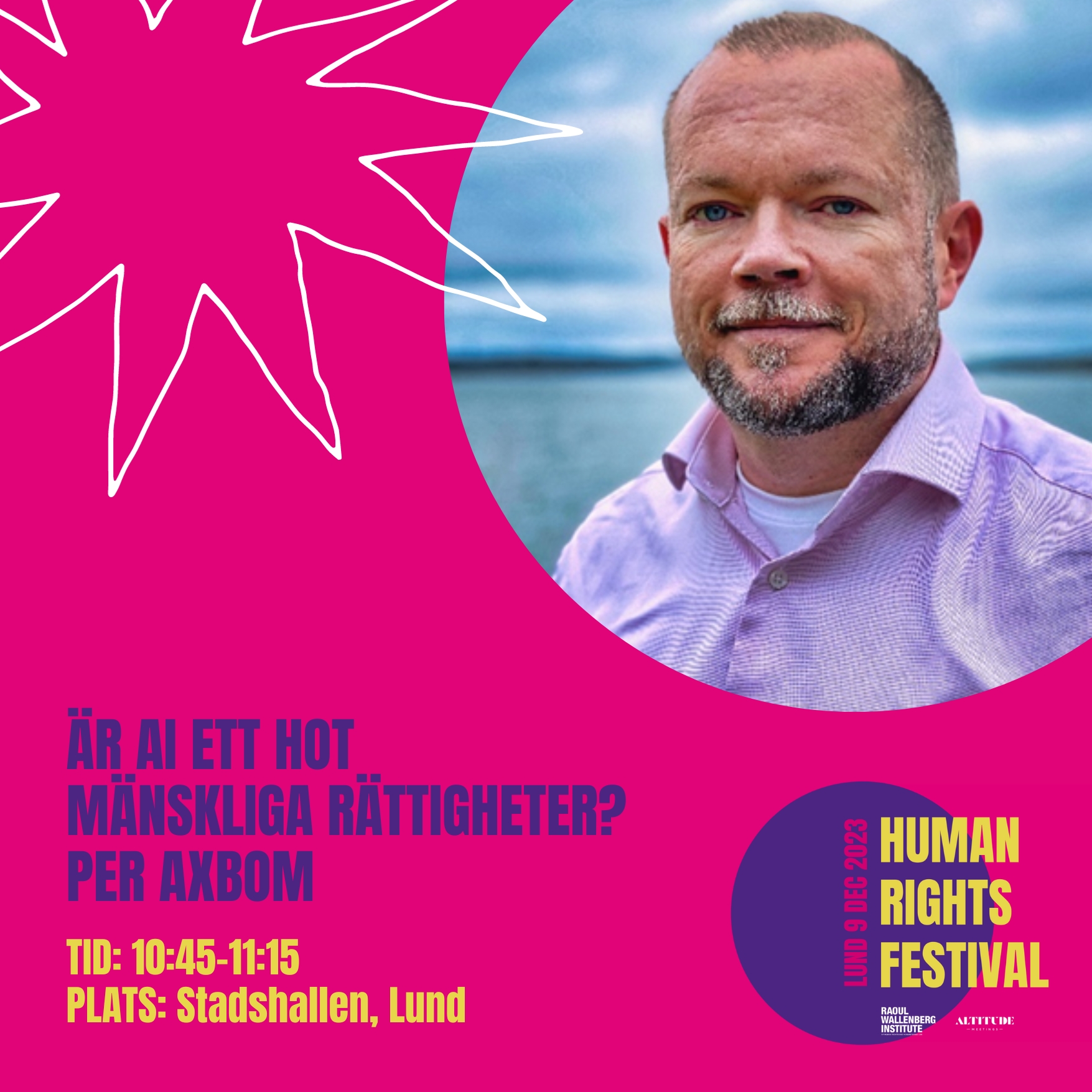
På Human Rights Festival i Lund lördagen den 9 december så kan man lyssna på mig kostnadsfritt i Stadshallen kl. 10.45. Det är bara för allmänheten att stiga in.
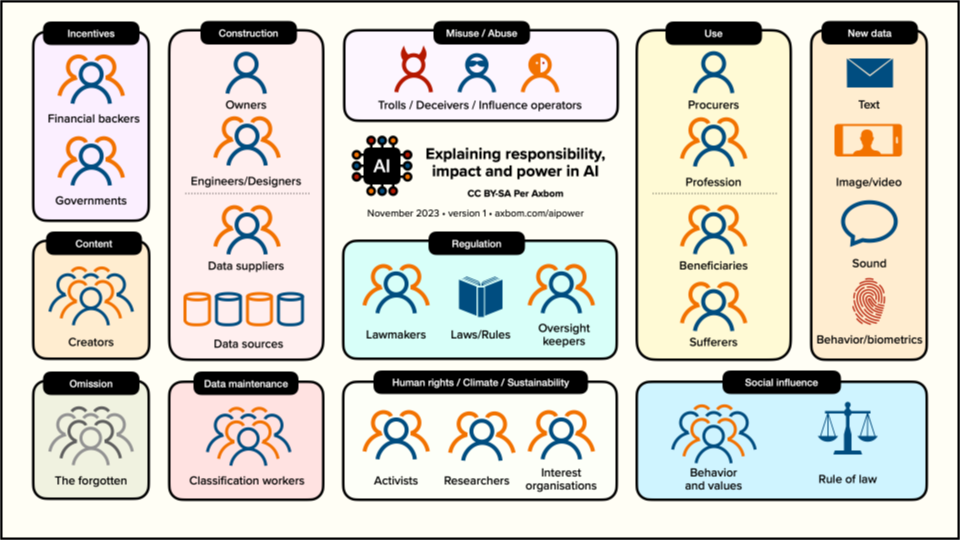
I made this diagram as an explanatory model for showing the relationships between different actors when it comes to AI development and use. It gives you something to point at when showing for example who finances the systems, who contributes to the systems and who benefits or suffers from them. In the blog post are explanations of each grouping in the chart.
« [Julian Joseph] used a tool called LazyApply to blast out 5,000 job applications "in a single click" — and managed to land around 20 job interviews. While that may sound a lot, that's a meager success rate of roughly half a percent. At the same time, though, he only got 20 or so interviews after applying to several hundred jobs the old-fashioned way. »
« In other words, recruiters are using AI tools to screen applications that were submitted by applicants using other AI tools. »
« [Julian Joseph] used a tool called LazyApply to blast out 5,000 job applications "in a single click" — and managed to land around 20 job interviews. While that may sound a lot, that's a meager success rate of roughly half a percent. »
Tech criticism does not stifle innovation. It influences public opinion, inspires regulation and ENCOURAGES INNOVATION that protects and contributes to well-being.
The trope that ethics and sustainability issues are tech-hostile is getting old.
They are hostile to bad practices and harmful behavior.
All industries need criticism to improve and innovate.
There are no details I have seen. But my expectation is that the car - detecting incomplete data- stops until it receives confirmation from a human that it can continue.
By way of @garymarcus newsletter I was made aware of the following:
In a New York Times article on the self-driving company Cruise that recently suspended its cars, some interesting figured were revealed:
”Half of Cruise’s 400 cars were in San Francisco when the driverless operations were stopped. Those vehicles were supported by a vast operations staff, with 1.5 workers per vehicle. The workers intervened to assist the company’s vehicles every 2.5 to five miles, according to two people familiar with is operations. In other words, they frequently had to do something to remotely control a car after receiving a cellular signal that it was having problems.”
That’s a human intervention every 4-8 kilometres. More and more people are becoming aware of how many people are involved in the development, maintenance and running of machine-learning models. It’s safe to assume that machine-controlled cars are no different.
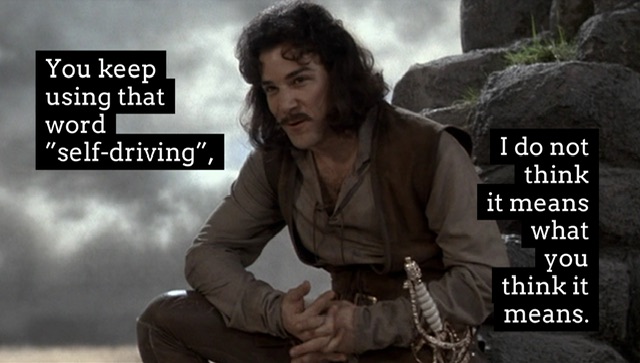
Most of the world is talking about self-driving and autonomous as if those are apt descriptions of what is already happening. Reality begs to differ. I think we need words that better describe what is really going on, and for media (and evangelists) to stop parroting whatever the companies feed them.
Autonomous used to mean something. Let’s ask the companies what they intend for the words to mean, and urge them to disclose the number of humans involved in making something appear ”autonomous”.
In light of these numbers being talked about, Cruise CEO Vogt clarifies (on Hacker News) that Cruise AVs are remotely assisted 2-4% of the time on average.* Interestingly he also says: ”This is low enough already that there isn’t a huge cost benefit to optimizing much further.” He also goes on to say that they are intentionally over staffed ”in order to handle localized bursts of RA demand”.
So maybe that’s what self-driving means.
—————
*Note that the numbers ”every 2.5 to 5 miles” and ”2-4% of the time” are not necessarily in conflict, especially in San Francisco.
LET ME KNOW what other terms you find have been invented or shifted to mean something else to obscure limited functionality. I may have to make a glossary. ”Hallucination” is for example another one of those for me.
Getting geared to watch Nineteen Eighty-Four (1984) today and reading up a bit on the controversy around the Eurythmics track ”Sexcrime” – composed for the movie and used in the trailer but which never made it into the movie. For reasons.
As part of the irony that only humans can deliver, the song ”Sexcrime” was also met with resistance in the US and many American radio stations actually banned it from their playlists.
The album featured a hype sticker when released, with the text ”Censored by the Thought Police”.
Getting geared to watch Nineteen Eighty-Four (1984) today and reading up a bit on the controversy around the Eurythmics track ”Sexcrime” – composed for the movie and used in the trailer but which never made it into the movie. For reasons.
As part of the irony that only humans can deliver, the song ”Sexcrime” was also met with resistance in the US and many American radio stations actually banned it from their playlists.
The album featured a hype sticker when released, with the text ”Censored by the Thought Police”.