
Jag har skrivit förr om det barnarbete som sker för att hela tiden utveckla digitala apparater, och även klara av den gröna omställningen, men jag har inte rest för att bevittna detta på plats.
Det gjorde däremot Staffan Lindberg och Magnus Wennman förra året, när de reste till Madagaskar för att med egna ögon prata med de undernärda barnen som gräver fram de mineraler som tillverkningen av elbilar kräver.
Det är platsen för världens första klimatsvält. Andra svältkatastrofer i modern tid har utlösts av krig och konflikter. För sex år sedan, när regnet slutade falla över södra Madagaskar, inleddes den första där den globala uppvärmningen var huvudorsaken enligt FN.
«Laha och de andra barnen känner inte till att mineralen de bryter används till elbilar. De har knappt sett något fossildrivet fordon, bortsett från uppköparens lastbil och en och annan FN-jeep.
Lahas tankar går till förändringen som orsakade svälten.
Fingrarna knäcker en liten bit glimmer.
– Om vi bara hade tillräckligt med mat som förr skulle vi orka gräva mer…»
Reportaget från december är för mig en sammanfattning av samtiden. Hur drivet att bygga nytt ska rädda oss från problemen som uppstått ur besattheten vid att bygga nytt. Hur de som drabbas hårdast av problemen drabbas ytterligare. Hur osynliga, och osynliggjorda, de som drabbas är för de som gynnas. Att varumärken knappt påverkas av omständigheterna. Att konsumtionen som lösning vinner om och om igen. Tills den inte gör det.
Vad betyder det att skriva på en barnkonvention?
https://special.aftonbladet.se/story/jleydo
@bigbro It's a closed session, which I also think is key to valuable and open conversations. But I definitely want to share more of takeaways and learnings on my blog later.
@julian Thank you for sharing. This is my experience as well... at least a year of sorting things out.
One of my takeaways is that online platforms will have lots of settings for memorializing accounts or deleting them completely. But they aren’t going to teach you how to download your content and make it available to your family in a sensible way.
It will actually be an open discussion as part of the session, what are designers' responsibilities. I'm also thinking of books, music, playlists that are likely to get lost…
People have of course been talking about these things for a long time but I don't see any clear answers.
Designers at least carry much of the weight of consent, information and communication. My reflection is that this can generally be done in a much better and more proactive way. And assume responsibility and talking about it more openly is a step forward.
@JackEric The thought did cross my mind earlier but I kind of dropped it as I kept working on the presentation... but now that you mention it it actually makes sense to bring this up towards the end... things will go wrong and we will need to evaluate them.
Doing a session tomorrow on Postmortem Design - actually designing to protect the legacy of users after they pass away.
I'm prepping my slides and I'm already crying. So much data getting lost and so hard for families to access it.
I'm using my grandma's attic as a backdrop. I used to love heading up there and discovering old photos, letters, stamps, coins and memorabilia each with its own story.
Now who owns everyone's attic… do our digital legacies matter and if so, who should own it and access it…
Sunday long-read on the environmental impact of data centers.
"Anthropologist Steven Gonzalez Monserrate draws on five years of research and ethnographic fieldwork in server farms to illustrate some of the diverse environmental impacts of data storage."
"Some have proposed relocating data centers to Nordic countries like Iceland or Sweden, in a bid to utilize ambient, cool air to minimize carbon footprint, a technique called “free cooling.” However, network signal latency issues make this dream of a haven for green data centers largely untenable to meet the computing and data storage demands of the wider world."
"[…] the Cloud now has a greater carbon footprint than the airline industry. A single data center can consume the equivalent electricity of 50,000 homes. At 200 terawatt hours (TWh) annually, data centers collectively devour more energy than some nation-states."
https://thereader.mitpress.mit.edu/the-staggering-ecological-impacts-of-computation-and-the-cloud/
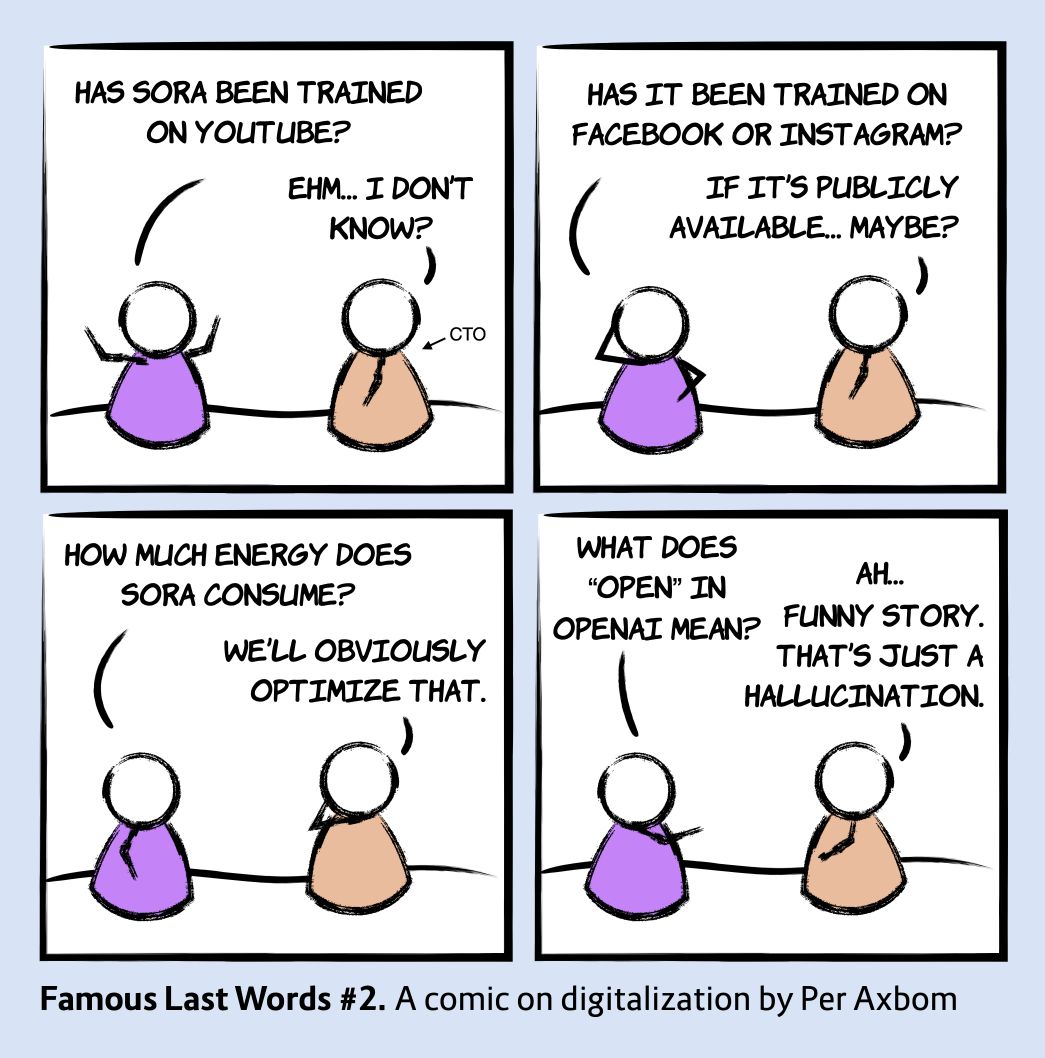
Famous Last Words number 2. A comic on digitalization by Per Axbom
Two people talking.
Person 1: Has Sora been trained on YouTube?
Person 2 (CTO): Ehm, I don' t know?
Person 1: Has it been trained on Facebook or Instagram?
Person 2: If it's publicly available… maybe?
Person 1: How much energy does Sora consume?
Person 2: We'll obviously optimize that.
Person 1: What does "Open" in OpenAI mean?
Person 2: Ah… Funny story. That's just a hallucination.
"Wait, grandpa!? You wanted to solve the climate crisis so you built tools that consumed even more electricity, and made the crisis happen even FASTER!?"
"Well, yes… efficiency was always the game. Exactly what we made more efficient wasn't really an issue. We did fuck up REALLY fast didn't we...? Imagine how many things we can improve now though…"
@sy Is the image description the prompt you used?
@sy Thanks, would it be okay to add this as a comment to the post?
It's good to give the complete picture of how different tools will fare on different prompts. The uncertainty of what tool will be able to do what is an important insight.
Generative AI can not generate its way out of prejudice
The concept of "generative" suggests that the tool can produce what it is asked to produce. In a study uncovering how stereotypical global health tropes are embedded in AI image generators, researchers found it challenging to generate images of Black doctors treating white children. They used Midjourney, a tool that after hundreds of attempts would not generate an output matching the prompt. I tried their experiment with Stable Diffusion's free web version and found it every bit as concerning as you might imagine.
https://axbom.com/generative-prejudice/
#AIEthics #DigitalEthics
@mia Thanks, fixed it now in the online version (it went out as a newsletter as well 😅)
This is a typo that several people have reached out about now, haha.
Generative AI can not generate its way out of prejudice
The concept of "generative" suggests that the tool can produce what it is asked to produce. In a study uncovering how stereotypical global health tropes are embedded in AI image generators, researchers found it challenging to generate images of Black doctors treating white children. They used Midjourney, a tool that after hundreds of attempts would not generate an output matching the prompt. I tried their experiment with Stable Diffusion's free web version and found it every bit as concerning as you might imagine.
https://axbom.com/generative-prejudice/
#AIEthics #DigitalEthics
If your concern is that humans are standing in the way of technological progress, your understanding of the purpose of tech should perhaps be the subject of consideration.
@isotopp Thanks for the quick feedback! 🙏
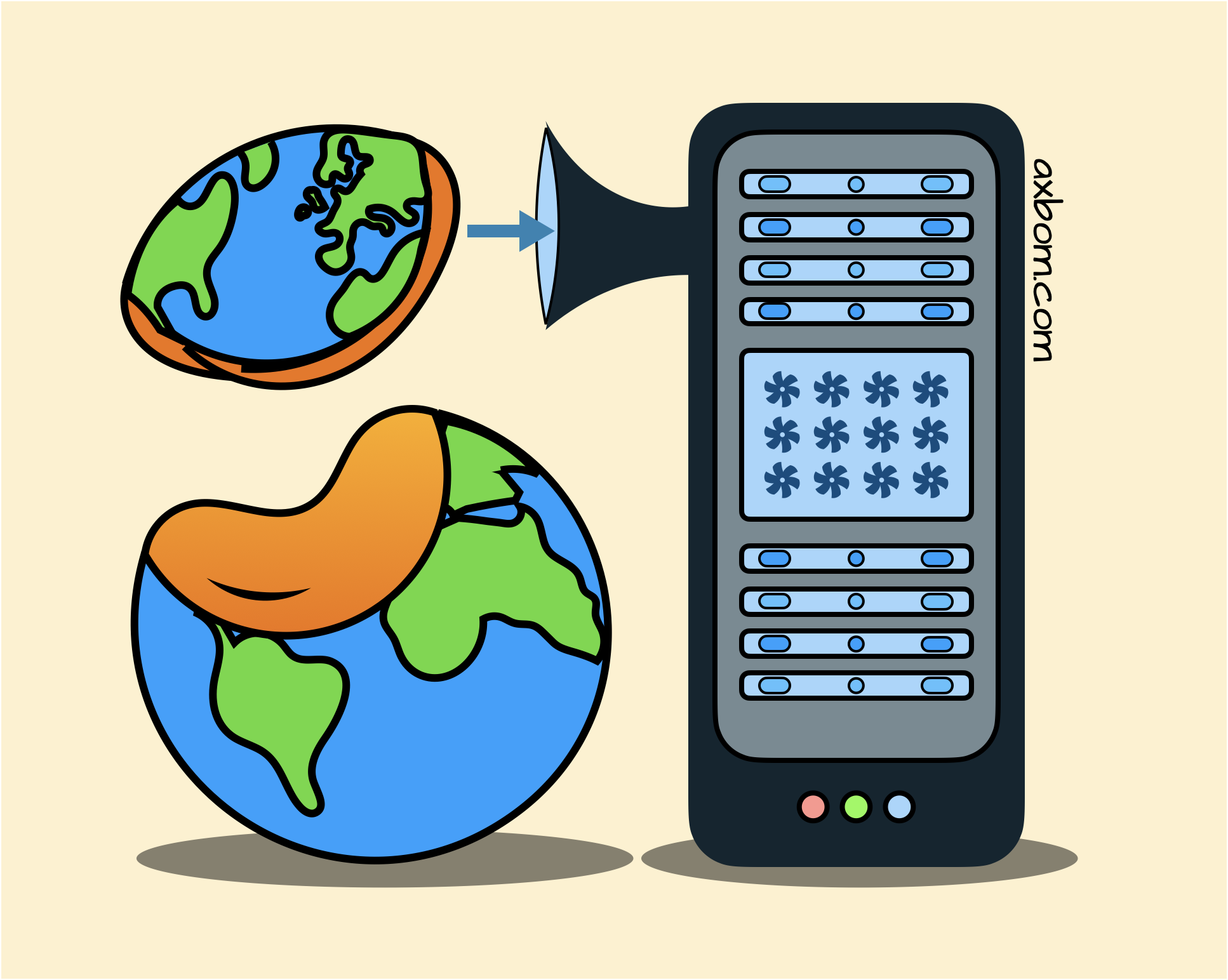
Quick sketch of an AI being trained on only bits of the world. Makes sense?
"I dagsläget finns inget beslut om att Skatteverket ska köpa in Microsoft 365 och Teams. Vi har påbörjat en undersökning om införande och användande", säger Peter Nordström, sektionschef på Skatteverket.
Det finns alltså inget beslut om att Skatteverket ska börja använda Teams. Man har påbörjat en utredning som inte är klar ännu. Detta kan man läsa i Skatteverkets eget pressmeddelande från 1 mars.
Ändå skriver flera tidningar som om Skatteverkets "beslut" har förändrat synen på myndigheters användning av amerikanska molntjänster. Och de som säljer tjänsterna drar förstås stora växlar på detta.
Som vanligt är det bra med lugn och is i magen. Och att läsa underlaget. Utredningen finns att ladda ner. Och det som utretts hittills är en tillämpning med kraftiga begränsningar. Bland annat skriver man i sin egen utredning att det inte finns "reell möjlighet att utöva sitt arkivansvar enligt 4 § arkivlagen, om Skatteverket övergår till M365Apps, Teams och Entra ID".
Det som kanske fascinerar mig mest, eftersom jag intresserar mig för människans interaktion med it-system, är hur Skatteverket förändrat sin syn på hur lätt det är att styra vilken information myndighetens medarbetare delar i dessa verktyg.
2021: Skatteverket bedömer att det inte kommer vara möjligt för myndigheten att skriva bestämmelser som tydliggör för alla deras 12 000 anställda exakt vilken information de får och inte får dela i ett Teams-möte.
2024: Skatteverket säger att de är medvetna om att det finns risk för att personuppgifter i slutändan kan hamna hos amerikanska myndigheter. För att hantera det ämnar Skatteverket ge medarbetarna instruktioner om vilken information som kan/får delges under olika typer av Teams-möten och i olika funktioner.
"I de delar av Teams, till exempel chatten och externa möten där det inte är möjligt att använda E2EE-kryptering kommer medarbetarna instrueras att inte behandla sekretesskyddade uppgifter" – Citat från Bilaga 3, Analys av Microsoft Teams
Nästa steg blir att fundera över, och kanske utreda, hur medborgares förtroende för Skatteverket påverkas av det ena eller andra synsättet – och framtida vägval.
Skatteverkets pressmeddelande med länkar till utredningen och dess bilagor: https://skatteverket.se/omoss/pressochmedia/nyheter/2024/nyheter/skatteverketspreliminarabedomningavmolntjanster.5.2fb39afe18dabf1e4d21f7f.html
I have now started reading Joseph Weizenbaum’s increasingly relevant book from 1976, ’Computer Power and Human Reason: From Judgment to Calculation’.
I expected to like it but 23 pages in I can already say I love it. On page 23 he quotes Hannah Arendt about recent makers and executors of policy in the Pentagon:
”They were not just intelligent, but prided themselves on being ’rational’… They were eager to find formulas, preferably expressed in a pseudo-mathematical language, that would unify the most disparate phenomena with which reality presented them; that is, they were eager to discover *laws* by which to explain and predict political and historical facts as though they were as necessary, and thus as reliable, as the physicists once believed natural phenomena to be… [They] did not *judge*; they calculated… an utterly irrational confidence in the calculability of reality [became] the leitmotif of the decision making.”
@deadsuperhero @BeAware
Glad someone else is testing with Akkoma. I couldn't find the account either.