Skip to content
Notes by Axbom
Per Axbom Bluesky

After finishing 'Amusing Ourselves to Death' I am now halfway through 'Technopoly'. It, too, is a bloody brilliant read. I'm just now blown away by Chapter 6, The ideology of Machines: Medical technology.

I wish I could post it here in whole.
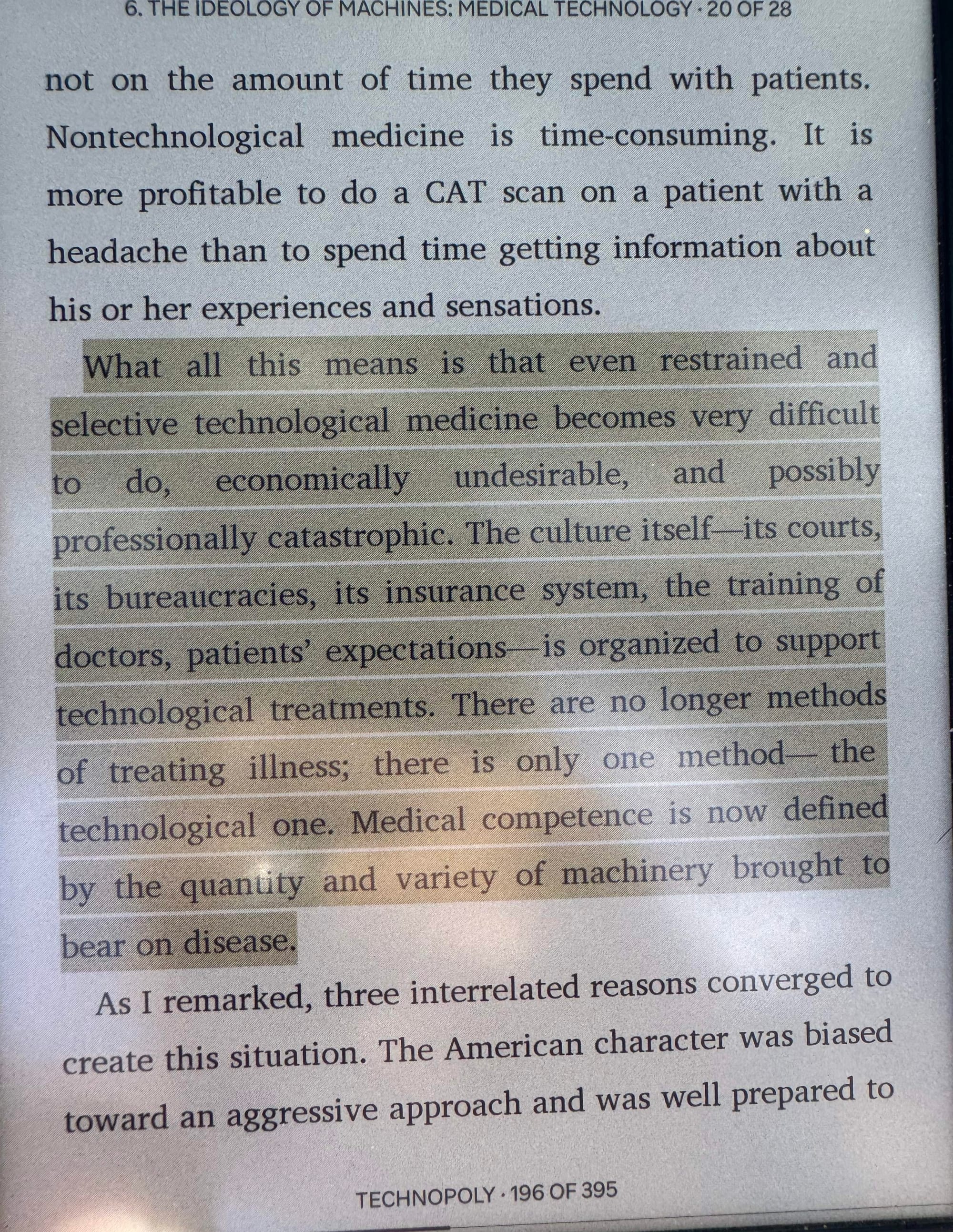
Photo of my Kobo reader, with this paragraph highlighted: "What all this means is that even restrained and selective technological medicine becomes very difficult to do, economically undesirable, and possibly professionally catastrophic. The culture itself-its courts, its bureaucracies, its insurance system, the training of doctors, patients' expectations—is organized to support technological treatments. There are no longer methods of treating illness; there is only one method the technological one. Medical competence is now defined by the quantity and variety of machinery brought to bear on disease."

The chapter is full of these points… aligned with an over-reliance on technology and numbers.

The assertation at time of writing (1992) is that the US was the only Technopoly, but that much of the 'western world' was set to follow.
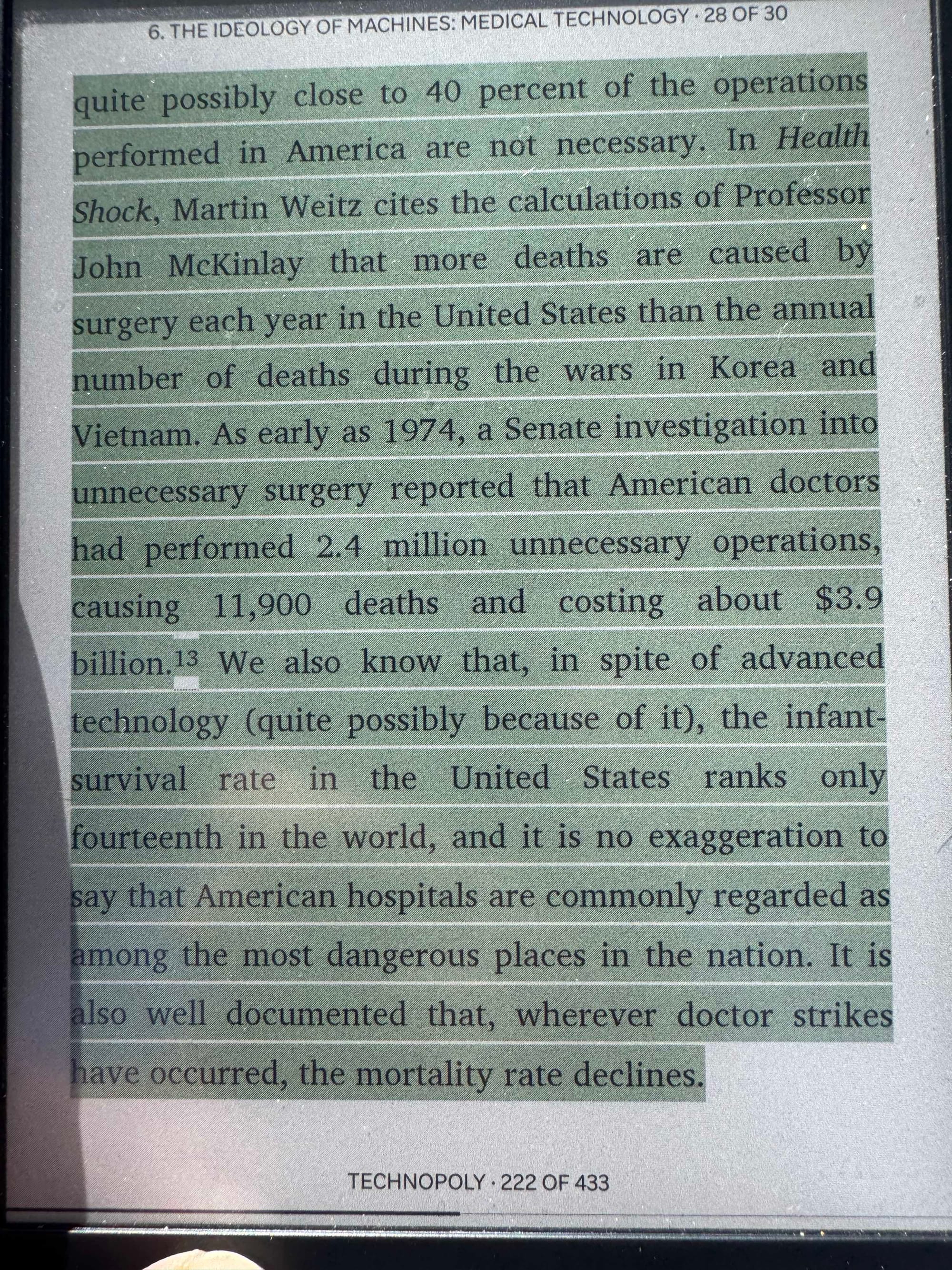
"quite possibly close to 40 percent of the operations performed in America are not necessary. In Health Shock, Martin Weitz cites the calculations of Professor John McKinlay that more deaths are caused by surgery each year in the United States than the annual number of deaths during the wars in Korea and Vietnam. As early as 1974, a Senate investigation into unnecessary surgery reported that American doctors had performed 2.4 million unnecessary operations, causing 11,900 deaths and costing about $3.9 billion. 13 We also know that, in spite of advanced technology (quite possibly because of it), the infant-survival rate in the United States ranks only fourteenth in the world, and it is no exaggeration to say that American hospitals are commonly regarded as among the most dangerous places in the nation. It is also well documented that, wherever doctor strikes have occurred, the mortality rate declines."

Quite sure we can replace 'doctors' here with pretty much any profession and their respective practice.
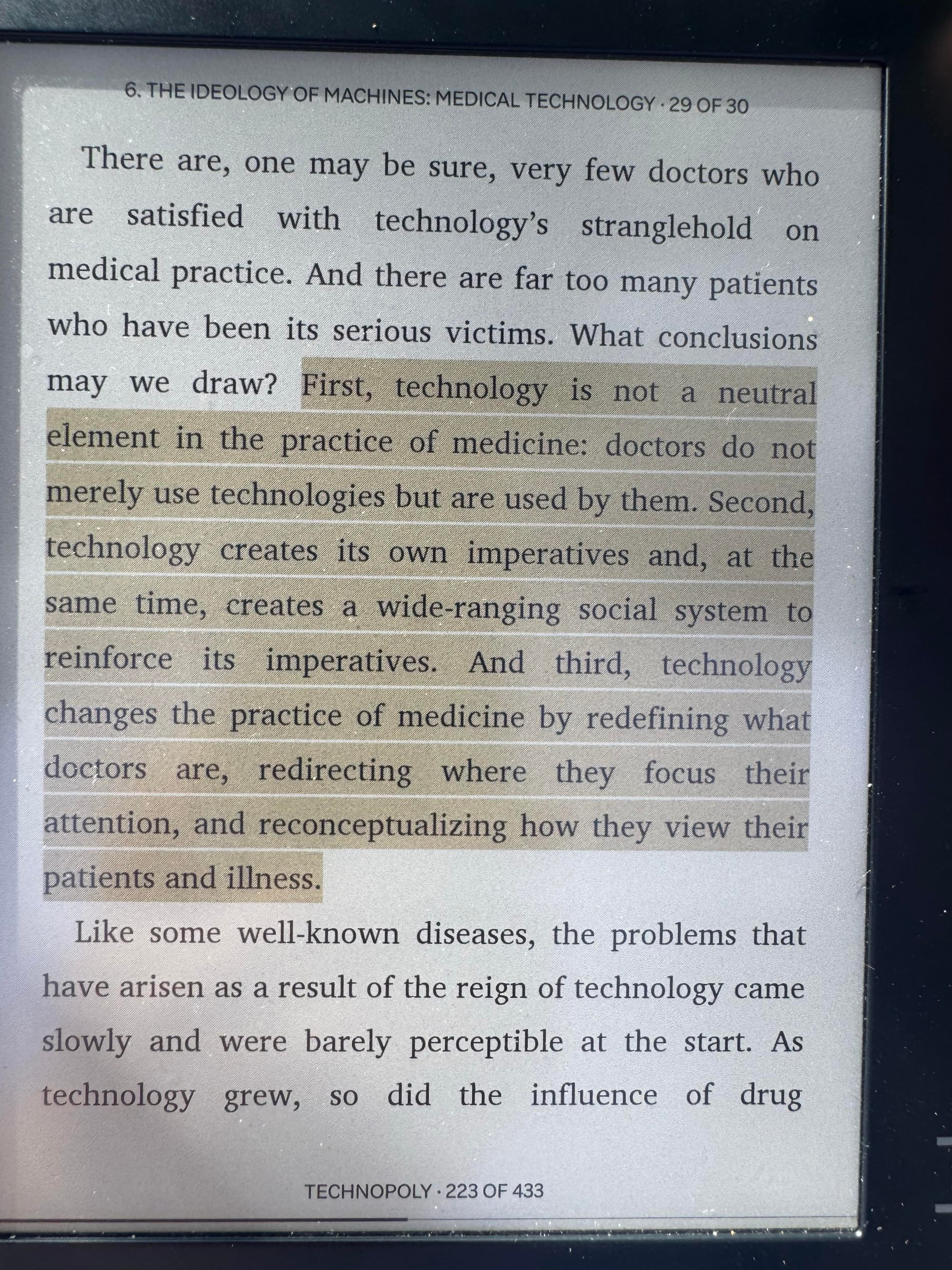
"First, technology is not a neutral element in the practice of medicine: doctors do not merely use technologies but are used by them. Second, technology creates its own imperatives and, at the same time, creates a wide-ranging social system to reinforce its imperatives. And third, technology changes the practice of medicine by redefining what doctors are, redirecting where they focus their attention, and reconceptualizing how they view their patients and illness."

🔗 Originally posted on Bluesky

24 Jul 2026, 13:36
Share
LinkedIn Bluesky Email
  • Notes by Axbom
  • RSS

© 2026 Notes by Axbom