"As [Aldous Huxley] saw it, people will come to love their oppression, to adore the technologies that undo their capacities to think."
– Neil Postman in the foreword to 'Amusing Ourselves to Death'.
"This idea-that there is a content called 'the news of the day'— was entirely created by the telegraph (and since amplified by newer media), which made it possible to move decontextualized information over vast spaces at incredible speed. ➜
➜ The news of the day is a figment of our technological imagination. It is, quite precisely, a media event. We attend to fragments of events from all over the world because we have
multiple media whose forms are well suited to fragmented conversation."
– Neil Postman, 'Amusing Ourselves to Death'
"When Galileo remarked that the language of nature is written in mathematics, he meant it only as a metaphor. Nature itself does not speak. Neither do our minds or our bodies or, more to the point of this book, our bodies politic. Our conversations about nature and about ourselves are conducted ➜
➜ in whatever 'languages' we find it possible and convenient to employ. We do not see nature or intelligence or human motivation or ideology as 'it' is but only as our languages are. And our languages are our media. Our media are our metaphors. Our metaphors create the content of our culture."
"We must remember that Galileo merely said that the language of nature is written in mathematics. He dia not say everything is. And even the truth about nature need not be expressed in mathematics. For most of human history, the language of nature has been the language of myth and ritual. ➜
➜ These forms, one might add, had the virtues of leaving nature unthreatened and of encouraging the belief that human beings are part of it. It hardly befits a people who stand ready to blow up the planet to praise themselves too vigorously for having found the true way to talk about nature."
"One sometimes hears it said, for example, that there is more printed matter available today than ever before, which is undoubtedly true. But from the seventeenth century to the late nineteenth century, printed matter was virtually all that was available. ➜
➜ There were no movies to see, radio to hear, photographic displays to look at, records to play. There was no television. Public business was channeled into and expressed through print, which became the model, the metaphor and the measure of all discourse. ➜
➜ The resonances of the lineal, analytical structure of print, and in particular, of expository prose, could be felt everywhere."
(Neil Postman is writing about the United States.)
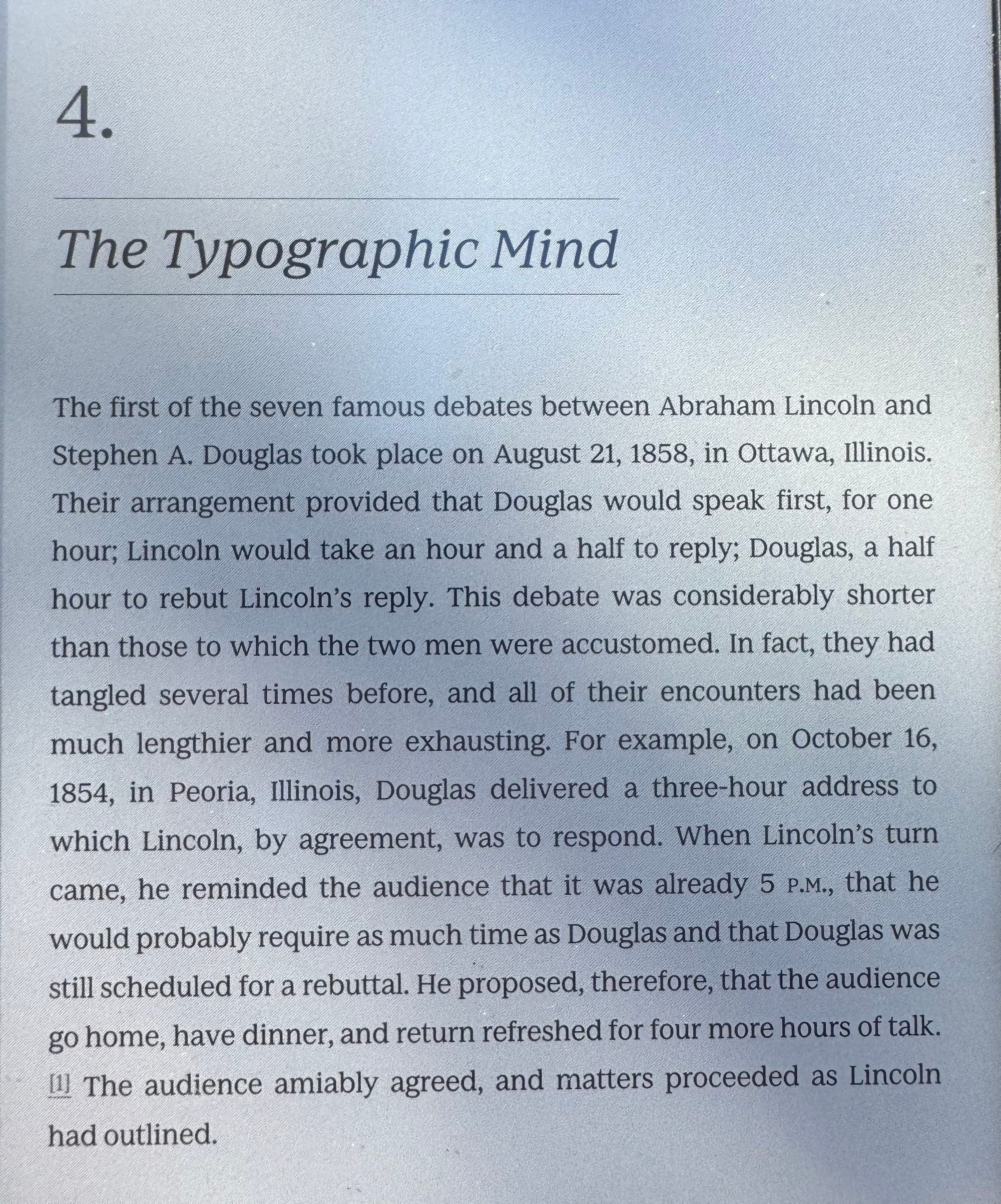
They sometimes say a 3-hour movie is pushing it, but imagine a population regularly attending 5-7 hour debates, where speakers are alloted 2-3 hours at a time.