@doktorzjivago Q2 2026; Googles första kvartal någonsin med negativt kassaflöde sedan deras börsintroduktion 2004. Huvudsakligen beroende på deras AI-utgifter, och ja, datacenter.
Google/Alphabet går såklart fortsatt med vinst, men det är en intressant utveckling när de menar att detta är det "nya normala".
Jag är något orolig över allas våra pensionspengar... 😬
Also worth a read. I appreciate the unsurprised tone. I feel the big story is how safety classifiers fired on Hugging Face when they tried to investigate.
@eryk.bsky.social: Seeding the “maybe our model is exhibiting self-awareness?” narrative to obliterate the “OpenAI is a negligent and potentially criminal actor” narrative is a reputation management move exclusive to this industry. Not a stunt, but a desperate need to control the narrative.
@eobet@troed Ja, min ståndpunkt är att alla bör ha en kritisk inställning till all teknik/teknologi som introduceras oavsett om det handlar om klockor, kaffebryggare eller kärnkraft, då all teknik har bäring på hur människor förhåller sig till varandra, och hur samhället utvecklas. Makthavare bör också göra sina resonemang tillgängliga för folket, dels för att utbilda/utmana och dels för att all teknik ger konsekvenser som gynnar och missgynnar, men skiljer sig åt i vem som drar fördelar och vem som förlorar. Och om makthavare inte kan uppvisa en förmåga till värderande granskning av förtjänster och brister, att pröva och resonera i dessa frågor, så är det min övertygelse att samhället förlorar på det. Särskilt när ny teknik/teknologi tar stor plats i sin aktuella påverkan.
Rekommenderar varmt boken Technopoly av Neil Postman.
"As [Aldous Huxley] saw it, people will come to love their oppression, to adore the technologies that undo their capacities to think."
– Neil Postman in the foreword to 'Amusing Ourselves to Death'.
"This idea-that there is a content called 'the news of the day'— was entirely created by the telegraph (and since amplified by newer media), which made it possible to move decontextualized information over vast spaces at incredible speed. ➜
➜ The news of the day is a figment of our technological imagination. It is, quite precisely, a media event. We attend to fragments of events from all over the world because we have multiple media whose forms are well suited to fragmented conversation."
– Neil Postman, 'Amusing Ourselves to Death'
"When Galileo remarked that the language of nature is written in mathematics, he meant it only as a metaphor. Nature itself does not speak. Neither do our minds or our bodies or, more to the point of this book, our bodies politic. Our conversations about nature and about ourselves are conducted ➜
➜ in whatever 'languages' we find it possible and convenient to employ. We do not see nature or intelligence or human motivation or ideology as 'it' is but only as our languages are. And our languages are our media. Our media are our metaphors. Our metaphors create the content of our culture."
"We must remember that Galileo merely said that the language of nature is written in mathematics. He dia not say everything is. And even the truth about nature need not be expressed in mathematics. For most of human history, the language of nature has been the language of myth and ritual. ➜
➜ These forms, one might add, had the virtues of leaving nature unthreatened and of encouraging the belief that human beings are part of it. It hardly befits a people who stand ready to blow up the planet to praise themselves too vigorously for having found the true way to talk about nature."
"One sometimes hears it said, for example, that there is more printed matter available today than ever before, which is undoubtedly true. But from the seventeenth century to the late nineteenth century, printed matter was virtually all that was available. ➜
➜ There were no movies to see, radio to hear, photographic displays to look at, records to play. There was no television. Public business was channeled into and expressed through print, which became the model, the metaphor and the measure of all discourse. ➜
➜ The resonances of the lineal, analytical structure of print, and in particular, of expository prose, could be felt everywhere."
(Neil Postman is writing about the United States.)
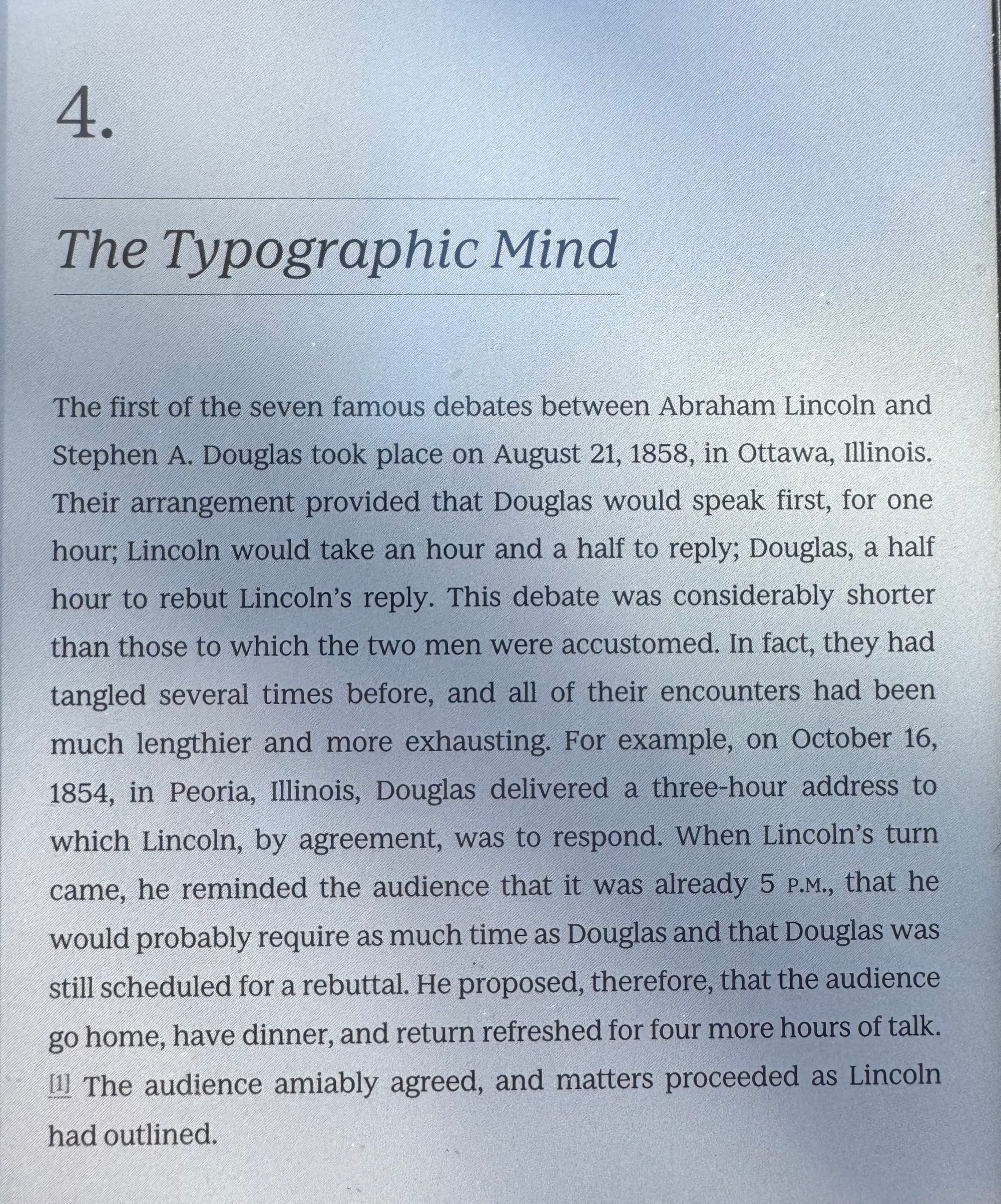
They sometimes say a 3-hour movie is pushing it, but imagine a population regularly attending 5-7 hour debates, where speakers are alloted 2-3 hours at a time.
Finns det någon politiker i Sverige som har tydliggjort att de har en kritisk inställning till ”AI” och kanske har läst böcker som The AI Con, Unmasking AI, Empire of AI eller Prophecy? Jag kan ärligt talat inte komma på någon just nu.
When people in positions of power tell others that they must hurry to adopt technology because it’s inevitable, I call that think-hostility. Personal agency and the capacity to question and form one's own opinions are disabled by voices that convince people it is too late to do anything differently.
Jag tror jag kom på vad som retar mig mest med halvtidsshowen i fotbolls-VM.
Normalt ägnas denna tid åt att reflektera, nyansera, analysera, sammanfatta och prognostisera. Vad ser du, vad tänker du, vad kan det innebära? Oavsett om det sker med andra eller inombords.
1/5
Så mycket idag handlar om att eliminera den typen av tänkande. Håll i stället gärnan oupphörligen sysselsatt med dopamin och endorfiner så att folk förblir loja och sävliga.
Detta gör att jag drar paralleller till Neil Postman’s verk ’Amusing Ourselves to Death’.
2/5
Postman argumenterar för att ’Du Sköna Nya Värld’ ligger närmare verkligheten än Orwells ’1984’. I Huxleys vision medicinerar människor sig själva till lycka och salighet, vilket gör att de helt frivilligt offrar sina rättigheter. Postman kritiserar bland annat television som bärare av kunskap.
3/5
Fotbollen ÄR underhållningen som fansen är där för att se. Jag funderar också på hur det skulle se ut om jag ser Così fan tutte på Kungliga Operan och efter första akten cyklar det ut clowner på enhjulingar för att stå för pausunderhållningen.
4/5
När operan är slut drar en ståupp-komiker igång som ett 30-minuters avslut på kvällen.
Jag tror jag kom på vad som retar mig mest med halvtidsshowen i fotbolls-VM.
Normalt ägnas denna tid åt att reflektera, nyansera, analysera, sammanfatta och prognostisera. Vad ser du, vad tänker du, vad kan det innebära? Oavsett om det sker med andra eller inombords.
Så mycket idag handlar om att eliminera den typen av tänkande. Håll i stället hjärnan oupphörligen sysselsatt med dopamin och endorfiner så att folk förblir loja och sävliga.
Detta gör att jag drar paralleller till Neil Postman’s verk ’Amusing Ourselves to Death’. Postman argumenterar bland annat för att ’Du Sköna Nya Värld’ ligger närmare verkligheten än Orwells ’1984’. I Huxleys vision medicinerar människor sig själva till lycka och salighet, vilket gör att de helt frivilligt offrar sina rättigheter. Postman kritiserar bland annat television som bärare av kunskap.
Fotbollen ÄR underhållningen som fansen är där för att se. Jag funderar också på hur det skulle se ut om jag ser Così fan tutte på Kungliga Operan och efter första akten cyklar det ut clowner på enhjulingar för att stå för pausunderhållningen. När operan är slut drar en ståupp-komiker igång som ett 30-minuters avslut på kvällen.
@malveus@AasaMariaHedberg Finns en app från Norge, för lokala grupper, som det börjat pratas om. Men att få folk att "byta app" är alltid en rejäl utmaning.
Jag har ingen egen egentlig erfarenhet av den, gillar bara att det börjar dyka upp alternativ.
@scottjenson Worth noting of course is that different software on the Fediverse may implement this differently. "Unlisted"/"Quiet Public" have nothing to do with the ActivityPub protocol, so the behavior across the Fediverse can potentially differ for anyone not on Mastodon.
Algorithms used in law enforcement and welfare enforce prejudice while displacing blame onto machines that responsible parties manage to convince the public as being neutral.
Discriminatory algorithm used by the French social security agence.
”The criteria that increase one’s risk score include parameters which discriminate against vulnerable households, including being on a low income, being unemployed, living in a disadvantaged neighbourhood, […]”
Poverty and discrimination in Serbia’s welfare state
”Bogdan was one of possibly thousands of people who lost social assistance after the Social Card law entered into force in March 2022 and introduced automation into the process of determining [eligibility for social assistance].”
”[The] Social Insurance Agency (Försäkringskassan) has silently conducted large-scale experiments with algorithms that score hundreds of thousands of people on benefits, supposedly predicting whether they will commit fraud.”
@jajo I det här fallet (SAFER) finns ännu inte tillstånd till insyn i hur algoritmen är uppbyggd, men i liknande historiska fall (COMPAS) har man visat att det inte spelar någon direkt roll om hudfärg är med i själva bedömningen eftersom fördomarna tar sig uttryck via så kallade proxy-egenskaper. Även i fallet med Försäkringskassans system för riskbedömning av bidragssökande, som i högre utsträckning pekade ut oskyldiga kvinnor och personer med utländsk bakgrund, förklarade rapporten från Lighthouse att det inte går att dra ett rakt streck mellan en specifik egenskap i beräkningsunderlaget (som man inte heller fick tillgång till då) och vidare till den orättvisa behandlingen. Det är för mig det som gör just de här större algoritmerna så farliga - det går inte att på ett enkelt sätt se, förstå och förklara varför ojämlikheterna uppstår, man kan bara se vilka som drabbas ofördelaktigt. Det blir då rättsosäkert när man inte kan förklara resonemangen bakom beslut (och ingen människa kan ta ansvar för dem). Särskilt när besluten handlar om sådant som inte hänt.
In Ontario, an ”AI tool” being used to predict prisoners’ behavior. Its primary feature is disproportionately placing Black prisoners in maximum security. The whole point of ”AI” is often to maintain or even strengthen prejudice, while displacing blame onto something ”other” – that the public is made to think is computationally neutral.
Prejudice is cemented by humans through the complete process of interplay with the software, from ideation to creation to usage: selection, development, implementation, interpretation and action. And there is no such thing as seeing into the future.
”The program assigns each prisoner a score from 0 to 100 that determines whether they’ll be placed in minimum, medium, or maximum security detention.”