
@edeverett Wow had not heard about this.
Tagged: reply
@sintrenton
Ja, väldigt bra text. Tack.
@mitsunee Haha, I hadn't thought of that but you're absolutely right.
Mailchimp have now abandoned all of its "whimsiness", so I doubt we'll ever really know.
@falcennial 😁 Off by default would definitely work for me.
@timthelion Oh yeah! I remember listening to The Missing Cryptoqueen and the part where they described graphs on a web page showing how investments in OneCoin were growing in value, all faked.
@dekaminski @web2brain
There is also this Swedish case wherein an algorithm was used to allocate school placement based on geographical distance from home, rather than travel distance. This resulted in children having to attend schools that were close on a map but were across a body of water that could take an hour to travel around. The interesting part of the case is how hard it was to get any sort of admittance of wrongdoing on the side of the municipality. This was also before algorithmic decision-making was allowed in the public sector (in 2020). The lawyer writing about this notes how the courts do not understand the technical aspects enough…
https://www.advokaten.se/tidigare-nummer/2022/nr-6-2022-argang-88/algoritmisk-orattvisa--nar-domstolen-ar-blind-for-digitala-bevis/
@Beantin Very cool. I had no idea this was possible.
@MariaLiv Ja, precis, och Konsumentverket (efter att många anmälningar kommit in) har ju sagt åt dem för mer än ett år sedan, men det faller lite platt med brevväxling som enda tillsägelse.
Det är lite si och så med tillämpningen kan jag tycka.
https://axbom.se/dagens-industri-konsumentverket/
@snowracer Jag trodde det också, men inte när de kör kampanjer, typ 99 kr för 3 månader. Då kör de fortfarande med att det förlängs på årsbasis om man missar att säga upp i tid (en vecka innan kampanjperiodens slut).
@stephenpa @scottjenson
I've _just_ switched to a self-hosted version of cal.com
@nafnlaus The decision to design them this way is purely human. There are a multitude of human decisions even in unsupervised "learning", when it comes to labelling and modelling. The fact that many of these algorithms are a black box when it comes to predictability is only an example of humans building an error-prone system based on human material.
The machine is also an extension of all human error contained in the unsupervised training material, including historical and representation bias. It's further adding more human input to the mix, not less. All that human labor fed into the machine, and none of those humans visible. Again, it's hard to see the humans (who produced all that content) because of the machines.
Unsupervised training is for example also how Child Sexual Abuse Material has made its way into image generators, and descriptions of abuse and violence into all the text generators. There are people working around the clock across the world to prevent this content from appearing in generated content. More invisible humans doing invisible labor.
I agree they aren't puppets, although puppet features exist in AI as well (deepfake generators). But they are truly not a separate entity from human influence and decision-making. The way I see it, it's all they are. And sometimes that leads to exacerbating human bias rather than minimising it.
@Caution
This makes me so happy 😊 Thank you for letting me know.
@JMMaok
@Caution @JMMaok
I couldn't resist making a real demo in jsbin:
https://output.jsbin.com/gapapox/
@JMMaok
While I don’t get a chance to code myself as much anymore, the recommendation would be to not style headings but instead apply class names for the visual appearance. Hence one would separate semantic hierarchy (h1…h6) from look-and-feel.
For instance:
<style>
.TitleXL {font-size: 2em}
.TitleL {font-size: 1.8em}
.TitleM {font-size: 1.4em}
.TitleS {font-size: 1.2em}
</style>
In my example then it would be.
<h1 class=“TitleXL”>Site Name</h1>
<h2 class=“TitleL”>Article 1</h2>
<h2 class=“TitleM”>Article 2</h2>
<h2 class=“TitleM”>Article 3</h2>
<h2 class=“TitleS”>Social media</h2>
<h2 class=“TitleS”>Resources</h2>
<h2 class=“TitleS”>Abous us</h2>
<h2 class=“TitleS”>Contact info</h2>
To complicate things, if I was building this page I would likely add a separate heading for the whole footer area. That heading would then be h2 and the four columns would each have an h3. But it was a quick example 😉
@JMMaok
If that is your only visual clue I would agree, but I would presume that there are other design features that indicate how a heading or title is related to the content it refers to.
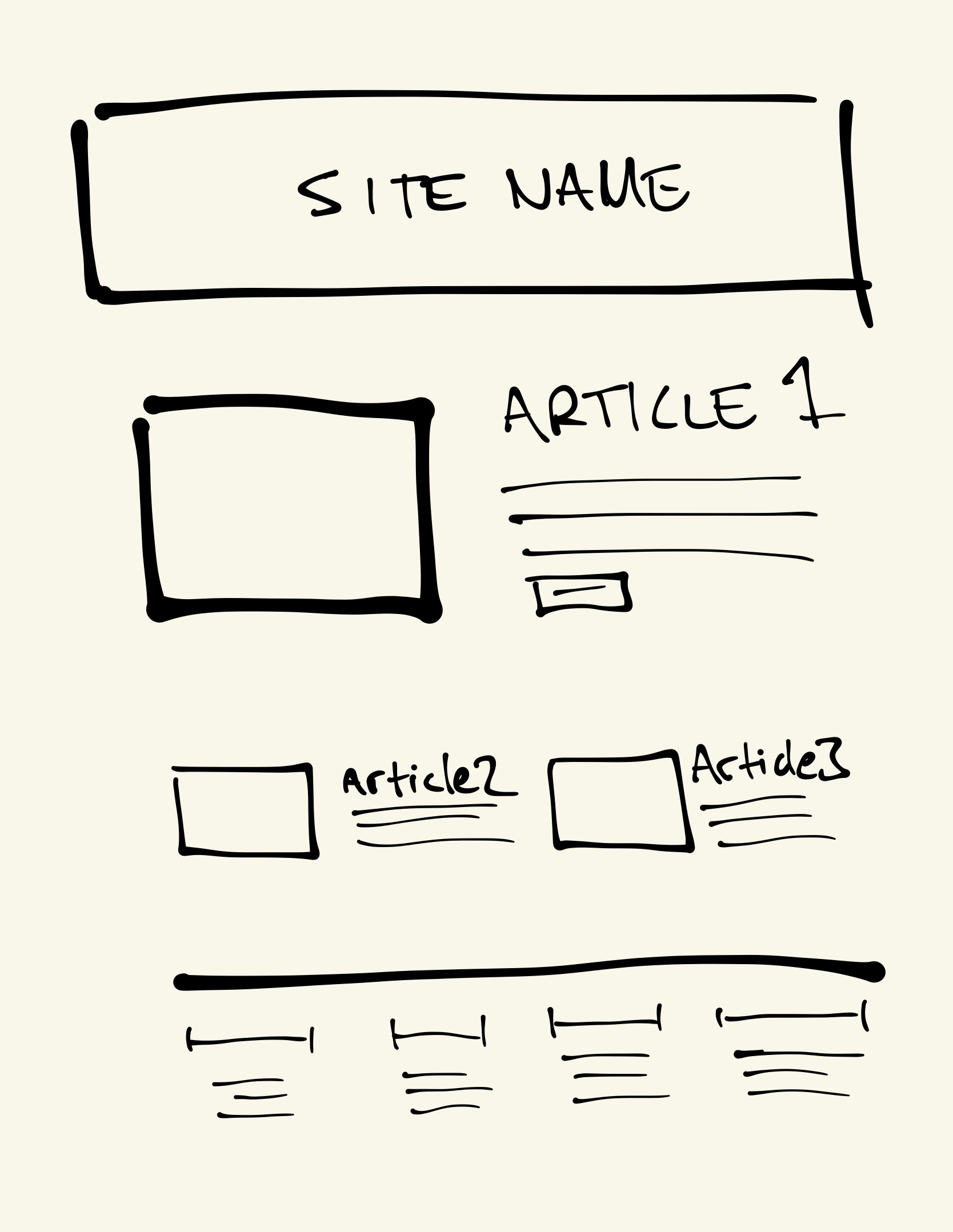
I made a quick sketch to explain.
In the attached sketch there are three articles but one is displayed as a featured article and the title of that article is visually displayed in a larger font.
If in this case the site title is chosen to be h1 then each of those three article titles would be h2, regardless of their visual size on screen. From the design, it is clear which content element each article refers to.
Moving on to the footer of the site, I have drawn 4 sections, or columns, with 3 links each. The heading of each of those sections is visually smaller than any of the article titles. But in this specific example they would be h2 headings as well, or the hierarchical structure would be off. If in the code they were h3 or h4, they would be interpreted as belonging to article 3, as they would then be subheadings under that article.
But I doubt that anyone looking at this page would interpret the footer headings to be subheadings of article 3, even if they are smaller than that heading. Similarly, the two articles in the center of the page are not easily interpreted as being part of article 1, even if the title fonts of article 2 and article 3 are smaller. The overall visual cues tell the whole story. The code should tell the same story.
@SuperTaliaDX
It’s a fair question. It functionally makes a difference primarily within 1) accessibility and 2) machine interpretation.
In the case of accessibility, the correct heading hierarchy makes it easier to navigate content and understand how different parts of a page relate to each other. With missing or misplaced headings the content becomes more confusing to read with a screen reader*. Jumping between, and listing, the headings of a page are common ways of navigating.
Similary, if machine interpretation is used to determine for example main, supporting and related content it can help pull relevant content to respond to questions and infer importance of one piece of content over another.
One very simple and common example would be an automated table of contents to jump to different sections of a page.
*(The use of a screen reader is of course also an example of machine interpretation)
@evilcookies98
h1 is generally the title of the page OR the title of the main article.
h2 will be subheadings
h3 will be subheadings to h2 sections
So you may not be doing it wrong?
What people tend to get wrong is the idea that they can not add h2 below h4. That just means that you are starting a new topic, which is fine. I also see people using h4 in for headings in sidebars (that are about something else than the main article) because they want a smaller font. But since they are new topics, they should often be h2, for example.
So, generally, like this is how one should think (example from the W3C page:
<h1>Plant foods</h1>
<h2>Fruit</h2>
<h3>Apple</h3>
<h3>Banana</h3>
<h2>Vegetables</h2>
<h3>Broccoli</h3>
<h3>Green breans</h3>
<h2>Related articles</h2>
Since this is the internet, someone will soon inform me that bananas are botanically berries. 😊
W3C on headings: https://www.w3.org/TR/WCAG20-TECHS/H42
There has long been a debate about whether you can have multiple h1's on a page, and generally, yes, I would argue that you can. Which Matt Cutts from Google also confirmed 15 years ago:
https://www.youtube.com/watch?v=GIn5qJKU8VM
@samuel
En Ghost-installation per domän. Men du kan ha flera författare per installation. Då får varje författare en sådan här sida med alla sina inlägg:
https://axbom.se/author/axbom/
Eftersom jag använder Cloudron kan jag starta en ny Ghost-installation med ett klick.
Så t ex https://digitill.se och https://dataskuggan.se är två av mina sajter också. För elever har jag en med inloggning: https://etik.axbom.se/ och ibland planerar jag bokskrivande på det sättet också: https://debook.axbom.com/
@fiaewald @konstellationen
@samuel @fiaewald
Ghost är bäst. 😁 Jag skrev ju den här långa när jag bytte: https://axbom.com/from-wp-to-ghost/ och sedan om Indieweb generellt.
Allt stämmer inte i inlägget längre men jag svarar också gärna på frågor. Har nog 5-6 Ghost-sajter nu. 😁
De har också en Substack-importer nu, vilket kan vara högst relevant.
@samuel @fiaewald
Obs att den artikeln handlar om en flytt till betalversionen av Ghost, medan jag numera kör Ghost på min egen VPS, så här
https://axbom.com/indieweb/
@grimalkina Yay! Congrats, Cat!