
@tante
In my head at the time of writing was ChatGPT. :)
I've written about Zoom before, and for me it fits the bill to some extent.
https://axbom.com/avoid-zoom/
For me it's a component of the whole "ship first, fix later" or "release now, fix later" which the gaming industry appears to suffer from as well. I suppose this model naturally became normalized soon after it was possible to ship updates over the net. Many people appear to appreciate early access over fully functional.
Tagged: Akkoma
A strategy for ethically dubious products is to release something with a set of really poor features, and then improve it significantly within a short period of time.
1. The company will be applauded, and get good press, for quickly fixing something there was already a fix for at the time of release. (Nobody would have applauded the company for releasing something that worked well enough from the start.)
2. People will now more readily accept the updated version because it is "fixed". Chances are that the updated version, had it been released from the start, would have been criticised for being inferior. Now, it can be presented as the much improved version.
3. People will tend to forget about all the other ways the product is inferior, because the company has shown that they are making efforts to improve.
Releasing crap with a quick fix makes people lower their standards.
#DigitalEthics
@efi I've had a handful of people react the way you do and reach out (since June), but my experience is that it's rare. I've had overwhelming positive feedback from people reasoning like I do. The title "If a hammer was like AI" usually gets people on the right track. If in doubt, there's always the web address :)
Mockery is not easy to pull off in a way that everyone gets the intent straight away, so I do understand it will sometimes fail in its messaging. I do appreciate you pointing out your interpretation and telling me.
Here's what happens when machine learning needs vast amounts of data to build statistical models for responses. Historical, debunked data makes it into the models and is preferred by the model output. There is much more outdated, harmful information published than there is updated, correct information. Hence statistically more viable.
"In some cases, they appeared to reinforce long-held false beliefs about biological differences between Black and white people that experts have spent years trying to eradicate from medical institutions."
In this regard the tools don't take us to the future, but to the past.
No, you should never use language models for health advice. But there are many people arguing for exactly this to happen. I also believe these types of harmful biases make it into more machine learning applications than language models specifically.
In libraries across the world using the Dewey Decimal System (138 countries), LGBTI (lesbian, gay, bisexual, transgender and intersex) topics have throughout the 20th century variously been assigned to categories such as Abnormal Psychology, Perversion, Derangement, as a Social Problem and even as Medical Disorders.
Of course many of these historical biases are part of the source material used to make today's "intelligent" machines - bringing with them the risk of eradicating decades of progress.
It's important to understand how large language models work if you are going to use them. The way they have been released into the world means there are many people (including powerful decision-makers) with faulty expectations and a poor understanding of what they are using.
https://www.nature.com/articles/s41746-023-00939-z
#DigitalEthics #AIEthics
@maddad Thank you.
New business cards. Haven't had any in a fair few years, but been at events lately where it makes sense to have something to hand over.
I don’t believe I’ve ever had time to “jump on a quick call”.
Benefits and risks of synthetic video and audio.
In this one-minute video I am speaking seven languages. In truth, I can speak two of those. None of the audio is actually me speaking, even if it sounds very much like my voice. And the video? Despite what it looks like, that’s not me moving my mouth. In some ways impressive and in other ways quite unsettling.
To make this happen I made a two-minute recording of myself talking in English about random stuff, and uploaded this as input to the generative tool provided by a service known as HeyGen. That video provided a voiceprint that can be used for more than 25 languages and counting. And honestly, the generated English voice really does sound like me.
With regards to the video, the scene where I appear to be standing is where I was actually standing when I recorded the original video. But the head, hand, eye and lip movements are all generated based on what I want my digital twin, or puppet, to say. I type text into a box and then the video with me, speaking in the selected language, comes out.
For purposes of firing up the mind to imagine what’s possible, this will likely suffice.
https://vimeo.com/875449365
In my latest blog post/newsletter I unpack the benefits and risks of this technology:
https://axbom.com/synthetic-video-benefits-risks/
#AIEthics #DigitalEthics #SyntheticVideo #DeepFake
”You’re naive, Per.”
”No. Naive is a construct. I choose love, kindness and compassion over surrendering to the invisible forces of perpetual growth. I’m winning every day.”
@marcusosterberg Jag har en teori om hopplöshetens grepp. Nästan alla förstår klimatkrisens hopplöshet, även om det för många är undermedvetet, och mycket av det vi ser är försvarsmekanismer. Man “bygger sin båt” och förbereder sig för att skydda sina närmaste. Man känner spontant att alla inte får plats i båten så man vill avgränsa. För vissa innebär paniken att man tar till våld, både i ord och handling.
Får mig att tänka på Den oändliga historien av Michael Ende, en av mina favoritböcker. Ingentinget – ett mörker – bara växer.
Hoppet får inte överge oss. Jag tror att människor komma stiga fram och hjälpa oss hitta det igen. Vi får plats i varandras båtar, i samtalen, i värmen av varandras närvaro. Vi hänger alla ihop.
När ledsamhet tynger oss måste vi kämpa, och kämpa för varandra. Och våga be om hjälp. Vi mår bra av att kämpa och hjälpa.
Det här var vara mina spontana reflektioner… som jag tydligen behövde skriva av mig. 😊
Nope, I won't write an analysis of Andreessen's manifesto. Attention is what he craves. He'll live rent-free in my head for as briefly as possible.
I'll just leave this emoji here and let that be my final word on the matter…
🤮
Shut the door on your way out, Marc.
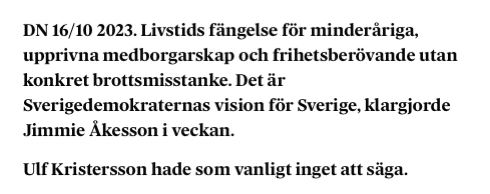
DN:s ledarredaktion träffade otäckt rätt idag. Allt känns surrealistiskt. Och ja det räcker nästan med att läsa ingressen…
https://www.dn.se/ledare/akesson-vill-lasa-in-minderariga-pa-livstid-kristersson-tycker-inget-sarskilt/
The idea appears to be to let computers exponentially proliferate some of the tasks they excel at: numbers, statistics, labelling people, copying, collecting data and mass surveillance. Rather than sit down and talk about how we boost the values we as humans wish to proliferate: compassion, love, care, connection and belonging.
Few are talking about how the former is antithetical to the latter.
I’m not saying ”stop using computers”, I’m saying ”stop letting computers assume the leadership position”. Computers can act as aids for compassion, love, care, connection and belonging. Think of games, text-to-speech and long-distance communication. But computers arrive there by instruction code from humans. Not the other way around.
The more alarming truth is this: computers can be used to destroy compassion, love, care, connection and belonging much faster than we can keep up with building it. Sometimes that destruction is with intent, but often it is oblivious.
Building machines
to perform tasks
we should have eliminated…
@april Haha, fair point. Though there aren’t many cars, or even places, without cameras anymore.
We've really made things efficient for highway robbers if they can just put a traffic cone on the hood, or place their own bespoke stop sign on the road, to stop the self-driving cars and rob whoever is inside.
At least it's efficiency for everyone.
Only humans can engage in increasing workplace efficiency for a century and end up working more.
Only humans can increase the number of methods and opportunities for communication exponentially, and end up feeling more lonely.