
@sintrenton
Ja, väldigt bra text. Tack.
Tagged: Akkoma
@mitsunee Haha, I hadn't thought of that but you're absolutely right.
Mailchimp have now abandoned all of its "whimsiness", so I doubt we'll ever really know.
@falcennial 😁 Off by default would definitely work for me.
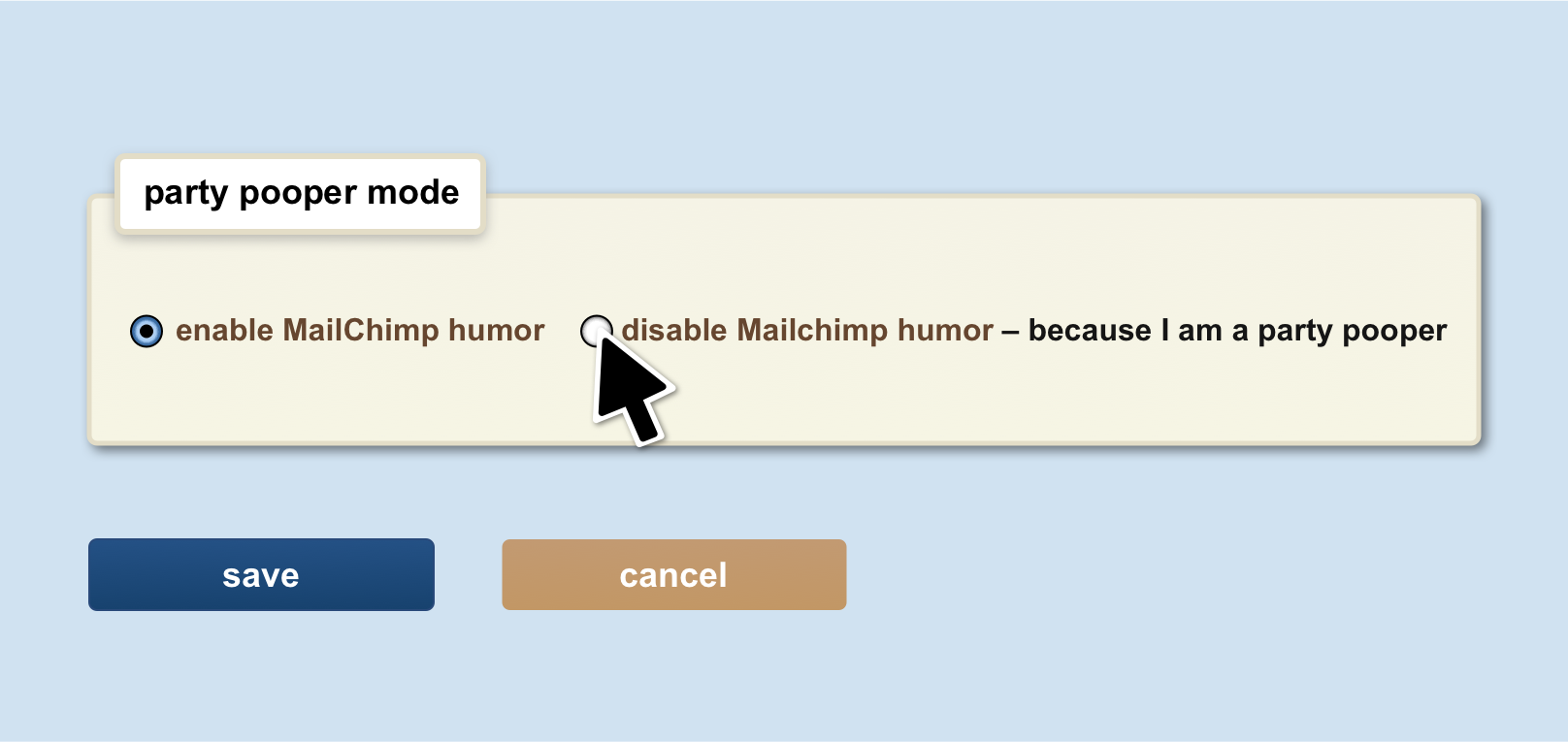
I remember when Mailchimp and its monkey mascot had a tone-of-voice that was full of jokes and whimsiness. Many found this annoying or offensive (either generally or after prolonged exposure) and in the end Mailchimp were compelled to implement a setting so that people could switch off the humor.
In a continued demonstration of zero concern for the real human discomfort of customers, they called that setting "party pooper mode".
Anyway, a setting that I would really appreciate is to turn off all the AI assistants that pop up in different services wherein I want to write my own text.
Feel free to call it "AI pooper mode".
(Update: after writing this I realised that "AI pooper" may more accurately describe the setting when it is turned on. This will get confusing. Just let me hide it from sight, please.)
Spread the word to all developers.
https://axbom.com/ai-pooper-mode/
@timthelion Oh yeah! I remember listening to The Missing Cryptoqueen and the part where they described graphs on a web page showing how investments in OneCoin were growing in value, all faked.
Remember when AI was used to generate a George Carlin comedy routine? That didn’t happen. Generative AI isn’t that good.
After the George Carlin’s estate sued, a representative of the show admitted that it was human-written. The claim that it was produced by an AI trained on Carlin’s material appears to be far from the truth, and rather used as a way to garner attention.
Cory Doctorow frequently reminds us that these stories of magical AI is peddled by both boosters and critics. Critics of AI make the mistake of also assuming that AI is this good, and talk about it as bad use of AI. This unnecessarily inflates the idea that AI can do things that it really can’t, adding fuel to magical thinking.
It’s probably a good idea to more often question if AI is even in the picture, given how effective it has become as a marketing vehicle. Was there AI involved? Perhaps, but not to the extent that salespeople would have you imagine
And yes, there's a name for this kind of criticism: "criti-hype.” A term coined by Lee Vinsel. Read more in Doctorow’s blog post, as always littered with further reading:
https://pluralistic.net/2024/01/29/pay-no-attention/#to-the-little-man-behind-the-curtain
#Critihype #DigitalEthics #AIEthics
How things play out when I’m critiquing a specific implementation of technology »»
Me: “My feeling is that the premise for this film is unconvincing and its portrayal of the protagonist are in poor taste.”
Miscontructionists: “Why do you hate all movies!?”
Idag släpptes avsnittet av Digitala influencer-podden med mig. Får man kalla sig influencer då? 😁
https://pca.st/3xc59gn3
@dekaminski @web2brain
There is also this Swedish case wherein an algorithm was used to allocate school placement based on geographical distance from home, rather than travel distance. This resulted in children having to attend schools that were close on a map but were across a body of water that could take an hour to travel around. The interesting part of the case is how hard it was to get any sort of admittance of wrongdoing on the side of the municipality. This was also before algorithmic decision-making was allowed in the public sector (in 2020). The lawyer writing about this notes how the courts do not understand the technical aspects enough…
https://www.advokaten.se/tidigare-nummer/2022/nr-6-2022-argang-88/algoritmisk-orattvisa--nar-domstolen-ar-blind-for-digitala-bevis/
@Beantin Very cool. I had no idea this was possible.
@MariaLiv Ja, precis, och Konsumentverket (efter att många anmälningar kommit in) har ju sagt åt dem för mer än ett år sedan, men det faller lite platt med brevväxling som enda tillsägelse.
Det är lite si och så med tillämpningen kan jag tycka.
https://axbom.se/dagens-industri-konsumentverket/
@snowracer Jag trodde det också, men inte när de kör kampanjer, typ 99 kr för 3 månader. Då kör de fortfarande med att det förlängs på årsbasis om man missar att säga upp i tid (en vecka innan kampanjperiodens slut).
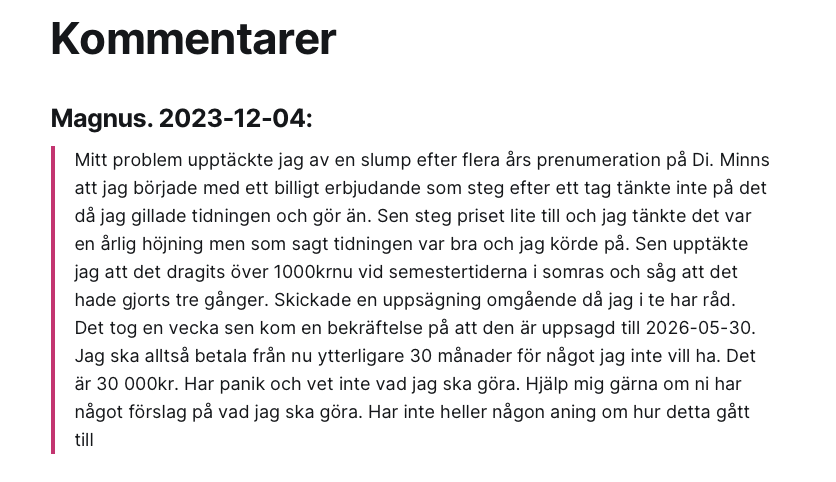
Tänk att bli inlåst i kostnader på 30.000 kronor. Det sticker i ögonen på mig när Dagens industri går ut och skryter om att det ökat mängden prenumeranter. Jag får fortfarande mejl, fyra år senare, från människor som i ren och skär panik vill ha hjälp att komma ur dyra Di-prenumerationer. Eller bara vill berätta vilka häpnadsväckande inlåsningar de fastnat i, som denna kommentar på min blogg från 4 december (jag har fixat några korrfel men original-texten syns i bilden):
Magnus. 2023-12-04:
"Mitt problem upptäckte jag av en slump efter flera års prenumeration på Di. Minns att jag började med ett billigt erbjudande som steg efter ett tag tänkte inte på det då jag gillade tidningen och gör än. Sen steg priset lite till och jag tänkte det var en årlig höjning men som sagt tidningen var bra och jag körde på. Sen upptäckte jag att det dragits över 1000kr nu vid semestertiderna i somras och såg att det hade gjorts tre gånger. Skickade en uppsägning omgående då jag inte har råd. Det tog en vecka sen kom en bekräftelse på att den är uppsagd till 2026-05-30. Jag ska alltså betala från nu ytterligare 30 månader för något jag inte vill ha. Det är 30 000kr. Har panik och vet inte vad jag ska göra. Hjälp mig gärna om ni har något förslag på vad jag ska göra. Har inte heller någon aning om hur detta gått till."
20 februari 2020 skrev jag mitt första inlägg om Dagens industri. Det är där kommentarer fortsätter komma, eller direktmejl till mig.
https://axbom.se/dagensindustri/
Den 13 februari 2023 figurerade min kritik i ett inslag av Plånboken i P1 då Di kritiserats av Konsumentverket:
https://axbom.se/dagens-industri-konsumentverket/
Den korta versionen av historien med Konsumentverket är att de bad DI att förklara varför de fått in så många anmälningar gällande Vilseledande marknadsföring och Oskäliga avtalsvillkor. DI svarade med en krystad förklaring som gäller en text som fallit bort i bekräftelsemejlet (som om avtal inte ingås innan bekräftelsen skickas). Konsumentverket nöjer sig med det och avslutar med andemeningen "okej men gör inte om det för vi håller ögonen på er".
Men jag undrar om det är någon som håller ögonen på Di? Inga andra dagstidningar i alla fall.
Om du vill berätta om dina erfarenheter så är du välkommen att höra av dig till mig, anonymt via Signal eller mejl. Men jag råder dig också att anmäla till Konsumentverket.
Konsumentvägledare Gabriel Södersten säger så här i Plånboken-inslaget:
"Jag skulle säga att den här typen av… sättet att binda upp konsumenter på, det är ju det vi brukar se i rådgivningen kring sådana här företag som sysslar med abonnemangsfällor nästan då, att man: 'nä men här är ett prova-på-paket i tre månader' och så står det i det finstilta 'du blir samtidigt bunden i ett år' och måste betala fyra tusen kronor till.
Så att det är ju den här typen av tillvägagångssätt det är ju inte riktigt kanske det man brukar förknippa med en stor, seriös, svensk dagstidning utan med lite mer obskyra bolag skulle jag säga."
ÖVERSKOTTSBEFÄL.
Det sägs man ska vara företagssam
men kan en ÖB vara företagsman
med en sådan sträng av lapsus på sin lyra
att han i varje ämne får bedyra
en drivkraft mer än bara företagsgagn?
@stephenpa @scottjenson
I've _just_ switched to a self-hosted version of cal.com
@nafnlaus The decision to design them this way is purely human. There are a multitude of human decisions even in unsupervised "learning", when it comes to labelling and modelling. The fact that many of these algorithms are a black box when it comes to predictability is only an example of humans building an error-prone system based on human material.
The machine is also an extension of all human error contained in the unsupervised training material, including historical and representation bias. It's further adding more human input to the mix, not less. All that human labor fed into the machine, and none of those humans visible. Again, it's hard to see the humans (who produced all that content) because of the machines.
Unsupervised training is for example also how Child Sexual Abuse Material has made its way into image generators, and descriptions of abuse and violence into all the text generators. There are people working around the clock across the world to prevent this content from appearing in generated content. More invisible humans doing invisible labor.
I agree they aren't puppets, although puppet features exist in AI as well (deepfake generators). But they are truly not a separate entity from human influence and decision-making. The way I see it, it's all they are. And sometimes that leads to exacerbating human bias rather than minimising it.
Fascinated by the rebuttal that humans make mistakes too, so algorithms should be allowed to as well.
As if the machine is disconnected from the humans building, deploying and using them.
The machines are an extension of human mistakes, not its own separate entity with free will.
It would appear, ironically, that when a huge number of humans are involved in building the machines, the humans become invisible.
Future historians:
"They couldn't see the humans because of all the machines."
#AIEthics #DigitalEthics
@Caution
This makes me so happy 😊 Thank you for letting me know.
@JMMaok
@Caution @JMMaok
I couldn't resist making a real demo in jsbin:
https://output.jsbin.com/gapapox/
@JMMaok
While I don’t get a chance to code myself as much anymore, the recommendation would be to not style headings but instead apply class names for the visual appearance. Hence one would separate semantic hierarchy (h1…h6) from look-and-feel.
For instance:
<style>
.TitleXL {font-size: 2em}
.TitleL {font-size: 1.8em}
.TitleM {font-size: 1.4em}
.TitleS {font-size: 1.2em}
</style>
In my example then it would be.
<h1 class=“TitleXL”>Site Name</h1>
<h2 class=“TitleL”>Article 1</h2>
<h2 class=“TitleM”>Article 2</h2>
<h2 class=“TitleM”>Article 3</h2>
<h2 class=“TitleS”>Social media</h2>
<h2 class=“TitleS”>Resources</h2>
<h2 class=“TitleS”>Abous us</h2>
<h2 class=“TitleS”>Contact info</h2>
To complicate things, if I was building this page I would likely add a separate heading for the whole footer area. That heading would then be h2 and the four columns would each have an h3. But it was a quick example 😉