
@shimriez
I can not see who you are conversing with (likely a limit in place) but it is far from my intent that anyone feel this poster implies Africa to be inferior (myself born in Liberia and have lived in Tanzania).
I'm happy to change wording if there is a suggestion?
And yes you are correct in assuming this rather calls out digital colonisation issues.
Many of these topics are explained further in my blog post on The Elements of AI Ethics:
https://axbom.com/aielements/
@timnitGebru
Tagged: Akkoma
@fasterandworse
Ah, no. Thanks, added to my playlist.
@tante
@fasterandworse
Oh excellent. Make sure to ping me when you're done.
@tante
@fasterandworse
Haha, you might enjoy my "review" of Hooked:
https://axbom.com/nir-eyal-habit-danger/
@tante
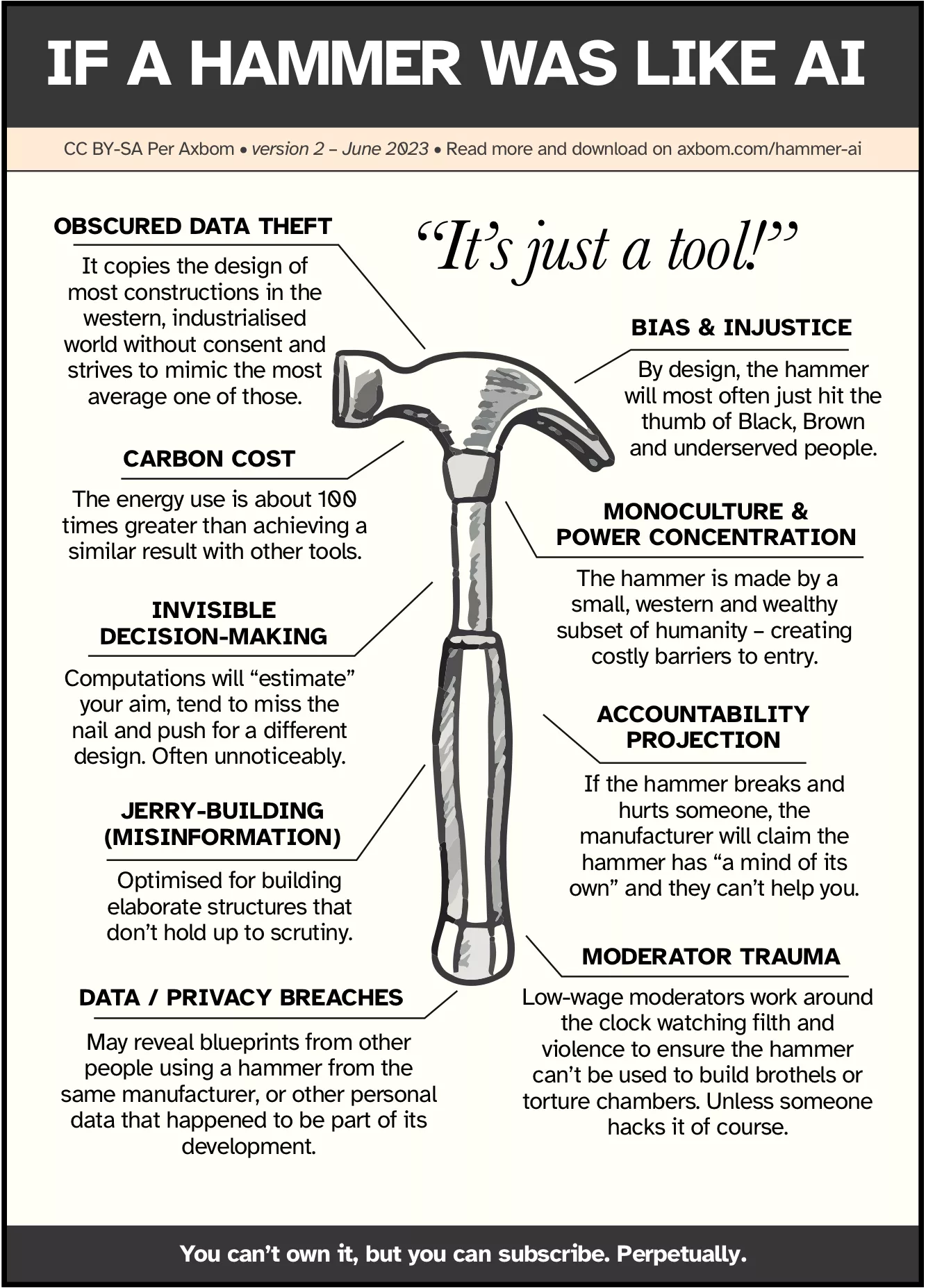
A common argument I come across when talking about ethics in AI is that it's just a tool, and like any tool it can be used for good or for evil. One familiar declaration is this one: "It's really no different from a hammer". I was compelled to make a poster to address these claims. Steal it, share it, print it and use it where you see fit.
https://axbom.com/hammer-ai/
#AiEthics #DigitalEthics
Poster: If a hammer was like AI.
Download and read more: https://axbom.com/hammer-ai/
#AiEthics
I'll add clarifications regarding some of the topics to this thread. 👇
Regarding Monoculture.
Today, there are nearly 7,000 languages and dialects in the world. Only 7% are reflected in published online material. 98% of the internet’s web pages are published in just 12 languages, and more than half of them are in English. When sourcing the entire Internet, that is still a small part of humanity.
76% of the cyber population lives in Africa, Asia, the Middle East, Latin America and the Caribbean, most of the online content comes from elsewhere. Take Wikipedia, for example, where more than 80% of articles come from Europe and North America.
Now consider what content most AI tools are trained on.
Through the lens of a small subset of human experience and circumstance it is difficult to envision and foresee the multitudes of perspectives and fates that one new creation may influence. The homogenity of those who have been provided the capacity to make and create in the digital space means that it is primarily their mirror-images who benefit – with little thought for the wellbeing of those not visible inside the reflection.
Regarding Power concentration.
When power is with a few, their own needs and concerns will naturally be top of mind and prioritized. The more their needs are prioritized, the more power they gain. Three million AI engineers is 0.04% of the world's population.
The dominant actors in the AI space right now are primarily US-based. And the computing power required to build and maintain many of these tools is huge, ensuring that the power of influence will continue to rest with a few big tech actors.
Regarding Invisible decision-making.
The more complex the algorithms become, the harder they are to understand. As more people are involved, time passes, integrations with other systems are made and documentation is faulty, the further they deviate from human understanding. Many companies will hide proprietary code and evade scrutiny, sometimes themselves losing understanding of the full picture of how the code works. Decoding and understanding how decisions are made will be open to infinitely fewer beings.
And it doesn't stop there. This also affects autonomy. By obscuring decision-making processes (how, when, why decisions are made, what options are available and what personal data is shared) it is increasingly difficult for individuals to make properly informed choices in their own best interest.
Regarding Bias and injustice.
One inherent property of AI is its ability to act as an accelerator of other harms. By being trained on large amounts of data (often unsupervised) – that inevitably contains biases, abandoned values and prejudiced commentary – these will be reproduced in any output. It is likely that this will even happen unnoticeably (especially when not actively monitored) since many biases are subtle and embedded in common language. And at other times it will happen quite clearly, with bots spewing toxic, misogynistic and racist content.
Because of systemic issues and the fact that bias becomes embedded in these tools, these biases will have dire consequences for people who are already disempowered. Scoring systems are often used by automated decision-making tools and these scores can for example affect job opportunities, welfare/housing eligibility and judicial outcomes.
Regarding Content moderator trauma.
In order for us to avoid seeing traumatitizing content when using many of these tools (such as physical violence, self-harm, child abuse, killings and torture) this content needs to be filtered out. In order for it to be filtered out, someone has to watch it. As it stands, the workers who perform this filtering are often exploited and suffer PTSD without adequate care for their wellbeing. Many of them have no idea what they are getting themselves into when they start the job.
Regarding Data / Privacy breaches
There are several ways personal data makes its way into the AI tools. First, since the tools are often trained on data available online and in an unsupervised manner, personal data will actually make its way into the workings of the tools themselves. Data may have been inadvertently published online or may have been published for a specific purpose, rarely one that supports feeding an AI system and its plethora of outputs. Second, personal data is actually entered into the tools by everyday users through negligent or inconsiderate use – data that at times is also stored and used by the tools. Third, when many data points from many different sources are linked together in one tool they can reveal details of an individuals’ life that any single piece of information could not.
If you speak French, here is a podcast episode taking you through the different topics in the hammer diagram. My French is unfortunately not good enough to follow along 😅
https://airescommunes.ca/@airescommunes/episodes/doit-on-reglementer-lintelligence-artificielle/activity
@samuel
Bra text! "Att värna sin personliga integritet är alltså något som anses vara misstänksamt. Det säger en hel del om dagens samhälle." 👏
Jag har bara lite svårt med läsflödet med anledning av typsnittet.
@Moddedphones
This year I have been consulting, teaching and… studenting 😁
I haven't been very vocal about it but alongside my day job I've been studying the remote Profile course Media, Communication and Sustainable Development at Umeå university.
The course covers different perspectives on sustainable development and what significance media, communication and journalism play when it comes to social change and sustainability.
The final assignment was two parts and I've published them on my blog.
The first paper is a critical review of an existing communication activity. In my case the Reach for Zero campaign by the Reach publishing group - an example of solution journalism.
https://axbom.com/solution-journalism-reach-for-zero/
The second paper is a plan for a communication activity of my own making. I call it Energy-Efficient Website.
https://axbom.com/campaign-energy-efficient-website/
I really enjoyed being a student again, and don't be surprised if I stay in school part-time this autumn as well. 😊
The law of the letter: Every 48 hours a tech oligarch wakes up and wonders what letter they may want to sign today to stay relevant.
Nu finns Elementen inom AI-etik på svenska.
https://axbom.se/aielementen/
#AIEtik #DigitalEtik
I was looking through a list of superhero jokes and this one caught my eye:
"Which is Thor’s favorite day of the week?"
"Thors-day, of course!"
It's funny to me because it would appear the inventor of the joke and the people who repeat it aren't aware that Thursday literally is Thor's Day.
Thursday comes from Old English thursdæg, which is from early Norse thōrsdagr, literally "day of Thor".
If you have a newsletter attached to your service, you would increase the likelihood of me signing up if you allowed me to specify a separate email address for it.
I still quite like newsletters. But I don't like them in my default inbox. My inbox is reserved for things I should act on, and the less time I spend moving irrelevant stuff out of there the better.
I use a service called Feedbin for all my newsletters and RSS feeds. I get a unique email address and I go to the website or app to read newsletters when it suits me, not when I'm interrupted. I wrote about this service, and some alternatives, a while back:
https://axbom.com/newsletters-the-mindful-way/
p.s. Yes I know I can create inbox rules, but that puts effort on me. And still expects me to use my default address for everything, which makes tracking easier.
@elbowspeak Thank you )oshua.
@Mabande
That one I hadn't read, though I read several similar ones in 2017. Thank you for sharing. It's hard to read but necessary. They are sharing their story with a hope for change to happen... and it's so difficult to fathom how long change takes.
I'm imagining a catch 22 wherein people aren't able to even read about it and hence it falls into invisibility and the trauma continues...
⚠️ Mentions of trauma and violence
In The Elements of AI Ethics I talk about content moderator trauma. But I don't think people tend to reflect on just how massive the trauma is. This recent ruling in Kenya gives some insights.
From reporting in The Guardian:
“I’ve seen stuff that you’ve never seen, and I’d never wish for you to see,” Frank Mugisha, 33, a moderator from Uganda told the Guardian.
"Many said that they didn’t have full knowledge of what they were signing up for when they took the job. Some alleged they were led to believe they were taking customer service roles, only to end up sifting through gruesome content under tight timelines."
“It alters the way you think and react to things,” said Mugisha. “We may be able to find other jobs, but would we be able to keep them? I don’t know. We don’t interact normally any more.”
“I remember my first experience witnessing manslaughter on a live video … I unconsciously stood up and screamed. For a minute, I almost forgot where I was and who I was. Everything went blank,” read one of the written testimonies.
When we talk about the benefits of social media and AI we also need to talk about harm. The question not being asked and discussed often enough is this one: To gain these benefits, how much suffering are we willing to ignore?
https://www.theguardian.com/global-development/2023/jun/07/a-watershed-meta-ordered-to-offer-mental-health-care-to-moderators-in-kenya
#AIEthics #DigitalEthics
@arpcomics
Agree. My worries are primarily about the klout that the person has and how they are influencing a younger generation who look up to them (and learn from them).
My worries may be misplaced as it's not unlikely that the younger generation can see right through this.
There's this "UX pioneer" who is so obsessed with IQ it's quite alarming and making me upset. Don't know if to call it out or move along. From his latest comment about ChatGPT:
"The backend is so useful that it overcomes the bad UI for high-IQ users, but I am convinced we'll see better design soon, which will be useful for broader segments of the population."
FFS.
In a sense I have called it out before as it's a big part of a job ad that I criticised in a blog post (that this person is likely to at least have coauthored):
https://axbom.com/nng-job-posting/
Oh, and of course I accidentally read his latest post talking about whether metaverse or AI is better...
"How could Mark Zuckerberg make such a blunder? All reports indicate he has a high IQ and a solid technical background. Likely below Bill Gates on both accounts, but having a lower IQ than Bill is no shame (I’m pretty sure I belong to the IQ<billg club myself)."
https://www.linkedin.com/pulse/ai-vs-metaverse-which-5th-generation-ui-jakob-nielsen/
I wrote this free e-book 10 years ago about the AceAwe experience model and my approach to UX design. 46 pages.
I just re-read it and I believe it still is valid and works well, though I may have chosen different illustrative examples had I written it today.
Honestly I think I will try and get back to using this model more in everyday work. As I wrote in the book, it works great as a thinking tool for everything from a big web project down to writing a blog post.
https://axbom.com/aceawe/
#UXDesign
Remember when Zuckerberg bet a boatload of money on the metaverse as the next big thing and even changed the Facebook parent company name to Meta?
You should, because that was less than 2 years ago.
Anyway, it’s a good reminder for checking out all the expert predictions for how hybrid work would be completely reinvented by 2024.
Anybody here ”commuting” into work through their headset yet?
In one timeline I imagine future alien archeologists concluding that the human race built a technology to save itself from environmental collapse but the thing they built turned out to be lighter fluid.
"a single chat with ChatGPT could cost up to 1,000 times as much as a simple Google search"
https://www.washingtonpost.com/technology/2023/06/05/chatgpt-hidden-cost-gpu-compute/
#AIEthics
@kolombiken Oh wow, that one was new to me.