@waspfactory @magnusjonasson Haha. Smurf.

Per Axbom
@waspfactory @magnusjonasson Ja, lite mer sansat på SR.
https://www.sverigesradio.se/artikel/uppmaning-da-ska-du-vaccinera-dig-mot-difteri
@waspfactory @magnusjonasson Lustigt nog vaccinerade jag mig mot difteri förra veckan. Egentligen mot stelkramp, men det är samma spruta i Sverige; DTP = difteri, tetanus (stelkramp), pertussis (kikhosta)
@kolombiken Hahaha!! 'Normater' är guld.
@kolombiken Tack! Bra feedback. Håller verkligen med, samtidigt som det kan bli lite mycket i ett kort avtal. Önskar jag hade ett samlingsbegrepp för vita, medelålders neurotypiska cis-män utan funktionsnedsättningar, och ett motsatsord. 😅
Så här ser det ut just nu:
"Jag är mån om mångfald och inkludering. Om ett arrangemang har en stor övervikt av talare som representerar ett snävt urval av erfarenheter eller identiteter (ofta neurotypiska män som jag själv) så avstår jag hellre min plats, och förbehåller mig rätten att dra mig ur."
@stephenpa @andrewhinton Really, really good framework and great reflections Stephen!! I appreciate this: "Honestly, there are so many ethical issues, this box should be triple the size!"
Can ”AI” be *used* ethically when every step of the way to the capability of being used, or even just a few of those steps, has been in service of unethical practice?
Thoughts that cross my mind almost every day.
Skriver på offert för ett föreläsningsuppdrag på ett större event och har nu med detta avsnitt om mångfald. Vad tror ni? Blir det tydligt? Något mer jag borde få med eller som jag kan uttrycka på ett annat sätt? Om det blir bra tänkte jag att jag kan föreslå att fler lägger in avsnittet i sina egna offerter.
"Notera. Jag är mån om mångfald och inkludering, och om det till exempel blir en slagsida där det är få kvinnor och i princip bara cis-män som står på scen så avstår jag hellre min plats, och förbehåller mig rätten att dra mig ur. Jag ser gärna att det finns ett tydligt mångfaldsarbete som kan kommuniceras och som också ger resultat. Meddela mig gärna om ni tror att det finns en risk för skev representation som framför allt gynnar redan privilegierade människor (som jag själv). Jag deltar inte heller i paneler med endast manliga deltagare."
Jag har också på min sajt detta, som kanske borde med i själva offerten också:
Jag är alltid nyfiken på dessa frågor och kan ni berätta mer (där det är relevant) så gör det mig alltid mer intresserad av att delta.
* Är alla lokaler anpassade för enkel framkomlighet för människor med fysiska funktionsnedsättningar?
* Finns stöd för att ta till sig innehållet (högtalarsystem, ljudslinga, teckentolkning, live-transkribering)?
* Har ni tagit hänsyn till sensorisk påverkan för att minska audiovisuella intryck och/eller erbjuder en yta för att återhämta sig i stillhet? Finns samtidigt tydlig skyltning så att man enkelt hittar rätt utan att behöva hitta någon att fråga?
* Finns det en tydligt utpekad person och/eller tillgänglig kanal för att rapportera upplevda obehag om de skulle uppstå (trakasserier, fördomar, med mera)?
* Finns det en tydligt utpekad person och/eller tillgänglig kanal för att informera om att man inte vill vara med på bild- och ljudupptagning, eller att kontaktuppgifter delas? Finns samtidigt en rutin för hur man säkerställer att önskemål tillgodoses?
* Har ni säkerställt hänsyn till matallergier och doftöverkänslighet?
* Finns en strategi för att minimera klimatpåverkan?
* Har ni tagit emot rådgivning om inkludering och hållbarhet från ämnesexperter?
Posts that barely get noticed on Bluesky can get upwards of 400 boosts on Mastodon, or many more. This has happened to me dozens of times now. It's fascinating. And I certainly understand where my confreres hang out.
(I'm really on Akkoma but that is a nerdy detail.)
@the_lemonaut Love these!! Do you have them on a web page I can share around?
This was a great film with Rutger Hauer and Mimi Rogers. I believe it was called Wedlock.
I want to publish a long-form report as an accessible html page instead of a PDF. I thought there would be lots of templates for this but it turns out it’s quite hard to find. The best one I’ve found so far is this, but it hasn’t been updated in 11 years(!): https://github.com/edmullen/HTML-Report-Template
What I like about it is the responsiveness, the anchor links for each section, a return to top link and a neat way of handling references and footer sections. The sharing options and always available table of contents are also a nice touch.
If you’re aware of a more modern template or library made for this purpose I’d be really thankful for any help. It doesn’t have to be free. Thanks.
@TerryBTwo Thanks Terry! I see what you mean. I'll see what I can do about that… I think I'm stuck seeing so many options or paths I found it hard to be as strict. But yes, perhaps better to be more strict in the criteria, which would require strongly motivated reasoning to deviate.
I recently came across writer Wendell Berry’s checklist in his 1987 essay Why I Am Not Going to Buy a Computer[a] referenced by Jason Kottke[b] and Ted Gioia[c]. Berry outlined criteria describing what it would take for him to use new technology in his work. I’ve personally bought and used computers since 1982, but the list still resonated with me. I’ve taken the liberty of rewriting and adding to his insights, making a list for the 2020s that makes sense to me.
[This is a draft for a blog post.]
As should be expected, many of these questions do not have a strict yes-or-no answer. They do, however, encourage reflection and consideration around each topic area – which is what moral reasoning is all about.
Desirable characteristics of new technology:
1. Considering all manners of cost, new tech should be less costly than the task or phenomenon it replaces.
2. The output and work of new tech should be clearly and demonstrably better than what it replaces.
3. New tech should use less energy than what it replaces, or clearly boost impaired physical or mental capacity in service of wellbeing.
4. Information about the waste produced and natural resources consumed by new technology must be made available explicitly and in an accessible format. This includes the complete value chain of production.
5. New tech should be repairable by most people with access to tools, or repairable at a reasonable distance from home–by a tradesperson–at an affordable price.
6. New tech should not replace or disrupt anything good that already exists, which includes family and community relationships.
7. New tech should never explicitly replace human beings – its purpose is to support human beings in accomplishing humanity-desirable goals.
8. New tech should not require surveillance-like or privacy-invasive features to work. Any such features should be off by default and clearly apparent and understood by anyone using–or being subjected to–the technology.
9. People must be provided a clear and accessible path to objecting to new technology and not have it forced upon them–whether it’s as users, as subjects of use or as involuntary contributors.
10. All new technology must be accompanied with clear instructions on its intended use and how to achieve defined outcomes.
11. It must be possible for makers of new technology to be held accountable when use of the technology according to accompanying instructions causes measurable harm to humans, other sentient beings or the environment.
12. The making, maintenance and operations of technology should never require or amplify suffering.
It's hard to make an exhaustive list and I always feel like I must have missed something critical. But let's start here, and I'm always open to input. I can definitely see myself using these criteria in teaching, and as a framework for running workshops.
---
[a] Wendell Berry's original essay as a scanned PDF: Why I am not going to buy a computer – containing responses and Berry's reply to the responses. https://classes.matthewjbrown.net/teaching-files/philtech/berry-computer.pdf
[b] Kottke's post Nine Rules for Evaluating New Technology, found via @tante. https://kottke.org/25/05/nine-rules-for-evaluating-new-technology
[c] Gioia’s walkthrough of the nine rules. https://www.honest-broker.com/p/9-rules-for-new-technology
↩ Replying to @fasterandworse.com
It's like they were asking, "how can we make this tech even more detrimental to the environment?"
And with environment I mean both nature and social spaces.
I identified with that famed XKCD cartoon for too long. Drawing a new panel myself made it easier to manifest another way of being.
I identified with that famed XKCD cartoon for too long. Drawing a new panel myself made it easier to manifest another way of being.
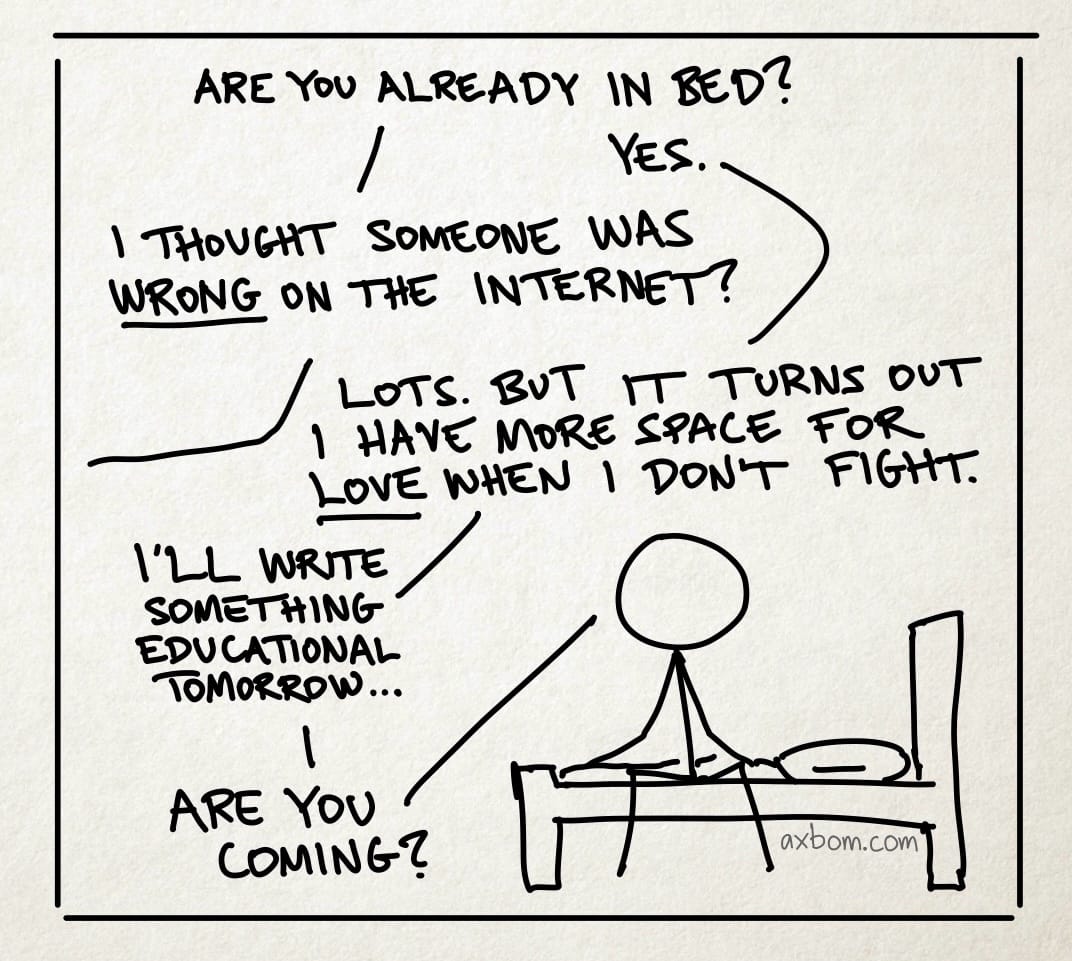
I identified with that famed XKCD cartoon for too long. Drawing a new panel myself made it easier to manifest another way of being.

You know a country is car-centric when everyone starts their company in a garage.
Make a 'mistake' in your post. Have people comment to correct it. Immediate boost in engagement. This is one way people game algorithms.
