Take a break from all manners of hype. 😁
A recording of my closing keynote at #CampDigital, on the spectacular lies of maps, has now been published.
This page has all the slides, reference links, embedded videos and a link to the full talk.
https://axbom.com/cdmaps/

Per Axbom
Gick igenom gamla skisser på paddan och hittade dessa som jag måste gjort för 6-8 år sedan(!) Handlar om bedömning och triagering av patienter i vården, och hur det utvecklas i och med digitaliseringen.


Security experts: Making all your data available to US spying is a significant risk.
UK government: Hold my beer.
https://www.bbc.co.uk/news/articles/czdv68gejm7o.amp
Security experts: Making all your data available to US spying is a significant risk.
UK government: Hold my beer.
www.bbc.co.uk/news/article...
OpenAI and UK sign deal to use AI in public services - BBC News
From the archives.
”As more and more decisions about human fates are made by algorithms, a lack of accountability and transparency will elevate heartless treatment driven by efficiency devoid of empathy. Humans become mere data shadows.”
”The main argument in defense of algorithms is that they eliminate the obstacle of human inefficiency. Often this sentiment fails to take into account the many benefits of human inefficiency, such as taking time to reflect, taking time to question and taking time to listen.”
https://axbom.com/killer-robots/
Once respectable news outlets can be made to believe pretty much anything, and spew out unfounded nonsense that betrays readers and makes them less informed.
This is the world now.

Once respectable news outlets can be made to believe pretty much anything, and spew out unfounded nonsense that betrays readers and makes them less informed.
This is the world now.
@melaniemitchell.bsky.social: In a stunning moment of self-delusion, the Wall Street Journal headline writers admitted that they don't know how LLM chatbots work.
View original post
Mindblowing and beautiful.
@dieworkwear.bsky.social: Sorry for the string of videos, but this is amazing and makes me wonder if this is what life could be like if we all just logged off the internet. IG risolve
View original post
↩ Replying to @johancarlstrom.bsky.social
If you need feeds for the Sveriges radio programmes you can find them here 😊
sr-restored.se
I really struggle with how some 'podcasts' are only released on Spotify.
Hence it's not really a podcast.
"There is a good chance the quote you have been using to make your strong, serious arguments is both false and wrongly attributed." – Mary Shelley
"There is a good chance the quote you have been using to make your strong, serious arguments is both false and wrongly attributed." – Mary Shelley
#ProtectEU is essentially #ChatControl under a new name.
It’s worrying that these initiatives keep coming.
www.techradar.com/vpn/vpn-priv...
↩ Replying to @loukas.bsky.social
I can see that as well. There is a definitely a problem here and I'd really like to see scholars (and journalists) to address it more transparently.
It could also be that we are being gaslighted by industry when just using language that comes naturally.
"I'm not saying it's alive, you are."
↩ Replying to @acuity.design
Yes, this is a very fair way of phrasing it.
@troed So much technology these days seem to be just this!
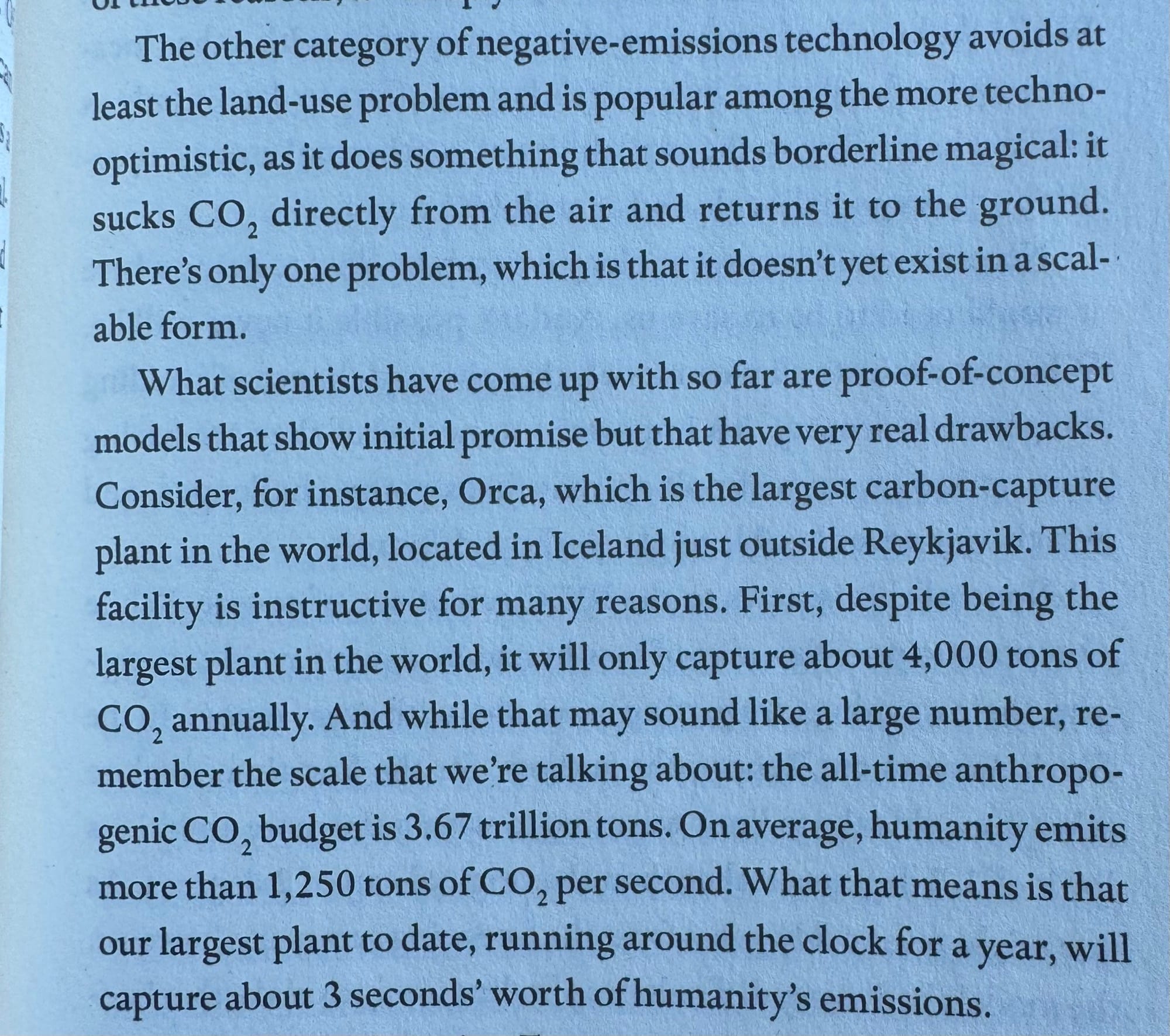
I'm reading Catastrope Ethics by Travis Rieder. This passage drives home why we need to question how politicians talk so promisingly about negative-emissions tech that sucks CO2 from the air.
Human language is lacking in not being able to describe large language models, as well as other software and machines, without (dangerously) inferring human traits.
I'm reading Catastrope Ethics by Travis Rieder. This passage drives home why we need to question how politicians talk so promisingly about negative-emissions tech that sucks CO2 from the air:
"The other category of negative-emissions technology avoids at least the land-use problem and is popular among the more techno-optimistic, as it does something that sounds borderline magical: it sucks CO, directly from the air and returns it to the ground. There's only one problem, which is that it doesn't yet exist in a scalable form.
What scientists have come up with so far are proof-of-concept models that show initial promise but that have very real drawbacks.
Consider, for instance, Orca, which is the largest carbon-capture plant in the world, located in Iceland just outside Reykjavik. This facility is instructive for many reasons. First, despite being the largest plant in the world, it will only capture about 4,000 tons of CO2 annually. And while that may sound like a large number, remember the scale that we're talking about: the all-time anthropogenic CO2 budget is 3.67 trillion tons. On average, humanity emits more than 1,250 tons of CO2 per second. What that means is that our largest plant to date, running around the clock for a year, will capture about 3 seconds' worth of humanity's emissions."
Just 100 companies are responsible for 71% of human emissions. If institutions are the problem we could be letting them off the hook by focusing on individuals.
"[…] this sort of deflection of responsibility is likely what energy companies and other major corporations want: if we're pointing the finger at one another, we're not pointing it at them." (Catastrophe Ethics, p. 50)
Climate scientist Michael Mann in an interview about his book The New Climate War:
"Any time you are told a problem is your fault because you are not behaving responsibly, there is a good chance that you are being deflected from systemic solutions and policies. Blaming the individual is a tried and trusted playbook that we have seen in the past with other industries. In the 1970s, Coca Cola and the beverage industry did this very effectively to convince us we don't need regulations on waste disposal. Because of that we now have a global plastic crisis. The same tactics are evident in the gun lobby's motto, 'guns don't kill people, people kill people,' which is classic deflection.
For a UK example look at BP, which gave us the world's first individual carbon footprint calculator. Why did they do that? Because BP wanted us looking at our carbon footprint not theirs."
The idea of individual responsibility can be weaponized to prevent real climate progress.